
World
Japan-China Tensions Escalate Following Prime Minister’s Remarks

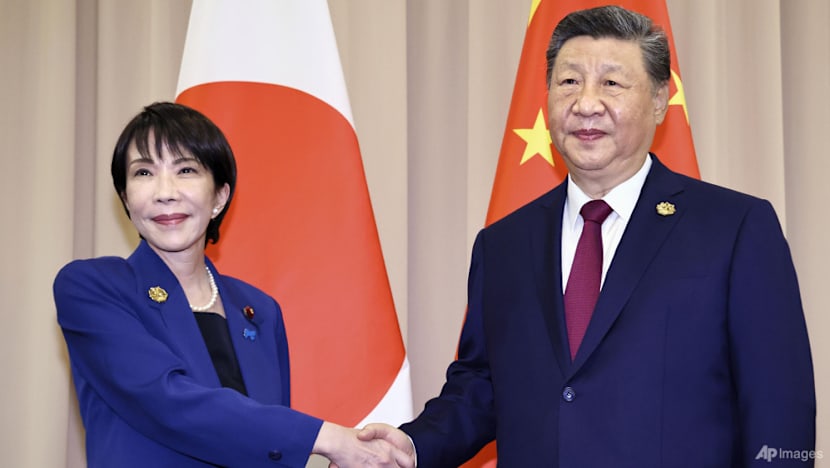
SINGAPORE: Tensions between Japan and China have escalated significantly following comments made by Japanese Prime Minister Sanae Takaichi on November 7, 2023. During a parliamentary session, she responded to questions from opposition lawmaker Katsuya Okada regarding crisis scenarios involving a potential blockade of Taiwan. Takaichi indicated that any Chinese military action against Taiwan, particularly if it involved attacks on US military forces, could pose a “survival threatening situation” for Japan. This statement marks the first time a sitting prime minister has articulated such a scenario, highlighting the gravity of the current diplomatic climate.
In response to Takaichi’s remarks, Beijing accused Japan of provocation, demanding a retraction of her statements. The situation intensified when the Chinese consul-general in Osaka reportedly posted a now-deleted comment on social media that suggested violent repercussions for Takaichi’s words. This exchange underscores a complex web of historical and political factors contributing to the ongoing tensions between the two nations.
Historical Context and Political Dynamics
The roots of Japan-China tensions can be traced back to the political relationship surrounding Taiwan. Japan does not officially recognize Taiwan’s government, having established formal relations with the People’s Republic of China (PRC) in 1972. The communique from that time clearly stated that Japan recognizes the PRC as the sole legal government of China, while also acknowledging the PRC’s claim over Taiwan. Notably, Japan’s position does not equate to acceptance of this claim; rather, it reflects a diplomatic agreement to coexist with differing views regarding Taiwan’s status.
Japan’s “one China” policy is designed to maintain official recognition of the PRC while leaving Taiwan’s status ambiguous. This ambiguity has long been a point of contention for Beijing, which insists on its “one China principle” that unequivocally asserts Taiwan as part of China. The recent remarks by Takaichi have, therefore, reignited longstanding disputes over Taiwan’s status, complicating Japan’s diplomatic posture.
Strategic Implications of Taiwan’s Geography
Beyond political disagreements, the physical location of Taiwan plays a crucial role in the dynamics of Japan-China relations. Taiwan is situated at a strategic point along vital sea lanes and air routes that connect Northeast and Southeast Asia. Disruption in this region could have devastating effects on Japan’s economy, which relies heavily on these routes for energy imports and international trade. The implications of a crisis in Taiwan would extend beyond Japan, potentially impacting economies throughout East Asia.
The exchange between Takaichi and Okada can thus be interpreted as a recognition of the strategic significance of Taiwan rather than a shift in Japan-Taiwan relations themselves. As Japan navigates its alliance with the United States, it faces pressure to openly support US maritime interests, complicating its approach to regional conflicts.
Domestic Support and Future Challenges
Public opinion in Japan currently supports Takaichi’s comments, reflecting a growing awareness of national security issues. As Japan’s security calculus evolves, the government may find it increasingly difficult to retract statements that highlight the potential threats arising from China’s assertiveness in the region. Takaichi’s administration is also under pressure to call for elections soon, adding to the likelihood that she will maintain her current stance.
China, under the leadership of President Xi Jinping, views the US-Japan alliance as a mechanism to encircle it. This perception has contributed to a heightened sense of urgency regarding Japan’s military posture and its political relationships in the region. The Takaichi administration is striving to maintain a calm demeanor while managing the economic coercion from Beijing, despite the rhetoric that is emerging from both sides.
As the situation develops, it is evident that the historical complexities, geographical realities, and evolving political dynamics will continue to shape Japan-China relations. The likelihood of future conflicts remains, particularly as public sentiment in Japan toward China may deepen in the wake of ongoing disputes.
In conclusion, the current tensions between Japan and China are influenced by a multitude of factors that are unlikely to resolve quickly. As regional dynamics shift, the long-term implications for both nations, and their neighbors, will require careful navigation in an increasingly uncertain geopolitical landscape. The ongoing spat serves as a reminder of the intricate balance of power in East Asia and the challenges that come with it.

Japan-China Tensions Escalate Following Prime Minister’s Remarks

Sacha Leong Returns to Redesign Odette a Decade After Launch

TikTok Agrees to Sell US Division to American Investor Group

Discover the Top Airlines for Economy Class Comfort in 2025

Nexi Rejects TPG’s Bid for Digital Banking Unit

Nexi Rejects TPG’s Bid for Digital Banking Division in Italy

Release of ‘Sahakutumbaanaam’ Delayed Again, New Date Set

Sehat Card Program Aids Over 1 Million Patients in KP, Spending Hits Rs31.66Bn

Startek Australia Wins Employer of Choice and Business Excellence Awards

Humanism Camp Engages 250 Youths in Summer Fest 2025

Kenvue Dismisses CEO Thibaut Mongon as Strategic Review Advances

De Minaur Triumphs at Washington Open After Thrilling Comeback

South Korea’s Foreign Minister Cho Hyun to Visit China This Week

Tupou and Daugunu Join First Nations Squad for Lions Clash

Colombian Senator Miguel Uribe Shows Signs of Recovery After Attack

ASEAN Gears Up for Historic Joint Meeting of Foreign and Economic Ministers

New Study Challenges Assumptions About Aging and Inflammation

Oil Prices Surge Following New EU Sanctions on Russia
-
 Lifestyle5 months ago
Humanism Camp Engages 250 Youths in Summer Fest 2025
-
 Business5 months ago
Kenvue Dismisses CEO Thibaut Mongon as Strategic Review Advances
-
 Sports5 months ago
De Minaur Triumphs at Washington Open After Thrilling Comeback
-
 World3 months ago
South Korea’s Foreign Minister Cho Hyun to Visit China This Week
-
 Sports5 months ago
Tupou and Daugunu Join First Nations Squad for Lions Clash
-
 Top Stories5 months ago
Colombian Senator Miguel Uribe Shows Signs of Recovery After Attack
-
 World5 months ago
ASEAN Gears Up for Historic Joint Meeting of Foreign and Economic Ministers
-
 Health5 months ago
New Study Challenges Assumptions About Aging and Inflammation
-
 Business5 months ago
Oil Prices Surge Following New EU Sanctions on Russia
-

 Business3 months ago
Starling Bank Plans Secondary Share Sale, Targeting $5.4 Billion Valuation
-

 Entertainment5 months ago
Detaşe-Sabah Violin Ensemble Captivates at Gabala Music Festival
-

 Entertainment5 months ago
Baku Metro Extends Hours for Justin Timberlake Concert