
Politics
South Africa Strengthens Ties with Singapore Through Fruit Exports

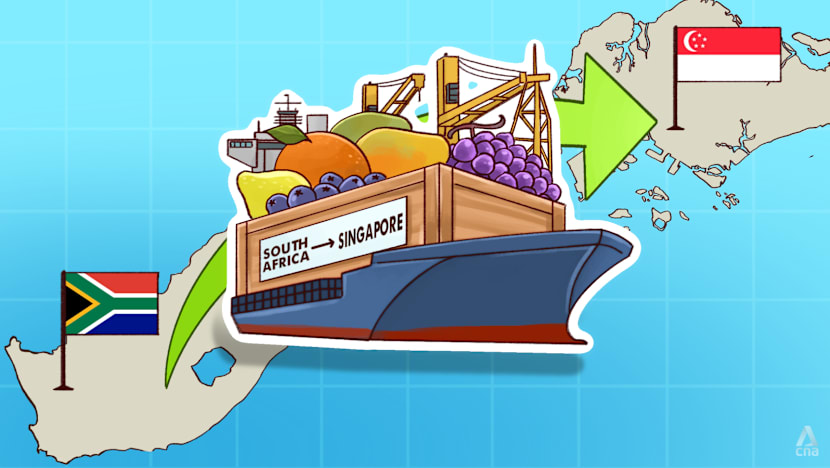
JOHANNESBURG: South African farmers are increasingly exporting fresh produce to Singapore, with a focus on diversifying the Southeast Asian nation’s food sources. Altus Kirsten, managing director of Angon Fruit, highlights the significance of the Singapore market, noting that it accounts for approximately 1 to 2 percent of his company’s total exports. Despite this small share, the demand for South African fruits such as grapes and blueberries has remained stable, according to Kirsten.
Singapore has been broadening its import portfolio as part of its new food security strategy, which was unveiled by Grace Fu, Minister for Sustainability and the Environment, last month. This strategy aims to mitigate risks associated with relying on a limited number of food sources during disruptions caused by adverse weather, geopolitical tensions, or trade route blockages. The issue of food security has also been a focal point at the recent G20 Summit held in Johannesburg, where Singapore’s Prime Minister Lawrence Wong participated at the invitation of South African President Cyril Ramaphosa.
South Africa’s Strategic Position
Experts believe South Africa’s geographical location and agricultural capabilities make it an ideal partner for Singapore’s food security strategy. Professor Paul Teng from the S Rajaratnam School of International Studies explains that South Africa’s position in the southern hemisphere allows it to supply products when northern hemisphere countries are less productive. Furthermore, South Africa is one of the few southern hemisphere nations with a well-established agri-food industry that meets international food safety standards.
The country’s diverse agroclimatic zones enable a range of agricultural production, enhancing its appeal as a supplier. Elyssa Kaur Ludher, a visiting fellow at the ISEAS-Yusof Ishak Institute, emphasizes that South Africa, along with Australia and New Zealand, is a leader in this sector. “South Africa offers a diverse crop basket that complements our existing suppliers,” says Bjorn Low, founder of the urban farming initiative Edible Garden City.
Trade conditions further support this relationship. According to Fhumulani Ratshitanga, CEO of Fruit SA, South African fresh fruit enters Singapore at a zero percent tariff, providing a competitive edge compared to other Asian markets.
Current Market Dynamics
While fresh fruit exports to Singapore represent about 1 to 2 percent of South Africa’s total fruit exports, certain categories are gaining traction. For instance, citrus exports to Singapore made up approximately 4 to 6 percent of South Africa’s exports to Asia in recent years. The 2025 citrus season marked a notable increase, with shipments rising from around 16,800 tonnes to over 25,200 tonnes, reflecting a 50 percent year-on-year growth.
Although blueberry exports have seen some fluctuations, Singapore remains one of South Africa’s largest markets in the region. Ratshitanga acknowledges that the growth potential is somewhat constrained due to Singapore’s relatively small population. Nonetheless, the zero percent tariff remains a significant incentive for continued trade.
Researcher Diaan Venter from the Agricultural Business Chamber of South Africa notes that while Singapore is not a primary expansion market, it still serves as an important destination for South African exports. The focus has shifted to high-value products like edible nuts and wine, which align with Singapore’s consumer preferences for quality and traceability.
Challenges and Considerations
Despite the promising trade relationship, experts highlight several challenges related to importing food from South Africa. Professor Teng points out that South Africa does not have the same level of food security or surplus as major exporting regions like North America or Europe. This discrepancy raises concerns about the consistency of export volumes, particularly when domestic demands arise.
Moreover, logistical constraints such as long shipping times and compliance with Singapore’s stringent import requirements add to the complexities of trade. Venter emphasizes that maintaining a reliable cold chain is essential, which can increase costs significantly. Additionally, the environmental impact of importing from distant locations is a growing concern as Singapore balances its food security needs with sustainability goals.
As Singapore continues to diversify its food sources, South Africa’s role in its food security strategy seems set to grow, albeit within the constraints of market dynamics and logistical challenges. The commitment from South African producers remains strong, driven by the favorable trade conditions and the opportunity to expand their presence in the Asian market.

European Leaders Must Forge Response to US ‘Civilizational Erasure’ Claim

LivingPhoenix Unveils Groundbreaking Biomimetic Collagen Technology

WRU Aims to Retain Talent After Morgan and Lake Join Gloucester

European Leaders Face “Civilizational Erasure” Claims as US Strategy Shifts

LivingPhoenix Innovates with Groundbreaking Biomimetic Collagen Technology

Messi Concludes India Tour with Enthusiastic Fans and Chaos

Singapore Airlines and Cathay Pacific: A Business Class Showdown

Australian Jews Mourn and Demand Action After Bondi Terror Attack

Pakistan Cuts Key Interest Rate to 10.5% in Unexpected Move

Kenvue Dismisses CEO Thibaut Mongon as Strategic Review Advances

Humanism Camp Engages 250 Youths in Summer Fest 2025

De Minaur Triumphs at Washington Open After Thrilling Comeback

Tupou and Daugunu Join First Nations Squad for Lions Clash

Colombian Senator Miguel Uribe Shows Signs of Recovery After Attack

ASEAN Gears Up for Historic Joint Meeting of Foreign and Economic Ministers

New Study Challenges Assumptions About Aging and Inflammation

Oil Prices Surge Following New EU Sanctions on Russia

South Korea’s Foreign Minister Cho Hyun to Visit China This Week
-
 Business5 months ago
Kenvue Dismisses CEO Thibaut Mongon as Strategic Review Advances
-
 Lifestyle5 months ago
Humanism Camp Engages 250 Youths in Summer Fest 2025
-
 Sports5 months ago
De Minaur Triumphs at Washington Open After Thrilling Comeback
-
 Sports5 months ago
Tupou and Daugunu Join First Nations Squad for Lions Clash
-
 Top Stories5 months ago
Colombian Senator Miguel Uribe Shows Signs of Recovery After Attack
-
 World5 months ago
ASEAN Gears Up for Historic Joint Meeting of Foreign and Economic Ministers
-
 Health5 months ago
New Study Challenges Assumptions About Aging and Inflammation
-
 Business5 months ago
Oil Prices Surge Following New EU Sanctions on Russia
-
 World3 months ago
South Korea’s Foreign Minister Cho Hyun to Visit China This Week
-

 Entertainment5 months ago
Detaşe-Sabah Violin Ensemble Captivates at Gabala Music Festival
-

 Business3 months ago
Starling Bank Plans Secondary Share Sale, Targeting $5.4 Billion Valuation
-

 Entertainment5 months ago
Baku Metro Extends Hours for Justin Timberlake Concert