
Top Stories
Taiwan’s Missile Tests Showcase Advanced Interception Capabilities

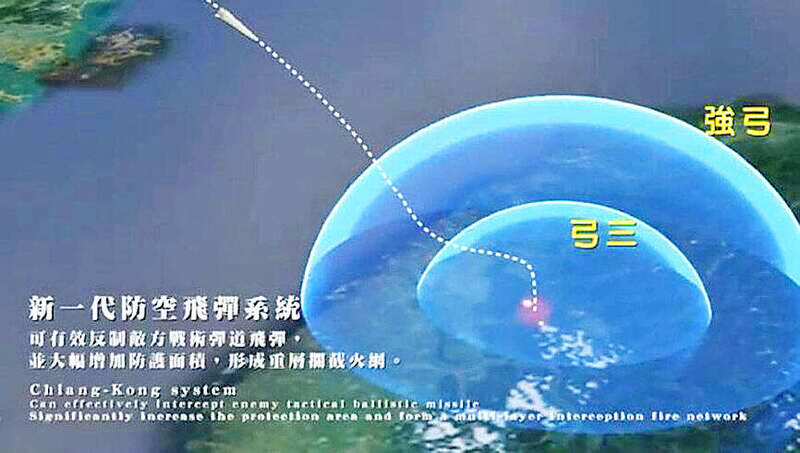
Recent missile tests conducted by the Chungshan Institute of Science and Technology (CSIST) indicate that Taiwan has developed advanced capabilities for intercepting ballistic missiles as they re-enter the atmosphere. This significant advancement is seen as a deterrent against potential missile threats from China, according to Chang Cheng, a former chief engineer of the Hsiung Feng III missile development project.
The tests, believed to be part of Project Chiang Kung, took place at the Jiupeng Military Base in Pingtung County. Unlike previous tests that operated under “unlimited” restriction zones, these recent trials specified a clear range of 30.48 kilometers. Chang explained that while “unlimited” zones do not imply infinite altitude, they serve as a warning against aircraft entering the designated area, particularly since the extended-range version of the Tien Kung III missile can reach altitudes of up to 70 kilometers, far exceeding typical aircraft capabilities.
Chang noted that establishing a maximum altitude at 30.48 kilometers represents a significant engineering challenge. At this height, atmospheric density is only 1 percent of that at sea level, which complicates the application of traditional aerodynamics used in missile maneuvering. To successfully intercept missiles at this altitude, a missile must employ advanced divert and attitude control systems or thrust vector control systems to adjust its trajectory.
The CSIST communicates to the international community through these tests that it possesses a limited high-altitude denial capability. This suggests that the institute is capable of designing missiles that can endure the intense heat of atmospheric re-entry while functioning in near-vacuum conditions. According to Chang, the CSIST’s missile technology may serve as a viable endo-atmospheric interceptor, enhancing Taiwan’s defensive capabilities.
Project Chiang Kung is reportedly focused on developing two versions of missiles, designated I and II, based on the extended-altitude TK-III missile. The Chiang Kung I is anticipated to achieve interception altitudes greater than those of the U.S.-produced Patriot III system, as highlighted by military sources during the Taipei Aerospace and Defense Technology Exhibition in September.
In addition to the Chiang Kung I, the Chiang Kung II is expected to have two derivatives. The Chiang Kung IIA is rumored to intercept at altitudes of 100 kilometers, comparable to the U.S. Terminal High Altitude Area Defense (THAAD) system. Meanwhile, the Chiang Kung IIB is anticipated to function as a new surface-to-surface ballistic missile with an estimated range of 1,000 kilometers.
These developments highlight Taiwan’s ongoing efforts to enhance its defense capabilities amid regional tensions, particularly with increasing missile threats. As missile technology continues to evolve, the implications for regional security and defense strategies remain significant.

Takaichi’s Leadership: A New Era for Japan’s Indo-Pacific Strategy

Singapore Commits S$37 Billion to Boost Research and Innovation

Bayern’s Luis Diaz Sees Champions League Ban Cut to Two Matches

Vaccine Makers Alarmed by US Advisory Panel’s Hepatitis B Shift

Favorites Shine in 2026 World Cup Draw; Trump Receives Honor

Taiwan and US Experts Advocate Energy Resilience Strategies

Vaccine Makers Alarmed by US Panel’s Shift on Hepatitis B for Newborns

Draw Unveils Groups for 2026 World Cup in North America

Taiwan and US Collaborate to Enhance Energy Resilience

Kenvue Dismisses CEO Thibaut Mongon as Strategic Review Advances

Humanism Camp Engages 250 Youths in Summer Fest 2025

De Minaur Triumphs at Washington Open After Thrilling Comeback

Tupou and Daugunu Join First Nations Squad for Lions Clash

Colombian Senator Miguel Uribe Shows Signs of Recovery After Attack

ASEAN Gears Up for Historic Joint Meeting of Foreign and Economic Ministers

New Study Challenges Assumptions About Aging and Inflammation

Oil Prices Surge Following New EU Sanctions on Russia

Detaşe-Sabah Violin Ensemble Captivates at Gabala Music Festival
-
 Business5 months ago
Kenvue Dismisses CEO Thibaut Mongon as Strategic Review Advances
-
 Lifestyle4 months ago
Humanism Camp Engages 250 Youths in Summer Fest 2025
-
 Sports4 months ago
De Minaur Triumphs at Washington Open After Thrilling Comeback
-
 Sports5 months ago
Tupou and Daugunu Join First Nations Squad for Lions Clash
-
 Top Stories5 months ago
Colombian Senator Miguel Uribe Shows Signs of Recovery After Attack
-
 World5 months ago
ASEAN Gears Up for Historic Joint Meeting of Foreign and Economic Ministers
-
 Health4 months ago
New Study Challenges Assumptions About Aging and Inflammation
-
 Business5 months ago
Oil Prices Surge Following New EU Sanctions on Russia
-
 Entertainment4 months ago
Detaşe-Sabah Violin Ensemble Captivates at Gabala Music Festival
-

 Entertainment4 months ago
Baku Metro Extends Hours for Justin Timberlake Concert
-
 Top Stories5 months ago
Rethinking Singapore’s F&B Regulations Amid Business Closures
-

 Business5 months ago
U.S. House Approves Stablecoin Bill, Sends to Trump for Signature