
Politics
Drones Transform Warfare in Russia-Ukraine Conflict

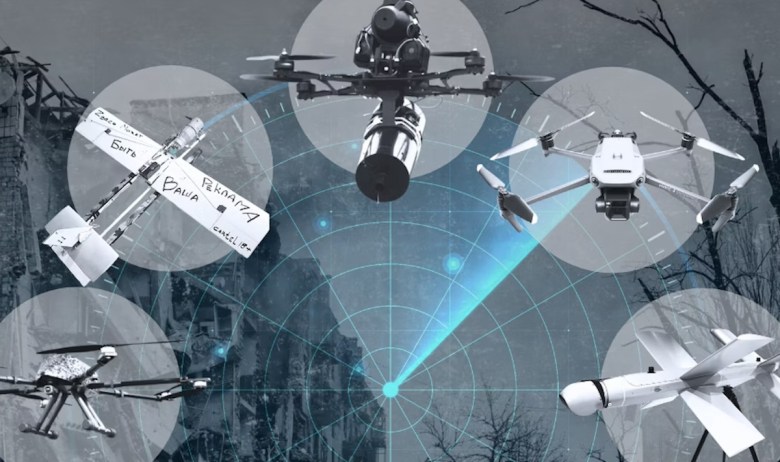
The conflict between Russia and Ukraine has seen an unprecedented rise in the use of drones, marking a significant evolution in modern warfare. Over the past five years, uncrewed aerial vehicles (UAVs) have become crucial for military operations, with hundreds or even thousands deployed daily along the frontlines. The integration of cheap, mass-produced consumer technology has enabled militaries to adapt commercial drone designs into highly effective tools for combat.
First-Person View Drones Take Center Stage
Among the various types of drones in use, first-person view (FPV) drones have gained prominence due to their agility and effectiveness. Pilots control these drones remotely, often donning virtual reality goggles to navigate their flight paths. Their speed and maneuverability allow them to target armoured vehicles, intercept enemy helicopters, and execute ambushes on ground troops. The Russian military primarily employs the Molniya-2, a drone that can be constructed for under $1,000 using mostly commercial components. Russia aims to manufacture two million FPV drones within this year alone.
To counteract the risks posed by radio jamming, Russian forces have adopted an innovative approach by controlling these drones via fibre optic cables that extend up to 40 kilometers in length. This adaptation has resulted in battlefields strewn with thousands of thin fibre optic lines. Additionally, FPV drones are starting to integrate artificial intelligence, initially to assist pilots and eventually to enhance autonomous capabilities.
Diverse Drone Types Expand Military Strategies
Multicopter drones represent another category that has proven versatile in various operational roles. These drones can perform reconnaissance, engage in electronic warfare, and deliver payloads, such as small bombs or anti-personnel mines. Many of these systems are modified commercial drones, including popular models like the Chinese-made DJI Mavic 3 and Autel EVO II. Larger, purpose-built drones like the MiS-150 and MiS-35 can carry payloads of up to 15 kilograms, while the in-development Buran hexacopter is designed to transport a staggering 80 kilograms.
On the other hand, winged drones serve different strategic purposes, classified into one-way (kamikaze) and reusable categories. Russia has heavily relied on the Geran series for long-range strikes against Ukrainian cities and infrastructure. By late June 2023, Russia had launched approximately 29,000 Geran drones, with production capabilities reaching 2,700 units monthly. These drones also function as decoys to distract air defenses, extending their tactical utility beyond direct engagement.
Reusable drones such as the Orlan-10 and ZALA 421 contribute to battlefield surveillance and coordination of attacks. The Orlan-10 has even evolved to serve as a mothership for launching smaller FPV drones, while the ZALA Lancet operates as a loitering munition, capable of identifying and striking targets upon command.
Counter-drone technology has emerged as an essential focus for military forces. The challenge lies in effectively neutralizing drones, which are typically small, fast, and numerous. Current counter-drone systems include a mix of warning sensors, electronic jammers, and missile systems. Although fighter aircraft can counter larger, aircraft-like drones, smaller FPV and multicopter drones remain difficult to target. Recent advancements in air-launched rocket systems enable fighter jets to potentially down multiple Geran drones in a single mission.
As drones continue to proliferate and diversify, the balance between mass-produced offensive platforms and effective defensive measures will significantly influence future conflicts. The military landscape is evolving rapidly, as seen in the ongoing Russia-Ukraine war, where drone technology is reshaping traditional warfare paradigms.

Takaichi’s Leadership: A New Era for Japan’s Indo-Pacific Strategy

Singapore Commits S$37 Billion to Boost Research and Innovation

Bayern’s Luis Diaz Sees Champions League Ban Cut to Two Matches

Vaccine Makers Alarmed by US Advisory Panel’s Hepatitis B Shift

Favorites Shine in 2026 World Cup Draw; Trump Receives Honor

Taiwan and US Experts Advocate Energy Resilience Strategies

Vaccine Makers Alarmed by US Panel’s Shift on Hepatitis B for Newborns

Draw Unveils Groups for 2026 World Cup in North America

Taiwan and US Collaborate to Enhance Energy Resilience

Kenvue Dismisses CEO Thibaut Mongon as Strategic Review Advances

Humanism Camp Engages 250 Youths in Summer Fest 2025

De Minaur Triumphs at Washington Open After Thrilling Comeback

Tupou and Daugunu Join First Nations Squad for Lions Clash

Colombian Senator Miguel Uribe Shows Signs of Recovery After Attack

ASEAN Gears Up for Historic Joint Meeting of Foreign and Economic Ministers

New Study Challenges Assumptions About Aging and Inflammation

Oil Prices Surge Following New EU Sanctions on Russia

Detaşe-Sabah Violin Ensemble Captivates at Gabala Music Festival
-
 Business5 months ago
Kenvue Dismisses CEO Thibaut Mongon as Strategic Review Advances
-
 Lifestyle4 months ago
Humanism Camp Engages 250 Youths in Summer Fest 2025
-
 Sports4 months ago
De Minaur Triumphs at Washington Open After Thrilling Comeback
-
 Sports5 months ago
Tupou and Daugunu Join First Nations Squad for Lions Clash
-
 Top Stories5 months ago
Colombian Senator Miguel Uribe Shows Signs of Recovery After Attack
-
 World5 months ago
ASEAN Gears Up for Historic Joint Meeting of Foreign and Economic Ministers
-
 Health4 months ago
New Study Challenges Assumptions About Aging and Inflammation
-
 Business5 months ago
Oil Prices Surge Following New EU Sanctions on Russia
-
 Entertainment4 months ago
Detaşe-Sabah Violin Ensemble Captivates at Gabala Music Festival
-

 Entertainment4 months ago
Baku Metro Extends Hours for Justin Timberlake Concert
-

 Top Stories5 months ago
Rethinking Singapore’s F&B Regulations Amid Business Closures
-

 Business5 months ago
U.S. House Approves Stablecoin Bill, Sends to Trump for Signature