
Politics
China Advances Nuclear Carrier Development, Challenging US Naval Power

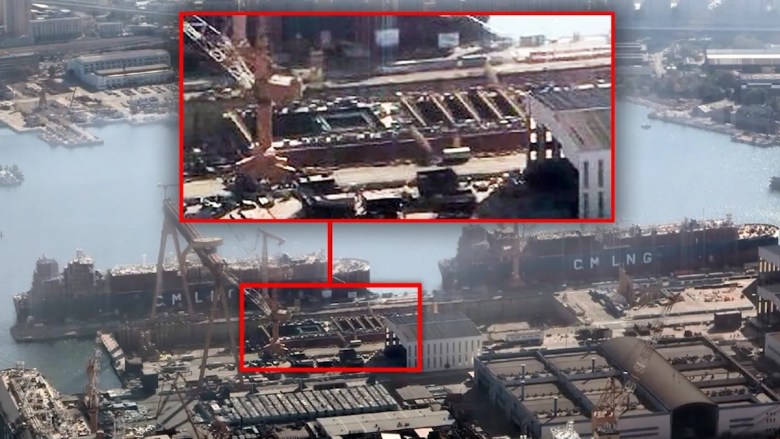
Construction of China’s latest aircraft carrier, the Type 004, is reportedly underway at the Dalian shipyard in Liaoning province. This development signals a significant shift as China aims to transition from a regional navy to a formidable blue-water competitor. Recent imagery suggests that the Type 004 may be nuclear-powered, featuring a reactor containment structure consistent with US nuclear supercarriers. This enhancement could substantially increase its operational capabilities.
The timing of this announcement aligns closely with the commissioning of China’s first domestically built carrier, the Fujian, which boasts advanced electromagnetic catapults. The People’s Liberation Army Navy (PLAN) is clearly accelerating its naval ambitions, as outlined by recent assessments from the US Department of Defense (DoD). These assessments indicate that China’s next-generation carriers, like the Type 004, will possess greater endurance, allowing them to operate far beyond China’s immediate coastal waters.
The potential introduction of a nuclear-powered Type 004 would provide China with virtually unlimited operational range, allowing for advanced sensor deployment and systems integration. This capability would narrow the existing gap with the US Navy, which currently operates a fleet of 11 nuclear carriers. Should the Type 004 be completed, it would position China alongside France as one of the few nations with nuclear-powered aircraft carriers.
Reports also indicate that China may explore a conventionally powered variant of the Type 004. This strategy would leverage China’s extensive shipbuilding capacity, enabling the country to field multiple carriers simultaneously. The dual approach reflects China’s ambition to project military power globally while maintaining conventional carriers for regional engagements, particularly concerning Taiwan and disputes in the South China Sea.
Despite the technological advancements represented by the Fujian, experts point out its limitations. US Navy Captain Carl Schuster noted that the Fujian might only operate at approximately 60% of the capacity of a US Nimitz-class carrier. A CNN report highlighted that the landing area on the Fujian is positioned at an angle of just 6 degrees off center, compared to the 9-degree angle found on US carriers. This design feature restricts the available space for repositioning recovered aircraft.
In addition, Lieutenant Commander Keith Stewart remarked on China’s lack of operational experience with electromagnetic catapults, as the Fujian is the first ship in its fleet equipped with such technology. He emphasized that certain operational lessons, particularly those acquired during nighttime carrier operations, can only be learned through real-time experience.
While the Fujian is a significant step for China’s naval capabilities, the Type 004 represents a more ambitious goal. If completed, this would give China a fleet of four carriers—three conventionally powered and one nuclear. This combination may present challenges, as three carriers could enable continuous operations through rotation, with one carrier deployed, another in training, and a third undergoing maintenance.
A fleet of six carriers could effectively maintain two flattops at sea, with the conventional carriers operating within the First Island Chain, a region with ample land-based support for refueling. Conversely, nuclear-powered carriers would have the freedom to operate throughout the Second Island Chain, which includes strategic locations such as the Bonin Islands, Guam, and Papua New Guinea.
With the aid of long-range ballistic missiles, including the DF-21 and DF-26, China’s conventionally powered carriers could establish localized air superiority in critical regions such as the Taiwan Strait and outmatch weaker regional powers in the South China Sea. Meanwhile, nuclear carriers could act as a maneuver element in the Second Island Chain, enhancing China’s military posture against US forces in a potential Taiwan conflict.
Nonetheless, China faces significant geographical challenges. Its carriers must navigate through two vulnerable exits, the Miyako Strait and Bashi Channel, both of which are monitored by US and allied missile systems. To counter this, China might consider enhancing carrier defenses, targeting US missile sites, and strategically influencing local politics in allied nations to reduce US military presence.
The development of both nuclear and conventional carriers allows China to address the quantitative aspect of its naval capabilities. Nuclear carriers provide global reach, while conventionally powered vessels can be produced rapidly and affordably, enabling China to build a larger fleet than the US may be able to sustain.
As the US explores the concept of “lightning carriers” that combine features of assault ships and carriers, experts caution that such platforms often fall short of fulfilling either role effectively. These hybrid vessels may sacrifice offensive power for defensive capabilities, and they might also lack the robust survivability features of traditional carriers.
China’s pursuit of a nuclear supercarrier not only underscores its growing ambitions but also poses a significant challenge to existing naval dynamics in the Indo-Pacific region. Should China succeed in overcoming geographical limitations, it could mark a pivotal shift in naval power, potentially altering the balance of power in the region.

Takaichi’s Leadership: A New Era for Japan’s Indo-Pacific Strategy

Singapore Commits S$37 Billion to Boost Research and Innovation

Bayern’s Luis Diaz Sees Champions League Ban Cut to Two Matches

Vaccine Makers Alarmed by US Advisory Panel’s Hepatitis B Shift

Favorites Shine in 2026 World Cup Draw; Trump Receives Honor

Taiwan and US Experts Advocate Energy Resilience Strategies

Vaccine Makers Alarmed by US Panel’s Shift on Hepatitis B for Newborns

Draw Unveils Groups for 2026 World Cup in North America

Taiwan and US Collaborate to Enhance Energy Resilience

Humanism Camp Engages 250 Youths in Summer Fest 2025

Kenvue Dismisses CEO Thibaut Mongon as Strategic Review Advances

De Minaur Triumphs at Washington Open After Thrilling Comeback

Tupou and Daugunu Join First Nations Squad for Lions Clash

Colombian Senator Miguel Uribe Shows Signs of Recovery After Attack

ASEAN Gears Up for Historic Joint Meeting of Foreign and Economic Ministers

New Study Challenges Assumptions About Aging and Inflammation

Oil Prices Surge Following New EU Sanctions on Russia

Detaşe-Sabah Violin Ensemble Captivates at Gabala Music Festival
-
 Lifestyle4 months ago
Humanism Camp Engages 250 Youths in Summer Fest 2025
-
 Business5 months ago
Kenvue Dismisses CEO Thibaut Mongon as Strategic Review Advances
-
 Sports4 months ago
De Minaur Triumphs at Washington Open After Thrilling Comeback
-
 Sports5 months ago
Tupou and Daugunu Join First Nations Squad for Lions Clash
-
 Top Stories5 months ago
Colombian Senator Miguel Uribe Shows Signs of Recovery After Attack
-
 World5 months ago
ASEAN Gears Up for Historic Joint Meeting of Foreign and Economic Ministers
-
 Health4 months ago
New Study Challenges Assumptions About Aging and Inflammation
-
 Business5 months ago
Oil Prices Surge Following New EU Sanctions on Russia
-
 Entertainment4 months ago
Detaşe-Sabah Violin Ensemble Captivates at Gabala Music Festival
-

 Entertainment4 months ago
Baku Metro Extends Hours for Justin Timberlake Concert
-

 Top Stories5 months ago
Rethinking Singapore’s F&B Regulations Amid Business Closures
-

 Business5 months ago
U.S. House Approves Stablecoin Bill, Sends to Trump for Signature