
Business
Japan Unveils Historic $136 Billion Stimulus Package to Boost Economy

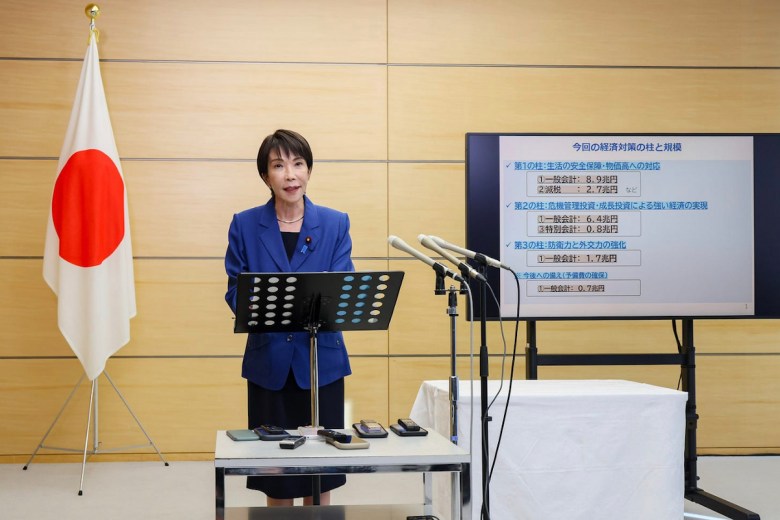
Japan’s cabinet, led by Prime Minister Sanae Takaichi, approved a significant stimulus package worth 21.3 trillion yen (approximately US$136.25 billion) on November 21, 2023. This package features a 17.7 trillion yen ($113.21 billion) supplemental budget intended for submission to the Diet in the current session. The overall financial commitment, including loan guarantees and other non-budgetary measures, reaches a total of 42.8 trillion yen (around US$273.77 billion), marking the largest stimulus initiative since the Covid-19 pandemic began.
The stimulus package is structured around three key priorities. It includes measures designed to alleviate the rising cost of living, strategic investments in sectors such as shipbuilding, artificial intelligence (AI), and semiconductors, and an increase in defense spending. The government aims to elevate total defense expenditures for fiscal year 2025 to 2% of GDP. According to Nikkei, the size of the stimulus grew as the Takaichi administration collaborated with both ruling and opposition parties, rejecting earlier proposals from the finance ministry in favor of a more substantial budget.
In her remarks during the announcement, Prime Minister Takaichi emphasized her government’s commitment to responsible fiscal expansion. She noted that the overall amount of debt issuance for fiscal year 2025 would be lower than that of the previous year. As the government prepares to draft the fiscal year 2026 budget, it will engage in ongoing discussions with financial markets to assure investors of its commitment to fiscal sustainability, aiming to prevent inflation that could adversely affect the yen’s value against major currencies.
Political Developments and Electoral Reforms
In a separate political development, officials from the Liberal Democratic Party (LDP) and Ishin no Kai met on the same day, agreeing to pursue a bill aimed at reducing the number of seats in the House of Representatives. This initiative is expected to lay the groundwork for broader discussions on electoral reform in the spring. However, Ishin no Kai has expressed concerns over the LDP’s approach to the process, indicating that it may take longer than anticipated to reach a resolution.
While co-leader Yoshimura Hirofumi acknowledged the collaboration, he stressed the need for clarity regarding the number of seats to be reduced and a timeline for implementation. The partnership appears stable for now, but tensions may arise if Ishin no Kai becomes frustrated with the LDP’s cautious pace. Meanwhile, opposition parties have reacted skeptically to the proposed seat reductions, although Democratic Party for the People leader Tamaki Yūichirō has shown interest in potentially co-sponsoring the legislation.
Japan-China Relations Strained
The relationship between Japan and China has also seen significant strain recently, as Beijing suspended bilateral discussions regarding the resumption of Japan’s beef exports, which have been on hold since 2001 due to concerns related to bovine spongiform encephalopathy (BSE), commonly known as mad cow disease. The Chinese government indicated that a prerequisite for pursuing a “strategic, mutually beneficial partnership” is for Prime Minister Takaichi to retract her comments about Japan’s role in responding to a potential Taiwan contingency.
While Chief Cabinet Secretary Kihara Minoru clarified that the Prime Minister would avoid making “hypothetical” statements about Taiwan to prevent confusion, the diplomatic relationship continues to face challenges.
In the background, Takaichi’s government has quickly settled into its role, with notable developments including the approval for restarting the Kashiwazaki-Kariwa nuclear power plant by Niigata Governor Hanazumi Hideyo. As the yen remains under pressure, Finance Minister Katayama Satsuki acknowledged that the government is “naturally” considering intervention to stabilize the currency’s value.
The Takaichi administration is navigating a complex political landscape, balancing fiscal stimulus with the need for long-term economic stability while managing relations with both domestic parties and international counterparts.

Takaichi’s Leadership: A New Era for Japan’s Indo-Pacific Strategy

Singapore Commits S$37 Billion to Boost Research and Innovation

Bayern’s Luis Diaz Sees Champions League Ban Cut to Two Matches

Vaccine Makers Alarmed by US Advisory Panel’s Hepatitis B Shift

Favorites Shine in 2026 World Cup Draw; Trump Receives Honor

Taiwan and US Experts Advocate Energy Resilience Strategies

Vaccine Makers Alarmed by US Panel’s Shift on Hepatitis B for Newborns

Draw Unveils Groups for 2026 World Cup in North America

Taiwan and US Collaborate to Enhance Energy Resilience

Kenvue Dismisses CEO Thibaut Mongon as Strategic Review Advances

Humanism Camp Engages 250 Youths in Summer Fest 2025

De Minaur Triumphs at Washington Open After Thrilling Comeback

Tupou and Daugunu Join First Nations Squad for Lions Clash

Colombian Senator Miguel Uribe Shows Signs of Recovery After Attack

ASEAN Gears Up for Historic Joint Meeting of Foreign and Economic Ministers

New Study Challenges Assumptions About Aging and Inflammation

Oil Prices Surge Following New EU Sanctions on Russia

Detaşe-Sabah Violin Ensemble Captivates at Gabala Music Festival
-
 Business5 months ago
Kenvue Dismisses CEO Thibaut Mongon as Strategic Review Advances
-
 Lifestyle4 months ago
Humanism Camp Engages 250 Youths in Summer Fest 2025
-
 Sports4 months ago
De Minaur Triumphs at Washington Open After Thrilling Comeback
-
 Sports5 months ago
Tupou and Daugunu Join First Nations Squad for Lions Clash
-
 Top Stories5 months ago
Colombian Senator Miguel Uribe Shows Signs of Recovery After Attack
-
 World5 months ago
ASEAN Gears Up for Historic Joint Meeting of Foreign and Economic Ministers
-
 Health4 months ago
New Study Challenges Assumptions About Aging and Inflammation
-
 Business5 months ago
Oil Prices Surge Following New EU Sanctions on Russia
-
 Entertainment4 months ago
Detaşe-Sabah Violin Ensemble Captivates at Gabala Music Festival
-

 Entertainment4 months ago
Baku Metro Extends Hours for Justin Timberlake Concert
-

 Top Stories5 months ago
Rethinking Singapore’s F&B Regulations Amid Business Closures
-
 Business5 months ago
U.S. House Approves Stablecoin Bill, Sends to Trump for Signature