
World
Qantas Expands Non-Stop Flights to India Amid Fleet Enhancements

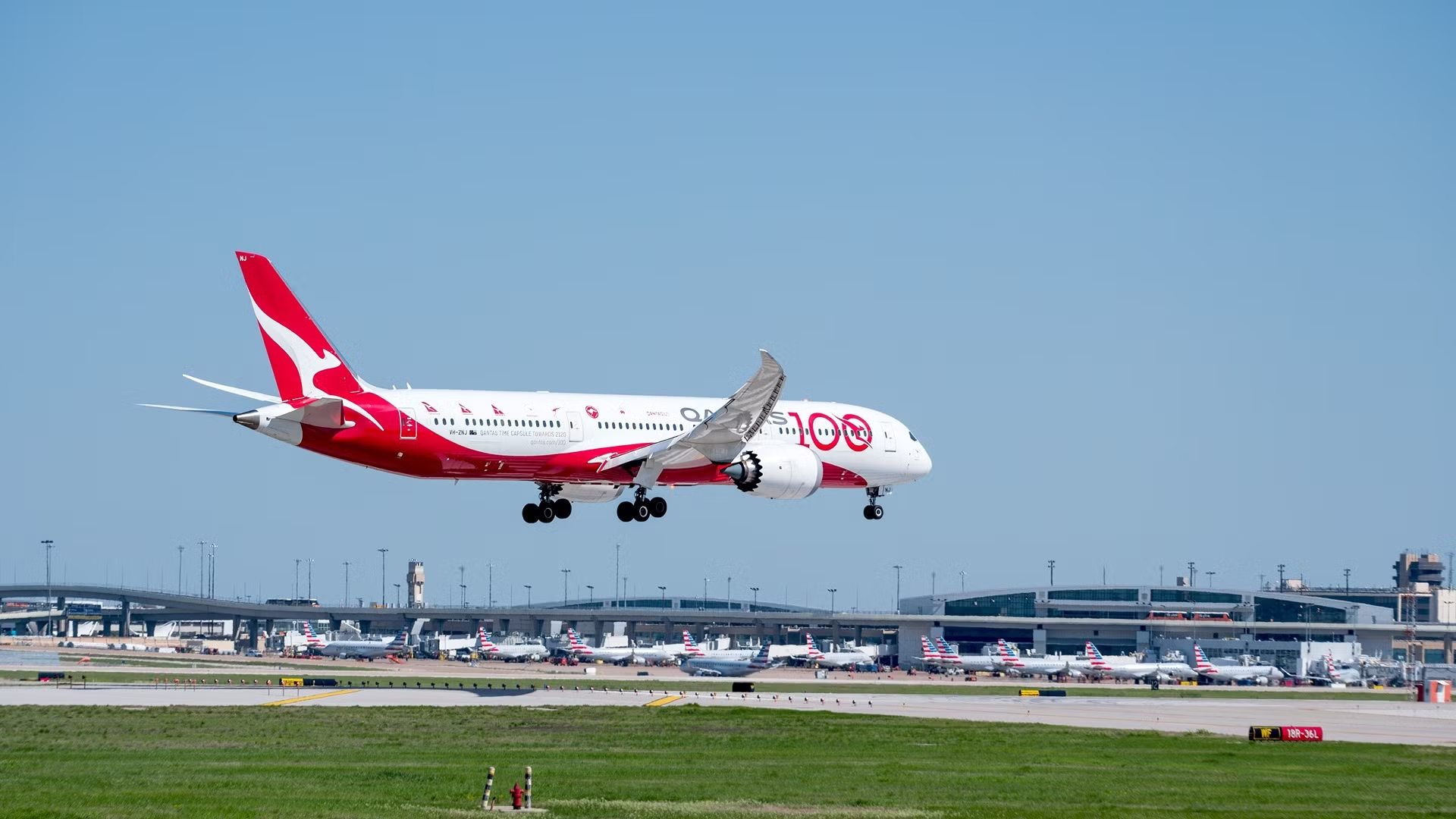
Australia’s flagship airline, Qantas, is set to expand its operations in India as it undergoes a significant fleet upgrade. The introduction of the new Airbus A350-1000 and Airbus A321XLR will free up existing Boeing 787 aircraft, allowing Qantas to enhance its non-stop flight offerings between Australia and the Indian subcontinent.
Cam Wallace, Qantas International Chief Executive Officer, shared insights with Executive Traveller regarding the airline’s current success with its two non-stop services to India. He emphasized the airline’s commitment to redeploying the right aircraft to meet growing demand in this lucrative market. Currently, Qantas operates services to India using its Airbus A330 fleet, which Wallace noted may not be the best fit for these routes.
Fleet Expansion and Route Development
With the arrival of the A350-1000, Qantas expects to optimize its fleet configuration. This change will enable the carrier to repurpose existing and new Boeing 787 Dreamliners for additional services to India and potentially Sri Lanka. Qantas has placed an order for twelve A350-1000 and 787 aircraft, which are intended to replace its aging A330 fleet.
The carrier also plans to leverage the long-range capabilities of the Airbus A321XLR to establish new non-stop routes from Perth International Airport (PER). Wallace indicated that flights from Perth to India are a priority, stating, “Perth-India is another market that, over time, we’ll definitely serve.” This strategic move complements the expansion of the Perth Airport Central precinct, facilitating seamless connections for both domestic and international flights.
Currently, Qantas operates direct services between Sydney Kingsford Smith Airport (SYD) and Bangalore Kempegowda International Airport (BLR), as well as between Melbourne Tullamarine Airport (MEL) and Delhi Indira Gandhi International Airport (DEL).
Jetstar’s Role in Expanding Reach
In addition to enhancing its mainline operations, Qantas is looking to its low-cost subsidiary, Jetstar, to support competitive airfares to India. Jetstar, Australia’s second-largest airline, is currently retrofitting its Boeing 787 aircraft to elevate the passenger experience. This includes the introduction of dedicated crew rest areas, which will enable longer flights, potentially allowing the airline to serve direct routes to India and Sri Lanka from major Australian cities such as Sydney, Melbourne, and Perth.
Stephanie Tully, Jetstar Group Chief Executive Officer, noted that the upgrade of the 787 fleet will enhance operational capabilities, with the potential for flights reaching up to 16 hours. This dual-brand approach allows Qantas to cater to both premium and budget travelers, creating a collaborative strategy to capture a larger share of the Australia-India market.
At present, the primary competitors for flights between India and Australia are the Indian flag carrier Air India and SriLankan Airlines, which connects Colombo to both Sydney and Melbourne.
As Qantas strategically positions itself for growth in the Indian market, the airline’s focus on fleet modernization and expanded direct services reflects its commitment to meeting rising demand for travel between Australia and India.

India Unveils Long-Range Hypersonic Missile Amid Regional Tensions

SK bioscience Launches Global Trial for Universal Sarbecovirus Vaccine

Senegal Coach Pape Thiaw Suspended and Fined After Final Disruption

PAS Denies Abolishing Chairman Post, Contradicts Muhyiddin’s Claim

Mbappé Critiques Real Madrid’s Effort After Benfica Defeat

Thailand’s December Factory Output Surges 2.52% Year-on-Year

Ishita Dutta Reveals Her Parenting Secret: Strong Coffee

Older GPs Express Concerns Over New Digital Health Record Mandate

Urban Jurgensen: A 252-Year Legacy Enters a New Era

Regina Martinez Breaks New Ground for Mexico in Cross-Country Skiing

South Korea’s Foreign Minister Cho Hyun to Visit China This Week

Starling Bank Plans Secondary Share Sale, Targeting $5.4 Billion Valuation

Munsang College Celebrates 100 Years with Grand Ceremony

PAS Aims to Expand Parliamentary Influence in Upcoming Election

De Minaur Triumphs at Washington Open After Thrilling Comeback

Kenvue Dismisses CEO Thibaut Mongon as Strategic Review Advances

Humanism Camp Engages 250 Youths in Summer Fest 2025

Colombian Senator Miguel Uribe Shows Signs of Recovery After Attack
-
 Sports3 months ago
Regina Martinez Breaks New Ground for Mexico in Cross-Country Skiing
-
 World8 months ago
South Korea’s Foreign Minister Cho Hyun to Visit China This Week
-
 Business8 months ago
Starling Bank Plans Secondary Share Sale, Targeting $5.4 Billion Valuation
-
 Top Stories8 months ago
Munsang College Celebrates 100 Years with Grand Ceremony
-
 World8 months ago
PAS Aims to Expand Parliamentary Influence in Upcoming Election
-
 Sports9 months ago
De Minaur Triumphs at Washington Open After Thrilling Comeback
-
 Business10 months ago
Kenvue Dismisses CEO Thibaut Mongon as Strategic Review Advances
-
 Lifestyle9 months ago
Humanism Camp Engages 250 Youths in Summer Fest 2025
-
 Top Stories10 months ago
Colombian Senator Miguel Uribe Shows Signs of Recovery After Attack
-

 Sports10 months ago
Tupou and Daugunu Join First Nations Squad for Lions Clash
-

 World10 months ago
ASEAN Gears Up for Historic Joint Meeting of Foreign and Economic Ministers
-

 Health9 months ago
New Study Challenges Assumptions About Aging and Inflammation