
Business
The Panama Canal: A Crucial Link in Global Trade Dynamics

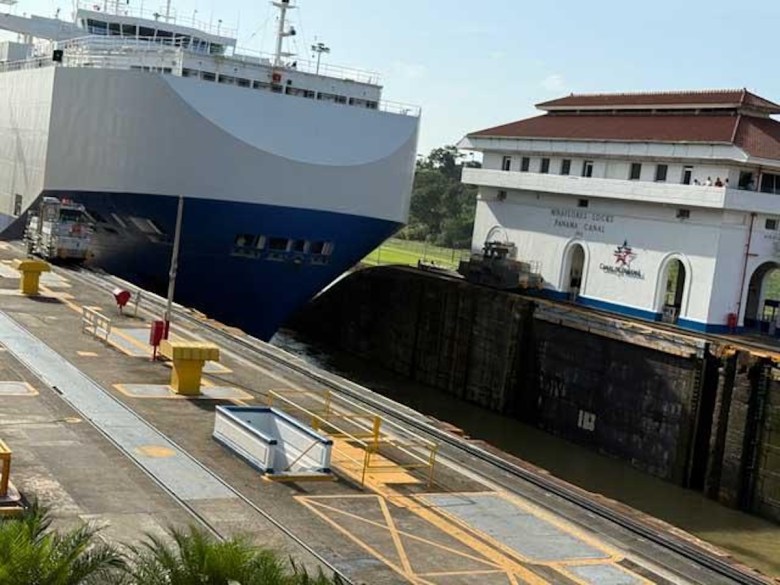
The Panama Canal has emerged as a pivotal element in the ongoing trade tensions between the United States and China, demonstrating its significance beyond mere logistics. In 2023, U.S. farmers faced a stark reminder of the canal’s importance when drought conditions drastically reduced water levels, crippling transit for ships carrying essential agricultural exports. Typically, between 25% and 30% of American grain exports travel through this vital waterway, but during the drought, almost none could navigate its channels. Consequently, shipping costs surged while farm-gate prices declined. The return of rainfall later allowed vessels to resume their journeys, but the vital role of the canal in global trade cannot be overstated.
Engineering Marvel with a Complex History
The Panama Canal stands as a monumental feat of engineering and construction. Its creation involved overcoming significant challenges, including a failed French attempt that lasted two decades and resulted in approximately 20,000 casualties. The successful American endeavor, which took place between 1904 and 1914, managed to complete the canal with far fewer lives lost—around 5,600, primarily among Caribbean workers.
According to historian David McCullough, the project required the excavation of more than 232 million cubic yards of earth and rock, with a staggering 25 million cubic yards dedicated to addressing ongoing landslides. The American effort introduced innovative lock systems that operate by gravity rather than pumps, allowing massive ships to be lifted 85 feet above sea level. This engineering triumph laid the foundation for a waterway that remains operational today, even after the construction of a new set of parallel locks between 2007 and 2016 to accommodate larger vessels.
The financial implications of the canal’s construction were substantial, costing approximately $352 million (around $10.8 billion in today’s currency). The project not only reshaped global shipping routes but also played a key role in shaping the nation of Panama itself.
Political Maneuvering and Contemporary Relevance
The canal’s construction was as much a political endeavor as it was an engineering one. President Theodore Roosevelt intervened in Colombian negotiations, supporting Panama’s independence to secure U.S. control over the canal zone. This move was met with mixed reactions, leading to lingering resentment in Panama regarding U.S. dominance.
In 1977, President Jimmy Carter signed a treaty that gradually returned control of the canal to Panama by 1999, a significant shift in the geopolitical landscape. Recently, former President Donald Trump reignited discussions about U.S. involvement in the canal, particularly concerning concerns over Chinese ownership of port facilities at both ends of the canal, owned by a Hong Kong-based company.
As the U.S. and China continue to vie for global influence, the Panama Canal remains a focal point of contention. Chinese companies are pushing for stake ownership, and U.S. investment groups are actively seeking to acquire port facilities, reflecting the canal’s ongoing strategic importance.
The Panama Canal, often taken for granted, is a reminder of the complex interplay between engineering, politics, and global trade. Its historical significance and contemporary relevance highlight not only its role in facilitating commerce but also its impact on international relations. As global trade dynamics evolve, the canal will undoubtedly remain at the forefront of discussions surrounding U.S.-China relations.

India Unveils Long-Range Hypersonic Missile Amid Regional Tensions

SK bioscience Launches Global Trial for Universal Sarbecovirus Vaccine

Senegal Coach Pape Thiaw Suspended and Fined After Final Disruption

PAS Denies Abolishing Chairman Post, Contradicts Muhyiddin’s Claim

Mbappé Critiques Real Madrid’s Effort After Benfica Defeat

Thailand’s December Factory Output Surges 2.52% Year-on-Year

Ishita Dutta Reveals Her Parenting Secret: Strong Coffee

Older GPs Express Concerns Over New Digital Health Record Mandate

Urban Jurgensen: A 252-Year Legacy Enters a New Era

Regina Martinez Breaks New Ground for Mexico in Cross-Country Skiing

South Korea’s Foreign Minister Cho Hyun to Visit China This Week

Starling Bank Plans Secondary Share Sale, Targeting $5.4 Billion Valuation

Munsang College Celebrates 100 Years with Grand Ceremony

PAS Aims to Expand Parliamentary Influence in Upcoming Election

De Minaur Triumphs at Washington Open After Thrilling Comeback

Kenvue Dismisses CEO Thibaut Mongon as Strategic Review Advances

Humanism Camp Engages 250 Youths in Summer Fest 2025

Colombian Senator Miguel Uribe Shows Signs of Recovery After Attack
-
 Sports3 months ago
Regina Martinez Breaks New Ground for Mexico in Cross-Country Skiing
-
 World8 months ago
South Korea’s Foreign Minister Cho Hyun to Visit China This Week
-
 Business8 months ago
Starling Bank Plans Secondary Share Sale, Targeting $5.4 Billion Valuation
-
 Top Stories8 months ago
Munsang College Celebrates 100 Years with Grand Ceremony
-
 World8 months ago
PAS Aims to Expand Parliamentary Influence in Upcoming Election
-
 Sports9 months ago
De Minaur Triumphs at Washington Open After Thrilling Comeback
-
 Business10 months ago
Kenvue Dismisses CEO Thibaut Mongon as Strategic Review Advances
-
 Lifestyle9 months ago
Humanism Camp Engages 250 Youths in Summer Fest 2025
-
 Top Stories10 months ago
Colombian Senator Miguel Uribe Shows Signs of Recovery After Attack
-

 Sports10 months ago
Tupou and Daugunu Join First Nations Squad for Lions Clash
-

 World10 months ago
ASEAN Gears Up for Historic Joint Meeting of Foreign and Economic Ministers
-

 Health9 months ago
New Study Challenges Assumptions About Aging and Inflammation