
World
Navigating Chongqing: Life in a City of Steep Elevations

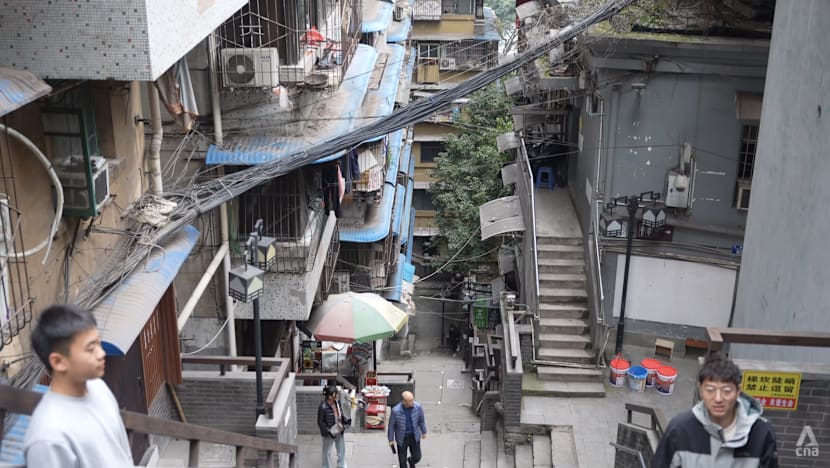
Chongqing, a sprawling metropolis in southwest China, is home to around 32 million people and is often referred to as an “8D city” due to its unique topography. This nickname reflects the city’s intricate maze of steep streets and elevated structures, presenting residents with a daily challenge of navigation and elevation. The life of Chen Hao, a 63-year-old retiree living in Gangfeng village, encapsulates the struggles and adaptations that characterize this urban environment.
Getting to Chen Hao’s apartment involves a winding path through one of Jiangbei district’s remaining old residential communities. Here, daily life unfolds with laundry hanging between balconies and elderly neighbours gathering for their customary tea. The absence of elevators in many buildings forces residents like Chen to navigate numerous flights of stairs, a task he has performed for decades since his family moved into the area in the 1980s.
Standing on his balcony, Chen reflects on the changes that have taken place over the years. “Originally, we could see the mountains, see Jialing River – even Shamo Stone far away,” he recalls. “Now we can’t see any of that.” This nostalgic sentiment is echoed by many residents who witness their familiar landscapes gradually replaced by towering high-rises.
Life in a Vertical City
Chongqing’s unique geography, with mountains accounting for approximately 76 percent of its land area, profoundly influences the lifestyle of its inhabitants. Unlike other Chinese cities where bicycles and e-scooters are common, the steep terrain limits such modes of transport. Architect Li Weitao, who has spent over a decade designing buildings in the city, notes that entering some structures can feel disorienting. “You might find yourself on what you think is the first floor, only to walk out and realize you’re still on the street,” he explains.
The city’s elevation is not just a physical challenge; it also shapes the social fabric. Many older residents, like Chen Hao, express concerns over the loss of community spirit as new high-rises emerge. “If you live in a new building now, you don’t know your neighbours,” he states, lamenting the strong sense of connection that once characterized his community.
The Enduring Spirit of Chongqing
Before modern conveniences such as escalators and delivery apps, the city relied heavily on human labour. Porters, known locally as “bang bang jun,” once thrived in Chongqing, with an estimated 300,000 to 500,000 active porters during the 1990s. Today, that number has dwindled to just a few thousand. One of the remaining porters, Xu, reflects on his journey, which began over 30 years ago when he first arrived in the city from rural Dianjiang county.
Xu’s work involves long hours of carrying goods up steep slopes, often earning between 100 yuan (approximately US$14) and 200 yuan per day. Despite the physical toll it takes, Xu believes that human labour remains essential to moving goods in a city structured around elevation. “Without ‘bang bang’, how do goods get moved out?” he questions.
As younger generations navigate the city’s vertical landscape, they have adapted to its rhythms. For students like Bao and Shen, climbing stairs is simply part of life in Chongqing. “In Chongqing – everywhere you go, you’re climbing stairs,” says one student, embodying the city’s character.
Architectural innovations in Chongqing reflect its unique terrain. Projects like Baixiangju, a 24-storey residential complex completed in 1993, showcase the city’s approach to utilizing elevation creatively. Designed without elevators, the complex comprises six towers with interconnected stairways leading to various streets. This architectural strategy allows for a more engaging living environment while adhering to building regulations from that time.
Despite the challenges posed by Chongqing’s verticality, many residents, including Xu and the younger population, embrace the city’s unique lifestyle. “I think stairs are okay for me, because I like exercising,” says Gong Yupeng, a newcomer who moved to Chongqing 18 months ago. His positive attitude reflects a broader sentiment among those who have adapted to the city’s demands.
Balancing Old and New
As urban development progresses, a balance between the old and the new is crucial. In districts like Nan’an, government-led renewal projects aim to rejuvenate areas without resorting to demolition. By upgrading infrastructure and creating shared community spaces, these initiatives foster interaction between original residents and newcomers.
Li’s firm has played a pivotal role in these developments, focusing on enhancing public spaces while respecting the character of the area. “Through the creation of public space, we both respected the original residents’ living space and introduced new business formats,” he explains, highlighting the need for community integration.
While the city’s landscape continues to evolve, concerns about the erasure of memories and community ties remain. Chen Hao’s father, Chen Shijin, who retired from the Third Steel Plant in 1985, echoes this sentiment. “Honestly, I still miss the earlier era… there was a strong neighbourly feeling,” he shares.
As Chongqing navigates the complexities of modern urbanization, the spirit of its people remains resilient. The challenges presented by the city’s geography foster a unique culture of adaptation and perseverance. Whether it is through the daily climbs of its residents or the architectural ingenuity of its designs, Chongqing stands as a testament to the enduring human spirit amidst the steep elevations of life.

India Unveils Long-Range Hypersonic Missile Amid Regional Tensions

SK bioscience Launches Global Trial for Universal Sarbecovirus Vaccine

Senegal Coach Pape Thiaw Suspended and Fined After Final Disruption

PAS Denies Abolishing Chairman Post, Contradicts Muhyiddin’s Claim

Mbappé Critiques Real Madrid’s Effort After Benfica Defeat

Thailand’s December Factory Output Surges 2.52% Year-on-Year

Ishita Dutta Reveals Her Parenting Secret: Strong Coffee

Older GPs Express Concerns Over New Digital Health Record Mandate

Urban Jurgensen: A 252-Year Legacy Enters a New Era

South Korea’s Foreign Minister Cho Hyun to Visit China This Week

Starling Bank Plans Secondary Share Sale, Targeting $5.4 Billion Valuation

Munsang College Celebrates 100 Years with Grand Ceremony

PAS Aims to Expand Parliamentary Influence in Upcoming Election

Kenvue Dismisses CEO Thibaut Mongon as Strategic Review Advances

Humanism Camp Engages 250 Youths in Summer Fest 2025

De Minaur Triumphs at Washington Open After Thrilling Comeback

Tupou and Daugunu Join First Nations Squad for Lions Clash

Colombian Senator Miguel Uribe Shows Signs of Recovery After Attack
-
 World5 months ago
South Korea’s Foreign Minister Cho Hyun to Visit China This Week
-
 Business5 months ago
Starling Bank Plans Secondary Share Sale, Targeting $5.4 Billion Valuation
-
 Top Stories5 months ago
Munsang College Celebrates 100 Years with Grand Ceremony
-
 World5 months ago
PAS Aims to Expand Parliamentary Influence in Upcoming Election
-
 Business7 months ago
Kenvue Dismisses CEO Thibaut Mongon as Strategic Review Advances
-
 Lifestyle6 months ago
Humanism Camp Engages 250 Youths in Summer Fest 2025
-
 Sports6 months ago
De Minaur Triumphs at Washington Open After Thrilling Comeback
-
 Sports7 months ago
Tupou and Daugunu Join First Nations Squad for Lions Clash
-
 Top Stories7 months ago
Colombian Senator Miguel Uribe Shows Signs of Recovery After Attack
-
 World7 months ago
ASEAN Gears Up for Historic Joint Meeting of Foreign and Economic Ministers
-

 Health6 months ago
New Study Challenges Assumptions About Aging and Inflammation
-

 Business7 months ago
Oil Prices Surge Following New EU Sanctions on Russia