
Top Stories
US Navy Capacity Gaps Slow Response to Iranian Crisis

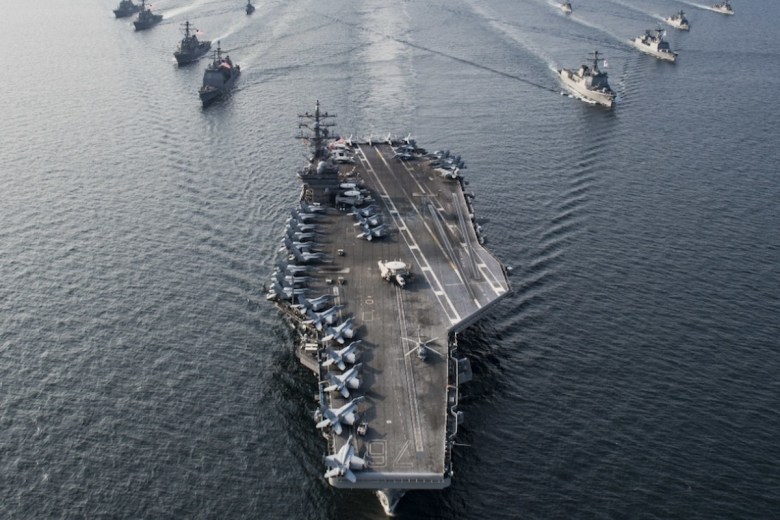
The ongoing protests in Iran, driven by economic decline and governmental repression, have led to a violent crackdown that has drawn international attention. The Iranian Revolutionary Guard Corps (IRGC) and Basij militia are reportedly using lethal force against demonstrators, prompting both the United States and Israel to prepare various military contingencies. In a recent statement, US President Donald Trump assured Iranian protesters that US support is forthcoming and declared that meetings with Iranian officials have been canceled until the violence ceases.
On January 2, Trump emphasized that the US is “locked and loaded” and ready to intervene if the Iranian regime escalates its use of force. Despite these strong statements, a tangible military response from the US has been delayed, largely due to limitations in naval capacities. Much of the US Navy’s active fleet is currently engaged in operations in the Indo-Pacific, the Caribbean, or undergoing maintenance. This situation complicates the US response to potential crises in the Middle East, as rapid naval deployment is essential for effective military action.
The protests began on December 28, 2022, spurred by widespread dissatisfaction regarding economic mismanagement and a collapsing currency. The Iranian government has faced mounting pressure from its citizens, leading to violent crackdowns reminiscent of the 2009 uprisings. Reports suggest that between 3,000 and 12,000 protesters may have been killed since the demonstrations began, according to Iran International. As the government enforces an internet blackout to obscure the crackdown, activists in the Iranian diaspora have called for international intervention.
Challenges in US Naval Readiness
A significant factor contributing to the slow US response is the shortage of naval assets in the Central Command (CENTCOM) area. After years of sustained military engagement in the region, much of the US Navy’s fleet is unavailable. Currently, only three aircraft carriers are deployed: the USS Gerald R. Ford, USS Abraham Lincoln, and USS George Washington. The latter two are operating in the Indo-Pacific, while the USS Iwo Jima Amphibious Ready Group is stationed in the Caribbean.
Additionally, the redeployment of the USS Gerald R. Ford from the Eastern Mediterranean to the Caribbean highlights the gaps in US force projection. Any military action against Iran would necessitate extensive naval missile-defense capabilities to counter potential retaliatory strikes. The US Navy’s ability to respond effectively is further hampered by the current distribution of its assets, as a quarter of the fleet is engaged in operations outside the region.
Declining Naval Production and Future Implications
The challenges facing the US Navy extend beyond immediate operational capacity to longer-term issues related to naval production. Analysts have indicated that decreasing production rates pose a significant threat to US military readiness. For instance, the Littoral Combat Ship (LCS) program, originally intended to produce 52 ships, now only has 35 operational vessels due to bureaucratic delays and constraints.
To address these challenges, the US government is exploring initiatives such as the Ensuring Naval Readiness Act, which aims to bolster domestic shipbuilding capacity through partnerships with countries like Finland, Japan, and South Korea. These collaborations are designed to enhance US naval production capabilities and workforce development.
Without a revitalized naval fleet, the US risks being unable to respond effectively to international crises, including the current situation in Iran. The Pentagon and Congress must prioritize naval revival to ensure the military is prepared for future challenges throughout the 2020s and beyond.
As the situation in Iran continues to evolve, the US military’s response will be critical in shaping both regional stability and the broader geopolitical landscape. The ability to project power effectively will depend on the readiness and capabilities of the US Navy moving forward.

India Unveils Long-Range Hypersonic Missile Amid Regional Tensions

SK bioscience Launches Global Trial for Universal Sarbecovirus Vaccine

Senegal Coach Pape Thiaw Suspended and Fined After Final Disruption

PAS Denies Abolishing Chairman Post, Contradicts Muhyiddin’s Claim

Mbappé Critiques Real Madrid’s Effort After Benfica Defeat

Thailand’s December Factory Output Surges 2.52% Year-on-Year

Ishita Dutta Reveals Her Parenting Secret: Strong Coffee

Older GPs Express Concerns Over New Digital Health Record Mandate

Urban Jurgensen: A 252-Year Legacy Enters a New Era

South Korea’s Foreign Minister Cho Hyun to Visit China This Week

Starling Bank Plans Secondary Share Sale, Targeting $5.4 Billion Valuation

Munsang College Celebrates 100 Years with Grand Ceremony

PAS Aims to Expand Parliamentary Influence in Upcoming Election

Kenvue Dismisses CEO Thibaut Mongon as Strategic Review Advances

Humanism Camp Engages 250 Youths in Summer Fest 2025

De Minaur Triumphs at Washington Open After Thrilling Comeback

Tupou and Daugunu Join First Nations Squad for Lions Clash

Colombian Senator Miguel Uribe Shows Signs of Recovery After Attack
-
 World5 months ago
South Korea’s Foreign Minister Cho Hyun to Visit China This Week
-
 Business5 months ago
Starling Bank Plans Secondary Share Sale, Targeting $5.4 Billion Valuation
-
 Top Stories5 months ago
Munsang College Celebrates 100 Years with Grand Ceremony
-
 World5 months ago
PAS Aims to Expand Parliamentary Influence in Upcoming Election
-
 Business7 months ago
Kenvue Dismisses CEO Thibaut Mongon as Strategic Review Advances
-
 Lifestyle6 months ago
Humanism Camp Engages 250 Youths in Summer Fest 2025
-
 Sports6 months ago
De Minaur Triumphs at Washington Open After Thrilling Comeback
-
 Sports7 months ago
Tupou and Daugunu Join First Nations Squad for Lions Clash
-
 Top Stories7 months ago
Colombian Senator Miguel Uribe Shows Signs of Recovery After Attack
-
 World7 months ago
ASEAN Gears Up for Historic Joint Meeting of Foreign and Economic Ministers
-

 Health6 months ago
New Study Challenges Assumptions About Aging and Inflammation
-

 Business7 months ago
Oil Prices Surge Following New EU Sanctions on Russia