
Top Stories
Trump’s Greenland Ambitions Spark Concerns at Davos Forum

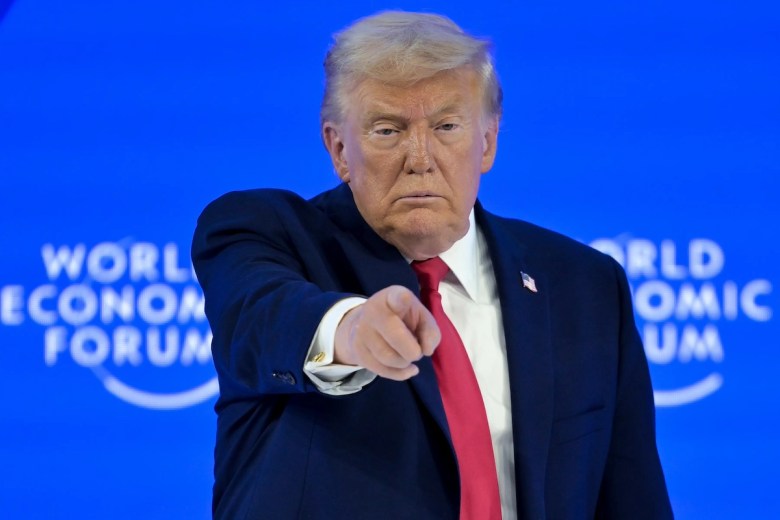
Donald Trump’s remarks at the World Economic Forum in Davos have raised questions about his ambitions for Greenland. During a speech on January 21, 2024, Trump hinted at a desire for the United States to acquire the territory, a move that could jeopardize relationships within NATO and disrupt North Atlantic political and economic ties. While he seemed to dismiss the idea of taking Greenland by force, his comments have prompted international leaders to consider their responses carefully.
Trump framed his interest in Greenland in strategic terms, emphasizing the significance of the Pituffik space base, formerly known as Thule air base. This location is crucial for monitoring Russian and Chinese military activities and serves as an early warning system against missile threats. As tensions in the Arctic increase, with Russia asserting claims to the region and China pursuing its “Polar Silk Road” strategy, Greenland’s geopolitical importance has grown.
In economic terms, the melting ice in Greenland has unveiled substantial deposits of rare earth elements and an estimated 31 billion barrels of oil. These resources are vital for the United States as it seeks to reduce its dependence on China and assert its dominance in mineral and energy sectors. Trump’s speech underscored American energy needs, yet he claimed not to covet Greenland’s mineral wealth.
Trump’s rhetoric suggested that acquiring Greenland would enable him to enhance global security by creating what he termed the “greatest Golden Dome ever built,” a missile defense system intended to protect the world. He stated, “All we’re asking for is to get Greenland, including right, title, and ownership, because you need the ownership to defend it. You can’t defend it on a lease.”
However, Denmark has reiterated that it welcomes a strengthened American military presence in Greenland and that the U.S. can invest in mineral exploration with Denmark’s approval. The reality is that Greenland’s fate cannot be determined without the consent of its 57,000 inhabitants. This situation has led to a perception of a power struggle, reminiscent of the 19th-century imperial contests.
Trump’s senior advisor, Stephen Miller, has echoed a sentiment that power dynamics, rather than international law, dictate global relations. In a recent interview, Trump stated, “I don’t need international law,” indicating a willingness to operate outside established norms. This attitude raises concerns among European leaders about the U.S. potentially becoming more adversarial than cooperative.
European nations find themselves in a complicated position, as their economies and militaries are deeply intertwined with the United States. A separation could have dire repercussions for military and intelligence capabilities, along with access to advanced technology and finance. The implications are particularly acute for the UK post-Brexit, where the realization is dawning that the U.S. might not always serve as a reliable ally.
In a panel discussion at Davos, Belgian Prime Minister Bart De Wever expressed concerns over Trump’s approach, noting the “number of red lines being crossed” and warning that Europe risks losing its dignity in the process. The contrast between Trump’s remarks and those of Canadian Prime Minister Mark Carney, who warned of a “rupture in the world order,” highlighted the growing divide in perspectives on international cooperation.
Carney emphasized that the rules-based order is “fading” and called on the global community to confront the harsh realities of rising great power dominance. This backdrop poses a critical question for NATO partners: should they appease Trump’s ambitions or actively resist them? As the situation unfolds, clarity regarding Trump’s proposed “framework” for Greenland will be crucial in determining the future of transatlantic relations.
The stakes are high, and the decisions made in the coming days and months could have lasting implications for international diplomacy and global stability. As leaders navigate this complex landscape, the world watches closely.

India Unveils Long-Range Hypersonic Missile Amid Regional Tensions

SK bioscience Launches Global Trial for Universal Sarbecovirus Vaccine

Senegal Coach Pape Thiaw Suspended and Fined After Final Disruption

PAS Denies Abolishing Chairman Post, Contradicts Muhyiddin’s Claim

Mbappé Critiques Real Madrid’s Effort After Benfica Defeat

Thailand’s December Factory Output Surges 2.52% Year-on-Year

Ishita Dutta Reveals Her Parenting Secret: Strong Coffee

Older GPs Express Concerns Over New Digital Health Record Mandate

Urban Jurgensen: A 252-Year Legacy Enters a New Era

Regina Martinez Breaks New Ground for Mexico in Cross-Country Skiing

South Korea’s Foreign Minister Cho Hyun to Visit China This Week

Starling Bank Plans Secondary Share Sale, Targeting $5.4 Billion Valuation

Munsang College Celebrates 100 Years with Grand Ceremony

PAS Aims to Expand Parliamentary Influence in Upcoming Election

De Minaur Triumphs at Washington Open After Thrilling Comeback

Kenvue Dismisses CEO Thibaut Mongon as Strategic Review Advances

Humanism Camp Engages 250 Youths in Summer Fest 2025

Colombian Senator Miguel Uribe Shows Signs of Recovery After Attack
-
 Sports2 months ago
Regina Martinez Breaks New Ground for Mexico in Cross-Country Skiing
-
 World6 months ago
South Korea’s Foreign Minister Cho Hyun to Visit China This Week
-
 Business6 months ago
Starling Bank Plans Secondary Share Sale, Targeting $5.4 Billion Valuation
-
 Top Stories6 months ago
Munsang College Celebrates 100 Years with Grand Ceremony
-
 World6 months ago
PAS Aims to Expand Parliamentary Influence in Upcoming Election
-
 Sports8 months ago
De Minaur Triumphs at Washington Open After Thrilling Comeback
-
 Business8 months ago
Kenvue Dismisses CEO Thibaut Mongon as Strategic Review Advances
-
 Lifestyle8 months ago
Humanism Camp Engages 250 Youths in Summer Fest 2025
-
 Top Stories8 months ago
Colombian Senator Miguel Uribe Shows Signs of Recovery After Attack
-

 Sports8 months ago
Tupou and Daugunu Join First Nations Squad for Lions Clash
-
 World8 months ago
ASEAN Gears Up for Historic Joint Meeting of Foreign and Economic Ministers
-

 Health8 months ago
New Study Challenges Assumptions About Aging and Inflammation