
Top Stories
South Korea’s President Navigates Tensions Between China and Japan

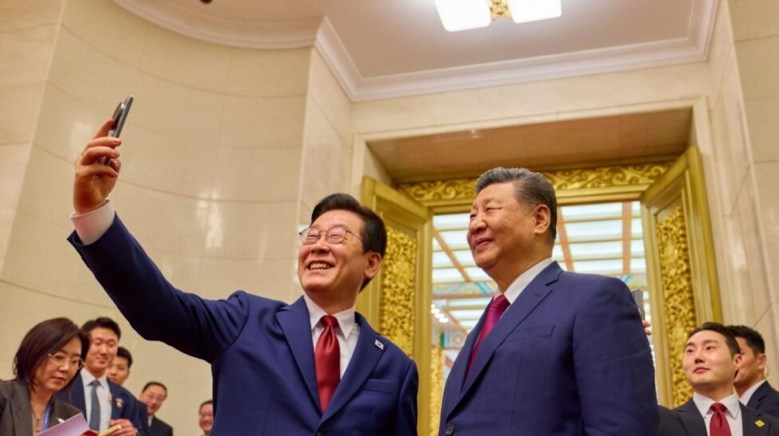
South Korean President Lee Jae Myung is undertaking a significant diplomatic mission as he seeks to strengthen ties with both China and Japan. His journey began with a historic visit to Beijing—the first by a South Korean president since 2019. In the coming week, he is set to meet with Japanese Prime Minister Sanae Takaichi in her hometown of Nara, emphasizing South Korea’s delicate position between two powerful neighbors eager for alignment.
The backdrop of this diplomatic endeavor is marked by increasing global uncertainty. Concerns are rising regarding the influence of the United States under President Donald Trump, particularly as it pertains to its assertive stance in regions like Venezuela. This shift has led many in Northeast Asia to speculate about a world divided into competing spheres of influence. According to Jung E-gil, a senior international affairs writer for the South Korean daily Hankyoreh, the geopolitical landscape is evolving, with the US, China, and Russia potentially reshaping their respective areas of dominance.
Lee’s Diplomatic Balancing Act in China
President Lee’s recent four-day trip to China reflects a broader Chinese initiative to engage with the new South Korean administration. This outreach began with Xi Jinping‘s attendance at the Asia-Pacific Economic Cooperation (APEC) Summit in late 2023. During his visit, Lee was accompanied by approximately 200 business leaders, highlighting the economic focus of these discussions.
However, the Chinese leadership’s messaging was steeped in historical narratives that framed their relationship with South Korea through a shared resistance to Japanese imperialism. As relations with Japan have strained, particularly following Takaichi’s nationalistic comments, Chinese officials have become increasingly wary of her government. They have responded with threats of trade restrictions on sensitive technologies, further complicating the regional dynamics.
Despite the optimistic tone of the visit, Lee’s assertiveness in maintaining South Korea’s policy on Taiwan was notable. He expressed respect for China’s “one China” principle, aligning with China’s historical perspective. Nevertheless, many South Koreans recognize that their nation’s history of resistance to Japanese occupation predates the establishment of the Republic of Korea in 1948.
Prospects for Japan-South Korea Relations
Following his visit to China, President Lee is expected to engage in crucial discussions with Prime Minister Takaichi. The two leaders previously met for a brief but cordial exchange during the APEC conference, where Lee attempted to counter perceptions of being “anti-Japanese” by advocating for a “forward-looking” relationship.
Expectations are high for the upcoming meeting, especially given shared concerns about China’s assertiveness in the region and the unpredictable nature of US foreign policy. Japanese scholar Ayumi Teraoka has noted the necessity for collaboration between Japan and South Korea to maintain regional security, particularly as the US appears to withdraw from multilateral engagements.
Nonetheless, the path to a stronger partnership is fraught with challenges. The historical grievances stemming from wartime actions remain unresolved, and Takaichi’s position on sensitive issues, such as the disputed Dokdo islands, complicates the potential for cooperation. The prime minister’s previous visits to the contentious Yasukuni Shrine and her vocal stance on historical claims indicate a potential for conflict during discussions.
Analysts suggest that the success of Lee’s diplomatic efforts hinges on navigating these sensitive topics. Moon Chung-in, a foreign policy scholar, posits that the meeting in Nara on January 13, 2024, could yield positive outcomes if Takaichi refrains from provocative comments regarding historical disputes.
Despite the optimism surrounding the meeting, the underlying issues of compensation for forced labor during Japan’s colonial rule remain unresolved. South Korean progressives argue that focusing solely on strategic cooperation without addressing these historical grievances is insufficient. The progressive daily Kyunghyang Shinmun emphasized that both nations must confront these challenges for any lasting resolution.
As President Lee navigates this complex diplomatic landscape, the outcomes of his engagements with both China and Japan will have lasting implications for South Korea’s foreign relations. Former US Ambassador to Korea Kathleen Stephens remarked on the skillful navigation of summit diplomacy, but cautioned that the real challenges will emerge as difficult choices must be made in the future.

India Unveils Long-Range Hypersonic Missile Amid Regional Tensions

SK bioscience Launches Global Trial for Universal Sarbecovirus Vaccine

Senegal Coach Pape Thiaw Suspended and Fined After Final Disruption

PAS Denies Abolishing Chairman Post, Contradicts Muhyiddin’s Claim

Mbappé Critiques Real Madrid’s Effort After Benfica Defeat

Thailand’s December Factory Output Surges 2.52% Year-on-Year

Ishita Dutta Reveals Her Parenting Secret: Strong Coffee

Older GPs Express Concerns Over New Digital Health Record Mandate

Urban Jurgensen: A 252-Year Legacy Enters a New Era

South Korea’s Foreign Minister Cho Hyun to Visit China This Week

Starling Bank Plans Secondary Share Sale, Targeting $5.4 Billion Valuation

Munsang College Celebrates 100 Years with Grand Ceremony

PAS Aims to Expand Parliamentary Influence in Upcoming Election

Kenvue Dismisses CEO Thibaut Mongon as Strategic Review Advances

Humanism Camp Engages 250 Youths in Summer Fest 2025

De Minaur Triumphs at Washington Open After Thrilling Comeback

Tupou and Daugunu Join First Nations Squad for Lions Clash

Colombian Senator Miguel Uribe Shows Signs of Recovery After Attack
-
 World5 months ago
South Korea’s Foreign Minister Cho Hyun to Visit China This Week
-
 Business5 months ago
Starling Bank Plans Secondary Share Sale, Targeting $5.4 Billion Valuation
-
 Top Stories5 months ago
Munsang College Celebrates 100 Years with Grand Ceremony
-
 World5 months ago
PAS Aims to Expand Parliamentary Influence in Upcoming Election
-
 Business7 months ago
Kenvue Dismisses CEO Thibaut Mongon as Strategic Review Advances
-
 Lifestyle6 months ago
Humanism Camp Engages 250 Youths in Summer Fest 2025
-
 Sports6 months ago
De Minaur Triumphs at Washington Open After Thrilling Comeback
-
 Sports7 months ago
Tupou and Daugunu Join First Nations Squad for Lions Clash
-
 Top Stories7 months ago
Colombian Senator Miguel Uribe Shows Signs of Recovery After Attack
-
 World7 months ago
ASEAN Gears Up for Historic Joint Meeting of Foreign and Economic Ministers
-

 Health6 months ago
New Study Challenges Assumptions About Aging and Inflammation
-

 Business7 months ago
Oil Prices Surge Following New EU Sanctions on Russia