
Top Stories
Singapore’s Construction Surge Faces Storage Challenges

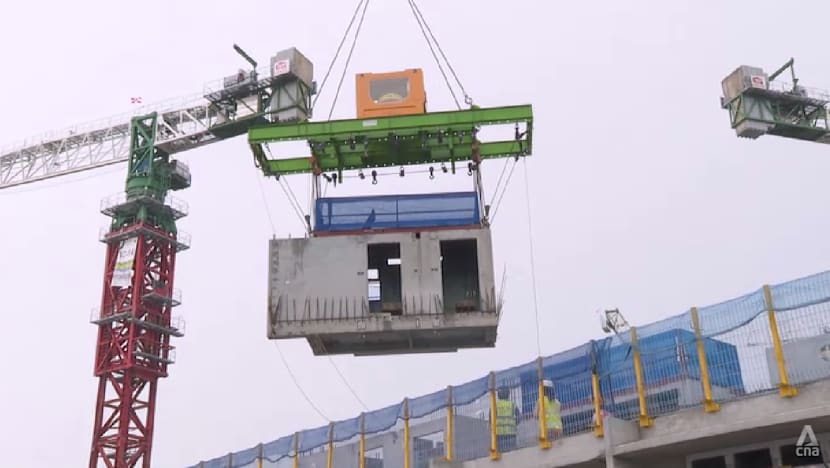
Singapore’s ongoing construction boom has led to a significant challenge for manufacturers of large prefabricated components. Limited storage space is hampering production and jeopardizing project timelines, as companies struggle to manage the growing demand for these essential building blocks.
Prefabricated components, some measuring up to 10 meters in length, are crucial for constructing homes and offices. The sheer size of these units makes storage a critical issue. In response to this challenge, Jurong Port is set to introduce shared, pay-per-use storage options at its upcoming Integrated Construction and Prefabrication Hub (ICPH), which will be the seventh of its kind in Singapore. This facility will host advanced factories designed to automate the production of building components.
Addressing Storage Constraints
For companies like Jin Cheng, the increase in demand has more than doubled output compared to pre-COVID-19 levels. However, the firm faces difficulties, not due to productivity issues, but because of the overwhelming demand combined with logistical challenges. Peng Guangzheng, executive director of Jin Cheng, noted that project schedules frequently shift due to various delays. This overlap often results in production demands exceeding available storage space. “This is happening in the market. (It’s) very common,” he stated.
Delays can create a domino effect, causing components to require longer storage, which further complicates production timelines. To counteract this issue, Jin Cheng plans to move into the new facility at Jurong Port upon its expected completion in 2027. Terence Seow, CEO of Jurong Port, emphasized the advantages of the new space: “The good thing is that the port has quite a large surface area to operate with. If they need surge storage capacity, we’re always ready to provide.”
Coordination Challenges Persist
While storage solutions are essential, industry analysts stress that improved coordination is equally critical. David Ng, chair of the Institution of Engineers Singapore‘s civil and structural engineering technical committee, pointed out that the underlying issue stems from inadequate communication between construction-site schedules and precasting production. Delays at construction sites often mean precast units cannot be received on time. This lack of communication can lead precasters to continue production without knowing that sites are unprepared for delivery.
“We need to streamline the planning and the programming of site installation and the precasting production in a seamless way,” Ng advised, advocating for closer collaboration between both sectors.
He suggested that leveraging artificial intelligence could help firms anticipate delays and better synchronize production timelines. Meanwhile, the Building and Construction Authority (BCA) is actively engaging with the industry to explore more effective, long-term storage solutions.
Looking ahead, construction demand in Singapore is projected to remain strong. The BCA estimates that total construction demand will reach an average of between S$39 billion and S$46 billion annually from 2026 to 2029. As the industry adapts, addressing these storage and coordination challenges will be vital for maintaining the momentum of Singapore’s construction sector.

India Unveils Long-Range Hypersonic Missile Amid Regional Tensions

SK bioscience Launches Global Trial for Universal Sarbecovirus Vaccine

Senegal Coach Pape Thiaw Suspended and Fined After Final Disruption

PAS Denies Abolishing Chairman Post, Contradicts Muhyiddin’s Claim

Mbappé Critiques Real Madrid’s Effort After Benfica Defeat

Thailand’s December Factory Output Surges 2.52% Year-on-Year

Ishita Dutta Reveals Her Parenting Secret: Strong Coffee

Older GPs Express Concerns Over New Digital Health Record Mandate

Urban Jurgensen: A 252-Year Legacy Enters a New Era

Regina Martinez Breaks New Ground for Mexico in Cross-Country Skiing

South Korea’s Foreign Minister Cho Hyun to Visit China This Week

Starling Bank Plans Secondary Share Sale, Targeting $5.4 Billion Valuation

Munsang College Celebrates 100 Years with Grand Ceremony

PAS Aims to Expand Parliamentary Influence in Upcoming Election

De Minaur Triumphs at Washington Open After Thrilling Comeback

Kenvue Dismisses CEO Thibaut Mongon as Strategic Review Advances

Humanism Camp Engages 250 Youths in Summer Fest 2025

Colombian Senator Miguel Uribe Shows Signs of Recovery After Attack
-
 Sports3 months ago
Regina Martinez Breaks New Ground for Mexico in Cross-Country Skiing
-
 World7 months ago
South Korea’s Foreign Minister Cho Hyun to Visit China This Week
-
 Business7 months ago
Starling Bank Plans Secondary Share Sale, Targeting $5.4 Billion Valuation
-
 Top Stories7 months ago
Munsang College Celebrates 100 Years with Grand Ceremony
-
 World7 months ago
PAS Aims to Expand Parliamentary Influence in Upcoming Election
-
 Sports8 months ago
De Minaur Triumphs at Washington Open After Thrilling Comeback
-
 Business9 months ago
Kenvue Dismisses CEO Thibaut Mongon as Strategic Review Advances
-
 Lifestyle8 months ago
Humanism Camp Engages 250 Youths in Summer Fest 2025
-
 Top Stories9 months ago
Colombian Senator Miguel Uribe Shows Signs of Recovery After Attack
-

 Sports9 months ago
Tupou and Daugunu Join First Nations Squad for Lions Clash
-
 World9 months ago
ASEAN Gears Up for Historic Joint Meeting of Foreign and Economic Ministers
-

 Health8 months ago
New Study Challenges Assumptions About Aging and Inflammation