
Science
Taiwan Institute Unveils Disease-Resistant Banana Variety to Transform Market

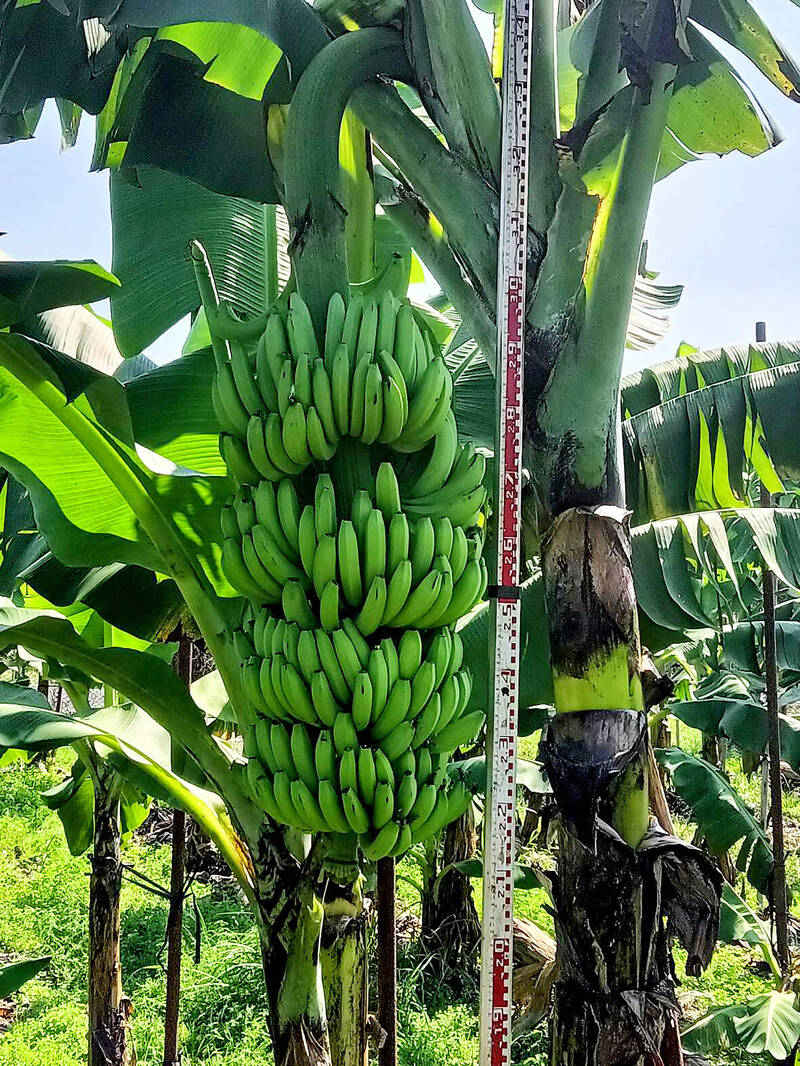
The Taiwan Banana Research Institute has introduced a new banana variety, known as Tai-Chiao No. 9 (TC9), engineered to resist Panama disease, a significant threat to global banana production. This development is expected to significantly impact the banana supply chain worldwide, providing a new avenue for growers facing crop loss due to this devastating disease.
Bananas hold immense economic value globally, and the emergence of TC9 is being hailed by experts as a vital step toward safeguarding banana cultivation. Researchers from Academia Sinica’s Agricultural Biotechnology Research Center, led by associate researcher Chen Ho-ming, collaborated with the institute and National Taiwan University to uncover the genetic basis for the increased resilience of Taiwanese bananas against Panama disease.
Through their research, the team discovered that the deletion of specific chromosomal segments in the banana genome markedly enhances resistance to Panama disease. This knowledge allowed for the cultivation of TC9, which is poised to enter the global market in the near future.
Established by the Ministry of Agriculture, the Taiwan Banana Research Institute is a leading entity in banana research. It has previously developed varieties capable of resisting tropical race 4 (TR4), a particularly aggressive strain of Panama disease. According to Chiu Chu-ying, the institute’s director, the link between TR4 and Panama disease was first identified in 1967 by NTU professor Su Hong-ji. His pioneering work laid the foundation for decades of research in tissue culture and seedling propagation aimed at developing disease-resistant bananas.
Over the years, the institute has screened numerous banana seedlings for disease resistance, successfully identifying varieties such as Tai-Chiao No. 4, Tai-Chiao No. 5, and Tai-Chiao No. 7. Chen began his collaboration with the institute a decade ago, focusing on genomic analysis to pinpoint the differences between resistant and susceptible banana varieties. His research revealed that the structural variations in chromosomes are critical for disease resistance, providing actionable targets for future breeding programs.
The findings from this research have been published in the respected journal, Proceedings of the National Academy of Sciences of the United States of America. While Chen is currently analyzing the molecular markers of TC9, he has not disclosed specific details due to the significant commercial interests involved. The Ministry of Agriculture has applied for plant breeders’ rights for this new variety.
Bananas, predominantly the Williams variety, are widely cultivated in the Philippines and Latin America but are highly susceptible to Panama disease. TC9, developed from the Williams variety, exhibits at least a 70 percent resistance to this disease, according to Chiu.
Although TC9 has received approval for plant breeders’ rights in Taiwan, the institute must secure similar rights in other countries before it can export seedlings. Chiu expressed concerns about the risk of technical leakage, given that bananas reproduce asexually. The potential for theft of the new variety’s sprouts remains a pressing issue as the institute prepares for international distribution.
As the demand for resilient crops grows amid ongoing agricultural challenges, TC9 could represent a crucial advancement in banana cultivation, offering hope to farmers and consumers alike in the battle against Panama disease.

India Unveils Long-Range Hypersonic Missile Amid Regional Tensions

SK bioscience Launches Global Trial for Universal Sarbecovirus Vaccine

Senegal Coach Pape Thiaw Suspended and Fined After Final Disruption

PAS Denies Abolishing Chairman Post, Contradicts Muhyiddin’s Claim

Mbappé Critiques Real Madrid’s Effort After Benfica Defeat

Thailand’s December Factory Output Surges 2.52% Year-on-Year

Ishita Dutta Reveals Her Parenting Secret: Strong Coffee

Older GPs Express Concerns Over New Digital Health Record Mandate

Urban Jurgensen: A 252-Year Legacy Enters a New Era

Regina Martinez Breaks New Ground for Mexico in Cross-Country Skiing

South Korea’s Foreign Minister Cho Hyun to Visit China This Week

Starling Bank Plans Secondary Share Sale, Targeting $5.4 Billion Valuation

Munsang College Celebrates 100 Years with Grand Ceremony

PAS Aims to Expand Parliamentary Influence in Upcoming Election

De Minaur Triumphs at Washington Open After Thrilling Comeback

Kenvue Dismisses CEO Thibaut Mongon as Strategic Review Advances

Humanism Camp Engages 250 Youths in Summer Fest 2025

Colombian Senator Miguel Uribe Shows Signs of Recovery After Attack
-
 Sports2 months ago
Regina Martinez Breaks New Ground for Mexico in Cross-Country Skiing
-
 World6 months ago
South Korea’s Foreign Minister Cho Hyun to Visit China This Week
-
 Business7 months ago
Starling Bank Plans Secondary Share Sale, Targeting $5.4 Billion Valuation
-
 Top Stories7 months ago
Munsang College Celebrates 100 Years with Grand Ceremony
-
 World6 months ago
PAS Aims to Expand Parliamentary Influence in Upcoming Election
-
 Sports8 months ago
De Minaur Triumphs at Washington Open After Thrilling Comeback
-
 Business8 months ago
Kenvue Dismisses CEO Thibaut Mongon as Strategic Review Advances
-
 Lifestyle8 months ago
Humanism Camp Engages 250 Youths in Summer Fest 2025
-
 Top Stories8 months ago
Colombian Senator Miguel Uribe Shows Signs of Recovery After Attack
-

 Sports8 months ago
Tupou and Daugunu Join First Nations Squad for Lions Clash
-

 World8 months ago
ASEAN Gears Up for Historic Joint Meeting of Foreign and Economic Ministers
-

 Health8 months ago
New Study Challenges Assumptions About Aging and Inflammation