
Science
Researchers Unlock Hibernation Secrets to Transform Human Health

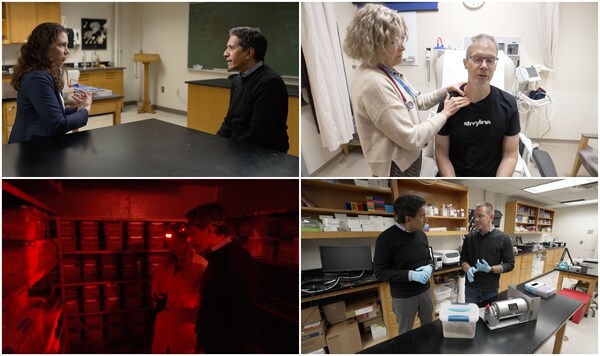
In a stunning exploration of the potential benefits of hibernation, CNN’s series Vital Signs has unveiled how researchers are “cracking the code on the genome” of hibernating animals. The latest episode, airing on November 29, 2025, showcases groundbreaking research that could revolutionize human health, with implications for treating diseases such as cancer and heart disease, as well as enhancing space travel capabilities.
Global Research Initiatives
Guided by Dr. Sanjay Gupta, CNN’s Chief Medical Correspondent, the episode takes viewers on a global journey, highlighting innovative work being conducted by various teams. One notable stop is the University of Utah, where Professor of Neurobiology Chris Gregg is investigating the genetic connections between hibernation and cancer. Motivated by his personal experience with stage 4 male breast cancer, Gregg, alongside colleagues Alana Welm and K-T Varley at the Huntsman Cancer Institute, aims to uncover why cancer growth halts during the hibernation process. Their research focuses on dormant cancer cells, seeking to answer critical questions about their dormancy and reactivation.
The exploration continues at Fauna Bio, a biotechnology firm studying the remarkable 13-lined ground squirrel, often referred to as the “Usain Bolt of hibernators.” These squirrels endure numerous “mini heart attacks or strokes” during their six-month hibernation yet can fully repair any resulting damage. The company has developed an artificial intelligence platform that compares genetic information from hibernators and humans, identifying potential compounds and genes that may protect human heart cells. Their work has already advanced to preclinical safety trials for a drug targeting heart failure.
Pioneering Research in Japan and the U.S.
The episode also features the RIKEN Laboratory for Hibernation Biology in Kobe, Japan, where Dr. Genshiro Sunagawa and his team have made significant strides in inducing a torpor-like state in non-hibernating mice. Their pioneering research from 2020 involved activating specific “Q neurons” in the brain, marking a potential breakthrough in human medicine. Dr. Sunagawa envisions a future where induced hibernation could transform emergency medicine, allowing safer patient transport, minimizing the need for general anaesthesia during surgeries, and extending the viability of organs for transplant.
Additionally, researchers from the University of Pittsburgh, in collaboration with NASA, have successfully induced a torpor-like state in human participants for up to 20 hours using an FDA-approved sedative. Participants experienced reduced metabolic rates while still being able to perform complex tasks, suggesting practical applications for human hibernation in the near future.
Overall, this episode of Vital Signs highlights the profound lessons that can be learned from hibernating animals and their potential to pave the way for a healthier and more adaptable human future. As the research progresses, it may not only provide insights into combating diseases on Earth but also unlock new possibilities for long-duration human space travel.
For further details, viewers can catch the episode on CNN channels at the scheduled airtimes: November 29 at 14:30 and 19:30 HKT, and November 30 at 02:30 and 12:00 HKT.

India Unveils Long-Range Hypersonic Missile Amid Regional Tensions

SK bioscience Launches Global Trial for Universal Sarbecovirus Vaccine

Senegal Coach Pape Thiaw Suspended and Fined After Final Disruption

PAS Denies Abolishing Chairman Post, Contradicts Muhyiddin’s Claim

Mbappé Critiques Real Madrid’s Effort After Benfica Defeat

Thailand’s December Factory Output Surges 2.52% Year-on-Year

Ishita Dutta Reveals Her Parenting Secret: Strong Coffee

Older GPs Express Concerns Over New Digital Health Record Mandate

Urban Jurgensen: A 252-Year Legacy Enters a New Era

Regina Martinez Breaks New Ground for Mexico in Cross-Country Skiing

South Korea’s Foreign Minister Cho Hyun to Visit China This Week

Starling Bank Plans Secondary Share Sale, Targeting $5.4 Billion Valuation

Munsang College Celebrates 100 Years with Grand Ceremony

PAS Aims to Expand Parliamentary Influence in Upcoming Election

De Minaur Triumphs at Washington Open After Thrilling Comeback

Kenvue Dismisses CEO Thibaut Mongon as Strategic Review Advances

Humanism Camp Engages 250 Youths in Summer Fest 2025

Colombian Senator Miguel Uribe Shows Signs of Recovery After Attack
-
 Sports1 month ago
Regina Martinez Breaks New Ground for Mexico in Cross-Country Skiing
-
 World6 months ago
South Korea’s Foreign Minister Cho Hyun to Visit China This Week
-
 Business6 months ago
Starling Bank Plans Secondary Share Sale, Targeting $5.4 Billion Valuation
-
 Top Stories6 months ago
Munsang College Celebrates 100 Years with Grand Ceremony
-
 World6 months ago
PAS Aims to Expand Parliamentary Influence in Upcoming Election
-
 Sports7 months ago
De Minaur Triumphs at Washington Open After Thrilling Comeback
-
 Business8 months ago
Kenvue Dismisses CEO Thibaut Mongon as Strategic Review Advances
-
 Lifestyle7 months ago
Humanism Camp Engages 250 Youths in Summer Fest 2025
-
 Top Stories8 months ago
Colombian Senator Miguel Uribe Shows Signs of Recovery After Attack
-

 Sports8 months ago
Tupou and Daugunu Join First Nations Squad for Lions Clash
-
 World8 months ago
ASEAN Gears Up for Historic Joint Meeting of Foreign and Economic Ministers
-
 Health7 months ago
New Study Challenges Assumptions About Aging and Inflammation