
Science
NMCG Approves Major Research Projects for River Management

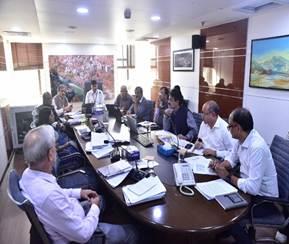
The 67th Executive Committee meeting of the National Mission for Clean Ganga (NMCG) took place on November 17, 2025, in Delhi, focusing on critical initiatives aimed at rejuvenating the Ganga River. Chaired by Director General Shri Rajeev Kumar Mital, the committee approved several major research projects to enhance scientific river management and pollution abatement strategies.
One of the key priorities discussed was the improvement of the Yamuna River’s health in Delhi. The committee emphasized the need for safe and efficient conveyance of treated sewage to this vital waterway. Additionally, educational outreach efforts targeting school children in Delhi were highlighted as essential to raise awareness about river conservation.
In a move reflecting its commitment to evidence-based policy-making, the Executive Committee approved a series of research-led initiatives. This includes monitoring critical Himalayan glaciers, developing a Digital Twin for the Ganga, and conducting high-resolution SONAR-based riverbed surveys. These projects aim to integrate advanced scientific tools and real-time hydrological modelling into comprehensive river basin management strategies.
Major Investments in River Rejuvenation
The NMCG’s approvals demonstrate a substantial financial commitment, with significant investments aimed at pollution abatement and sustainable practices. Among the largest initiatives is the project for the Interception and Diversion of drains and the construction of sewage treatment plants (STPs) for the River Mahananda in Siliguri, amounting to INR 1361.86 crore. This project will include 25 interception and diversion structures, four lifting stations, and two STPs with capacities of 27 million litres per day (MLD) and 22 MLD, all designed to mitigate pollution entering the river.
The committee also sanctioned the conveyance of treated sewage from the Coronation Pillar STP to the River Yamuna. This initiative aims to enhance the water quality of the Yamuna, supporting the ongoing efforts of the Yamuna Action Plan. Key components of this project involve tapping untreated sewage from the Jahangirpuri drain and constructing new pumping stations, along with a network of rising mains and RCC channels for effective conveyance.
Another significant project approved is the study on glaciers and their runoff impacts in the Upper Ganga Basin, with a budget of INR 3.98 crore. This initiative, managed by the National Institute of Hydrology, Roorkee, will assess the effects of glacier retreat and changing snow cover on melt-runoff patterns. Employing field observations and remote sensing, the aim is to identify associated risks, including flash floods and glacial lake outburst floods (GLOFs).
The Executive Committee further approved a SONAR-based bathymetric survey of the Ganga River, covering a distance of 1,100 km from Bijnor to Ballia. This project, estimated at over INR 3 crore, will create a high-resolution underwater topographic baseline to aid in sediment management and environmental flow assessments under the Namami Gange programme.
Innovative Approaches to Water Management
In addition to these projects, the NMCG greenlit a proposal aimed at Managed Aquifer Recharge (MAR) in the Ganga-Yamuna Doab, with a total budget of INR 242.56 lakh. This initiative seeks to identify government land sites for constructing scientifically designed recharge structures, which will bolster groundwater levels along the paleochannel between Kaushambi and Kanpur.
Another innovative approach involves the development of a Digital Twin and Water Cycle Atlas for the Ganga Basin, estimated at INR 3.31 crore. This project aims to leverage artificial intelligence, satellite remote sensing, and hydrological modelling for real-time river basin management, enhancing decision-making processes.
The committee also approved the digitization of historical maps of the Ganga Basin, with an investment of INR 2.62 crore. This project includes creating a GIS-based database and a secure geo-portal to analyze river morphology and floodplain changes over time.
Additionally, the initiative titled “Youth for Ganga, Youth for Yamuna” received funding of INR 39.37 lakh. This program aims to engage over 250,000 youth across at least 200 schools in the Delhi-NCR region, promoting awareness and responsibility towards river conservation through the formation of River Youth Clubs.
Through these strategic approvals, the NMCG is paving the way for enhanced water management, improved monitoring systems, and strengthened scientific capabilities crucial for the rejuvenation of the Ganga and its tributaries. As these projects unfold, they are expected to play a significant role in mitigating pollution, ensuring groundwater security, and fostering a sustainable future for India’s river ecosystems.

India Unveils Long-Range Hypersonic Missile Amid Regional Tensions

SK bioscience Launches Global Trial for Universal Sarbecovirus Vaccine

Senegal Coach Pape Thiaw Suspended and Fined After Final Disruption

PAS Denies Abolishing Chairman Post, Contradicts Muhyiddin’s Claim

Mbappé Critiques Real Madrid’s Effort After Benfica Defeat

Thailand’s December Factory Output Surges 2.52% Year-on-Year

Ishita Dutta Reveals Her Parenting Secret: Strong Coffee

Older GPs Express Concerns Over New Digital Health Record Mandate

Urban Jurgensen: A 252-Year Legacy Enters a New Era

Regina Martinez Breaks New Ground for Mexico in Cross-Country Skiing

South Korea’s Foreign Minister Cho Hyun to Visit China This Week

Starling Bank Plans Secondary Share Sale, Targeting $5.4 Billion Valuation

Munsang College Celebrates 100 Years with Grand Ceremony

PAS Aims to Expand Parliamentary Influence in Upcoming Election

De Minaur Triumphs at Washington Open After Thrilling Comeback

Kenvue Dismisses CEO Thibaut Mongon as Strategic Review Advances

Humanism Camp Engages 250 Youths in Summer Fest 2025

Colombian Senator Miguel Uribe Shows Signs of Recovery After Attack
-
 Sports2 months ago
Regina Martinez Breaks New Ground for Mexico in Cross-Country Skiing
-
 World6 months ago
South Korea’s Foreign Minister Cho Hyun to Visit China This Week
-
 Business7 months ago
Starling Bank Plans Secondary Share Sale, Targeting $5.4 Billion Valuation
-
 Top Stories6 months ago
Munsang College Celebrates 100 Years with Grand Ceremony
-
 World6 months ago
PAS Aims to Expand Parliamentary Influence in Upcoming Election
-
 Sports8 months ago
De Minaur Triumphs at Washington Open After Thrilling Comeback
-
 Business8 months ago
Kenvue Dismisses CEO Thibaut Mongon as Strategic Review Advances
-
 Lifestyle8 months ago
Humanism Camp Engages 250 Youths in Summer Fest 2025
-
 Top Stories8 months ago
Colombian Senator Miguel Uribe Shows Signs of Recovery After Attack
-

 Sports8 months ago
Tupou and Daugunu Join First Nations Squad for Lions Clash
-
 World8 months ago
ASEAN Gears Up for Historic Joint Meeting of Foreign and Economic Ministers
-

 Health8 months ago
New Study Challenges Assumptions About Aging and Inflammation