
Science
New Study Reveals Potential Asymmetry in Universe’s Shape

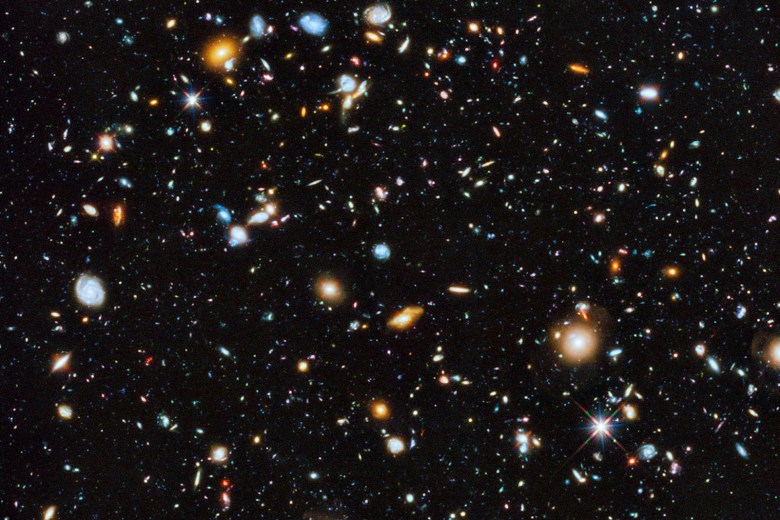
A recent study led by researchers at the University of Oxford suggests that the universe may not be as uniform as previously thought. The findings indicate the possibility of an asymmetric or lopsided structure, challenging the widely accepted “standard cosmological model,” known as the Lambda-CDM model. This model is built on the assumption that the universe is isotropic and homogeneous, meaning it appears the same in all directions and when averaged over large scales.
The study highlights significant discrepancies in cosmological data, specifically addressing a phenomenon known as the cosmic dipole anomaly. This anomaly poses a serious threat to our current understanding of the cosmos, prompting questions about the fundamental nature of the universe itself.
Understanding the Cosmic Dipole Anomaly
To grasp the implications of the cosmic dipole anomaly, it is essential to consider the cosmic microwave background (CMB). This relic radiation from the Big Bang is remarkably uniform across the sky, differing by only one part in a hundred thousand. Cosmologists typically rely on this uniformity to model the universe using Einstein’s theory of general relativity, particularly the FLRW description, which assumes a symmetric universe.
Despite this symmetry, the study draws attention to several anomalies, including the Hubble tension. Discovered in the late 2000s, this tension arises from conflicting measurements of the universe’s expansion rate, derived from data collected by the Hubble Space Telescope and the Gaia satellite. While the Hubble tension has garnered significant attention, the cosmic dipole anomaly is arguably more critical to our cosmological understanding.
The CMB exhibits a phenomenon known as CMB dipole anisotropy, where there is a temperature variation across the sky, with one side approximately one part in a thousand hotter than the other. While this variation does not directly challenge the Lambda-CDM model, it raises expectations for corresponding variations in other astronomical datasets.
In 1984, astronomers George Ellis and John Baldwin proposed a test to assess whether similar variations exist in the distribution of distant astronomical sources, such as radio galaxies and quasars. Their hypothesis, known as the Ellis-Baldwin test, suggests that if the universe is indeed symmetric, the temperature variation observed in the CMB should correlate with the distribution of these distant sources.
Data Insights and Future Implications
Recent data has revealed that the universe fails the Ellis-Baldwin test, as the variations in matter do not align with those observed in the CMB. This disconnect poses a profound challenge to the Lambda-CDM model and the FLRW description. Importantly, the consistency of the results from both terrestrial radio telescopes and mid-infrared satellite observations lends further credibility to these findings.
Despite the significance of the cosmic dipole anomaly, it has largely been overlooked within the astronomical community. This may stem from the complexity of addressing the issue, as resolving it would require not only abandoning the Lambda-CDM model but also rethinking the FLRW framework altogether.
The landscape of cosmology may soon shift with an influx of data from upcoming missions, including the Euclid and SPHEREx satellites, as well as the Vera Rubin Observatory and the Square Kilometre Array. These advancements could lead to groundbreaking insights, potentially facilitated by emerging artificial intelligence technologies, particularly in the realm of machine learning.
Such developments promise to have a significant impact on fundamental physics and our overall understanding of the universe. As researchers continue to explore these anomalies, the pursuit of a more accurate cosmological model may reshape our comprehension of the cosmos itself.

India Unveils Long-Range Hypersonic Missile Amid Regional Tensions

SK bioscience Launches Global Trial for Universal Sarbecovirus Vaccine

Senegal Coach Pape Thiaw Suspended and Fined After Final Disruption

PAS Denies Abolishing Chairman Post, Contradicts Muhyiddin’s Claim

Mbappé Critiques Real Madrid’s Effort After Benfica Defeat

Thailand’s December Factory Output Surges 2.52% Year-on-Year

Ishita Dutta Reveals Her Parenting Secret: Strong Coffee

Older GPs Express Concerns Over New Digital Health Record Mandate

Urban Jurgensen: A 252-Year Legacy Enters a New Era

Regina Martinez Breaks New Ground for Mexico in Cross-Country Skiing

South Korea’s Foreign Minister Cho Hyun to Visit China This Week

Starling Bank Plans Secondary Share Sale, Targeting $5.4 Billion Valuation

Munsang College Celebrates 100 Years with Grand Ceremony

PAS Aims to Expand Parliamentary Influence in Upcoming Election

De Minaur Triumphs at Washington Open After Thrilling Comeback

Kenvue Dismisses CEO Thibaut Mongon as Strategic Review Advances

Humanism Camp Engages 250 Youths in Summer Fest 2025

Colombian Senator Miguel Uribe Shows Signs of Recovery After Attack
-
 Sports2 months ago
Regina Martinez Breaks New Ground for Mexico in Cross-Country Skiing
-
 World6 months ago
South Korea’s Foreign Minister Cho Hyun to Visit China This Week
-
 Business6 months ago
Starling Bank Plans Secondary Share Sale, Targeting $5.4 Billion Valuation
-
 Top Stories6 months ago
Munsang College Celebrates 100 Years with Grand Ceremony
-
 World6 months ago
PAS Aims to Expand Parliamentary Influence in Upcoming Election
-
 Sports8 months ago
De Minaur Triumphs at Washington Open After Thrilling Comeback
-
 Business8 months ago
Kenvue Dismisses CEO Thibaut Mongon as Strategic Review Advances
-
 Lifestyle8 months ago
Humanism Camp Engages 250 Youths in Summer Fest 2025
-
 Top Stories8 months ago
Colombian Senator Miguel Uribe Shows Signs of Recovery After Attack
-

 Sports8 months ago
Tupou and Daugunu Join First Nations Squad for Lions Clash
-

 World8 months ago
ASEAN Gears Up for Historic Joint Meeting of Foreign and Economic Ministers
-

 Health8 months ago
New Study Challenges Assumptions About Aging and Inflammation