
Science
JNCASR and Dreamfly Innovations Collaborate on Aviation Battery Materials

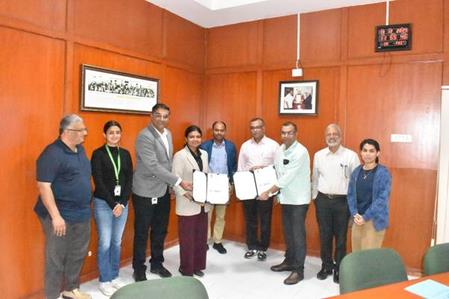
The Jawaharlal Nehru Centre for Advanced Scientific Research (JNCASR) has entered into a partnership with Dreamfly Innovations, a Bengaluru-based company, to develop advanced thermal materials aimed at enhancing aviation batteries. This collaboration, formalized through a Memorandum of Understanding (MoU) on January 24, 2024, seeks to address significant thermal management challenges in high-energy-density lithium-based batteries used in the aviation sector.
Under this initiative, the two organizations will focus on developing advanced thermal materials and thermoelectric devices that improve thermal management for aviation batteries. Effective heat management is critical in aviation, as excessive heat generation during high-power operations can lead to decreased efficiency, reduced battery lifespan, and increased safety risks.
The partnership brings together the expertise of JNCASR in materials design, synthesis, advanced characterization, and thermal transport measurements with Dreamfly Innovations’ capabilities in aviation battery engineering and system-level integration. According to the Ministry of Science and Technology, this joint effort aims to transform fundamental materials research into deployable thermal technologies suitable for real-world aviation applications.
Addressing Thermal Management Challenges
One of the core issues in aviation batteries is the challenge of managing heat effectively. Conventional passive thermal management strategies, such as Phase Change Materials (PCMs), offer advantages like low weight and zero power consumption. However, their adoption has been limited due to low thermal conductivity, which hinders their ability to absorb heat rapidly. Consequently, this inefficiency leads to a rise in temperature and accelerates the degradation of battery components.
To overcome these limitations, the collaboration plans to engineer advanced thermal materials with high thermal conductivity. These materials will be designed to quickly absorb excess heat during high-load operations, thereby maintaining optimal battery temperatures. The goal is to achieve lightweight thermal regulation while ensuring long-term stability, addressing common issues such as additive agglomeration that can occur during repeated thermal cycling.
A Focus on Innovation
This partnership highlights a significant step forward in addressing critical challenges related to drone performance, safety, and operational endurance. By leveraging the academic research expertise of Prof. Kanishka Biswas at JNCASR, alongside the industrial innovation of Dreamfly, the collaboration aims to push the boundaries of what is possible in aviation battery technology.
As the aviation industry continues to evolve, advancements in thermal management will play a crucial role in enhancing battery performance, ultimately leading to safer and more efficient aerial operations. This collaboration exemplifies the potential of combining academic research with industry innovation to solve pressing technological challenges.

India Unveils Long-Range Hypersonic Missile Amid Regional Tensions

SK bioscience Launches Global Trial for Universal Sarbecovirus Vaccine

Senegal Coach Pape Thiaw Suspended and Fined After Final Disruption

PAS Denies Abolishing Chairman Post, Contradicts Muhyiddin’s Claim

Mbappé Critiques Real Madrid’s Effort After Benfica Defeat

Thailand’s December Factory Output Surges 2.52% Year-on-Year

Ishita Dutta Reveals Her Parenting Secret: Strong Coffee

Older GPs Express Concerns Over New Digital Health Record Mandate

Urban Jurgensen: A 252-Year Legacy Enters a New Era

Regina Martinez Breaks New Ground for Mexico in Cross-Country Skiing

South Korea’s Foreign Minister Cho Hyun to Visit China This Week

Starling Bank Plans Secondary Share Sale, Targeting $5.4 Billion Valuation

Munsang College Celebrates 100 Years with Grand Ceremony

PAS Aims to Expand Parliamentary Influence in Upcoming Election

De Minaur Triumphs at Washington Open After Thrilling Comeback

Kenvue Dismisses CEO Thibaut Mongon as Strategic Review Advances

Humanism Camp Engages 250 Youths in Summer Fest 2025

Colombian Senator Miguel Uribe Shows Signs of Recovery After Attack
-
 Sports2 months ago
Regina Martinez Breaks New Ground for Mexico in Cross-Country Skiing
-
 World6 months ago
South Korea’s Foreign Minister Cho Hyun to Visit China This Week
-
 Business6 months ago
Starling Bank Plans Secondary Share Sale, Targeting $5.4 Billion Valuation
-
 Top Stories6 months ago
Munsang College Celebrates 100 Years with Grand Ceremony
-
 World6 months ago
PAS Aims to Expand Parliamentary Influence in Upcoming Election
-
 Sports8 months ago
De Minaur Triumphs at Washington Open After Thrilling Comeback
-
 Business8 months ago
Kenvue Dismisses CEO Thibaut Mongon as Strategic Review Advances
-
 Lifestyle8 months ago
Humanism Camp Engages 250 Youths in Summer Fest 2025
-
 Top Stories8 months ago
Colombian Senator Miguel Uribe Shows Signs of Recovery After Attack
-

 Sports8 months ago
Tupou and Daugunu Join First Nations Squad for Lions Clash
-

 World8 months ago
ASEAN Gears Up for Historic Joint Meeting of Foreign and Economic Ministers
-

 Health8 months ago
New Study Challenges Assumptions About Aging and Inflammation