
Politics
Vietnam’s To Lam Reassumes Power, Promises Economic Overhaul

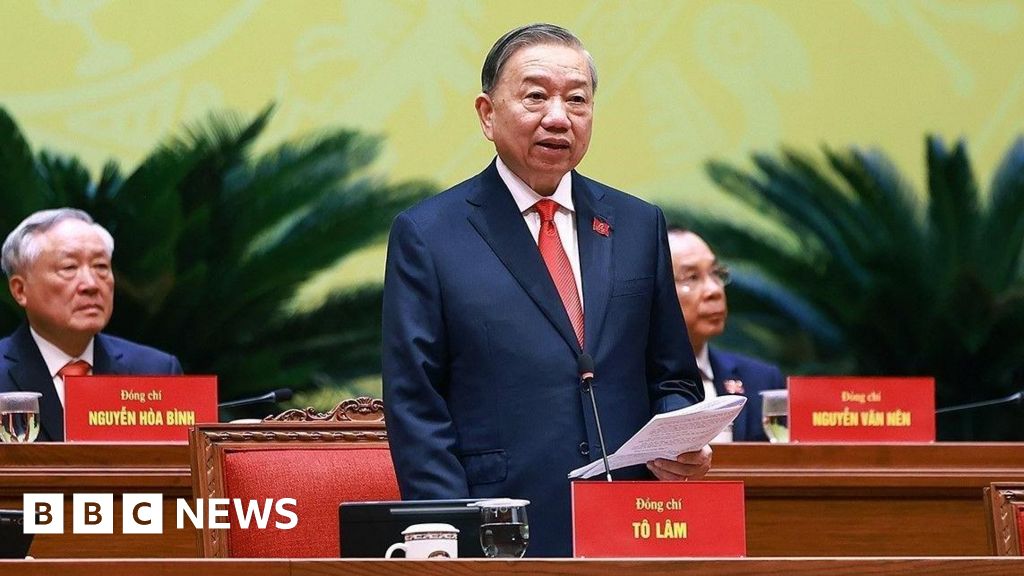
To Lam has been re-elected as General Secretary of the Communist Party of Vietnam, positioning him to continue his ambitious targets for the country’s economy over the next five years. The decision was made during the party congress, which concluded earlier than planned on October 20, 2023. This congress, attended by nearly 1,600 delegates, was key in shaping Vietnam’s political landscape and its economic direction.
To Lam, who took over leadership after the death of his predecessor Nguyen Phu Trong in early 2022, addressed the congress with a vision of a “national rise.” His reappointment was largely anticipated, yet the political dynamics within the party highlight a complex interplay between various factions, particularly the public security and military groups. Political analysts, including Edmund Malesky, a professor of political economy at Duke University, note that this congress reflects a significant consolidation of power, with To Lam’s influence recognized as the strongest since 1991.
Vision for Economic Growth
To Lam’s leadership marks a departure from the traditional communist ideology of Vietnam, particularly following the implementation of Resolution 68 in May 2022. This resolution elevated the private sector to a status previously reserved for state-owned enterprises, signaling a shift in economic policy that could redefine Vietnam’s economic landscape. The new framework indicates that the private sector will be the “most important driving force” of the national economy, a notable change from the previous stance.
To Lam outlined ambitious economic targets, including achieving double-digit annual growth, doubling the number of private businesses by 2030, and establishing a knowledge-based economy by 2045. This timeline coincides with the centenary of Vietnam’s independence from French colonial rule. Such aspirations aim to lift Vietnam out of the so-called “middle-income trap,” a challenge that has hindered many Southeast Asian nations.
Central to To Lam’s strategy is the support for “national champions” in the private sector, with the goal of fostering leading companies capable of competing globally. Currently, only eight Vietnamese companies appear on the latest Fortune 500 list, with half of these being state-owned enterprises. To Lam aims to cultivate at least 20 globally competitive private firms by 2030, drawing inspiration from South Korea’s successful model of state-supported conglomerates.
Challenges Ahead
Despite the significant progress Vietnam has made in economic growth and poverty reduction over the past 30 years, substantial challenges remain. The state-owned sector continues to play a dominant role, with 671 state-owned enterprises contributing 29% of the nation’s GDP. These entities often enjoy preferential treatment, creating obstacles for private companies seeking to thrive in a competitive environment.
Recent developments, including the passage of Resolution 79 earlier this month, indicate potential pushback against the newfound prominence of the private sector. This resolution emphasizes the role of state-owned enterprises as “leading geese,” aiming for 50 of them to reach the Fortune 500 by 2030. Such policies may hinder the progress of private enterprises that To Lam seeks to bolster.
Furthermore, many Vietnamese industries remain heavily reliant on foreign investment and technology. To Lam himself has acknowledged this dependency, questioning the value added by local industries engaged primarily in low-end manufacturing. The challenge is exacerbated by Vietnam’s integration into a global supply chain that often leaves local firms at the lower end of production.
As Vietnam navigates these complexities, the success of To Lam’s vision hinges on his ability to implement reforms that truly empower the private sector without creating a new class of politically-connected conglomerates. Analysts warn that if not managed carefully, the transition could lead to a system where small and medium enterprises—critical for employment and innovation—are sidelined.
Amid these tensions, Vietnam’s reliance on access to the US market raises additional uncertainties, especially with the evolving geopolitical landscape under the current US administration. The effectiveness of Vietnam’s “bamboo diplomacy” will be tested as it seeks to balance international relations while pursuing economic growth.
As To Lam embarks on this ambitious journey, the world will be watching closely to see if his promises translate into tangible outcomes for Vietnam’s economy and its people.

India Unveils Long-Range Hypersonic Missile Amid Regional Tensions

SK bioscience Launches Global Trial for Universal Sarbecovirus Vaccine

Senegal Coach Pape Thiaw Suspended and Fined After Final Disruption

PAS Denies Abolishing Chairman Post, Contradicts Muhyiddin’s Claim

Mbappé Critiques Real Madrid’s Effort After Benfica Defeat

Thailand’s December Factory Output Surges 2.52% Year-on-Year

Ishita Dutta Reveals Her Parenting Secret: Strong Coffee

Older GPs Express Concerns Over New Digital Health Record Mandate

Urban Jurgensen: A 252-Year Legacy Enters a New Era

South Korea’s Foreign Minister Cho Hyun to Visit China This Week

Starling Bank Plans Secondary Share Sale, Targeting $5.4 Billion Valuation

Munsang College Celebrates 100 Years with Grand Ceremony

PAS Aims to Expand Parliamentary Influence in Upcoming Election

Kenvue Dismisses CEO Thibaut Mongon as Strategic Review Advances

Humanism Camp Engages 250 Youths in Summer Fest 2025

De Minaur Triumphs at Washington Open After Thrilling Comeback

Tupou and Daugunu Join First Nations Squad for Lions Clash

Colombian Senator Miguel Uribe Shows Signs of Recovery After Attack
-
 World5 months ago
South Korea’s Foreign Minister Cho Hyun to Visit China This Week
-
 Business5 months ago
Starling Bank Plans Secondary Share Sale, Targeting $5.4 Billion Valuation
-
 Top Stories5 months ago
Munsang College Celebrates 100 Years with Grand Ceremony
-
 World5 months ago
PAS Aims to Expand Parliamentary Influence in Upcoming Election
-
 Business7 months ago
Kenvue Dismisses CEO Thibaut Mongon as Strategic Review Advances
-
 Lifestyle6 months ago
Humanism Camp Engages 250 Youths in Summer Fest 2025
-
 Sports6 months ago
De Minaur Triumphs at Washington Open After Thrilling Comeback
-
 Sports7 months ago
Tupou and Daugunu Join First Nations Squad for Lions Clash
-
 Top Stories7 months ago
Colombian Senator Miguel Uribe Shows Signs of Recovery After Attack
-

 World7 months ago
ASEAN Gears Up for Historic Joint Meeting of Foreign and Economic Ministers
-

 Health6 months ago
New Study Challenges Assumptions About Aging and Inflammation
-
 Business7 months ago
Oil Prices Surge Following New EU Sanctions on Russia