
Politics
Vietnam’s Political Landscape Shifts with To Lam’s Re-election

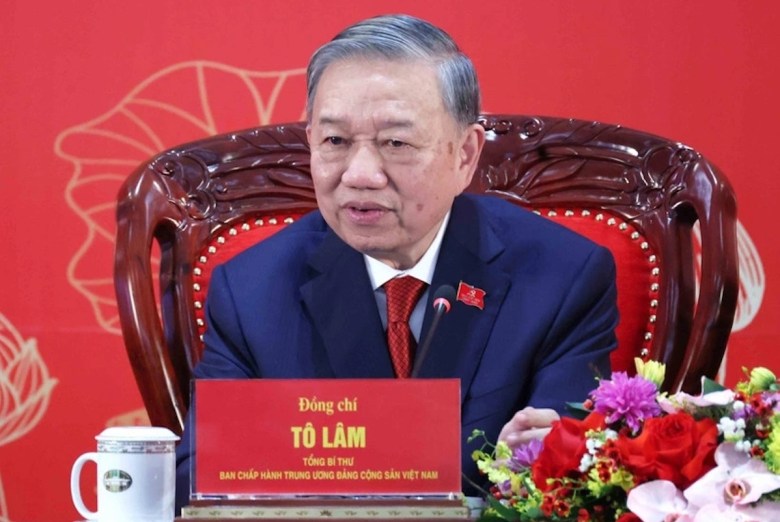
The recent conclusion of the 14th National Congress of the Vietnamese Communist Party marked a pivotal moment in the nation’s politics, with General To Lam securing a unanimous re-election as General Secretary. Alongside this, Lam outlined an ambitious target of 10% GDP growth, signaling a commitment to economic expansion. While initial interpretations suggested stability and continuity within the party, deeper analysis highlights significant shifts in the political framework.
One notable development was the Congress Resolution, which included a directive to propose amendments to the Party Charter “immediately after” the five-yearly event. This directive contradicts earlier assurances from senior party officials that the Charter would remain unchanged. Such a reversal in approach suggests that the current political framework, particularly the “four pillars” system that was carefully upheld by the late General Secretary Nguyen Phu Trong, is becoming increasingly incompatible with Lam’s evolving power dynamics.
Power Consolidation and Political Strategy
Under Trong’s leadership, the Party Charter served as the foundation of political legitimacy, with his anti-corruption campaign relying heavily on strict adherence to existing regulations, specifically Regulations 37 and 41. Stability was achieved through the enforcement of the Charter rather than altering it. The recent Congress appears to invert this logic, as the urgency to amend the Charter suggests a shift toward a new leadership structure that is redefining the rules.
Immediately following his re-election, Lam chaired an international press conference—a role typically reserved for the head of state. This move, coupled with the exclusion of the sitting Prime Minister and State President from the new Central Committee, effectively dismantles the checks and balances that characterized the previous governance model. As a result, Lam is positioned to emerge as a singular power center within the Vietnamese political landscape.
The forthcoming amendments to the Charter may facilitate the institutionalization of these changes, potentially merging the roles of General Secretary and President or granting Lam direct executive powers over the governmental apparatus that were previously distinct.
Emerging Alliances and Economic Challenges
With the Charter undergoing potential revisions, questions arise regarding the beneficiaries of these changes. The composition of the new Central Committee reveals a complex power structure, moving away from a consensus model. Lam, along with the Ministry of Public Security, now holds absolute political dominance, controlling key positions such as General Secretary and Inspection Commission head, while acting as a protective force for the Party.
The apparent dominance of the military within the new Central Committee, with 33 out of 200 members affiliated with the armed forces, may be misleading. While the military appears to hold a significant presence, there is evidence that under Lam’s leadership, the military is being placated with positions and economic advantages. Additionally, there is a growing willingness within the military to collaborate with capital groups that support Lam’s vision.
A notable figure in this evolving landscape is Nguyen Thanh Nghi, the son of former Prime Minister Nguyen Tan Dung. Nghi’s entrance into the Politburo, after years of political suppression, indicates a pragmatic alliance forming under Lam’s leadership. The ambitious economic target set by Lam raises questions about his ability to deliver growth, given his background in security rather than economic development.
The traditional Party Charter, designed for collective leadership and ideological consistency, may struggle to accommodate this new developmental security state where the police and technocrats collaborate closely. The anticipated amendments could streamline decision-making processes, potentially shielding technocrats from the very anti-corruption initiatives that played a role in Lam’s ascent to power—provided they achieve the desired economic results.
The consolidation of power by Lam introduces risks, as he may be stepping into a “peak power trap.” In the past, failures within the government could be attributed to systemic issues or specific ministries. By dismantling the “four pillars” and considering the unification of key roles, Lam removes this safety net. Economic setbacks, diplomatic challenges, or other failures will now be squarely attributed to his leadership.
The urgency for Charter amendments hints at underlying insecurities within the current consensus, which appears to be held together by a temporary alignment of interests between security and capital. Vietnam is entering a new era where traditional rules are becoming more flexible, and the definition of stability is being redefined in real-time.
For foreign investors and diplomats, the focus now shifts from who holds the titles to whether a system centered on security centralism can accommodate the openness necessary for achieving a 10% growth economy. The rewritten Party Charter will serve as a crucial test of this emerging contradiction.

India Unveils Long-Range Hypersonic Missile Amid Regional Tensions

SK bioscience Launches Global Trial for Universal Sarbecovirus Vaccine

Senegal Coach Pape Thiaw Suspended and Fined After Final Disruption

PAS Denies Abolishing Chairman Post, Contradicts Muhyiddin’s Claim

Mbappé Critiques Real Madrid’s Effort After Benfica Defeat

Thailand’s December Factory Output Surges 2.52% Year-on-Year

Ishita Dutta Reveals Her Parenting Secret: Strong Coffee

Older GPs Express Concerns Over New Digital Health Record Mandate

Urban Jurgensen: A 252-Year Legacy Enters a New Era

Regina Martinez Breaks New Ground for Mexico in Cross-Country Skiing

South Korea’s Foreign Minister Cho Hyun to Visit China This Week

Starling Bank Plans Secondary Share Sale, Targeting $5.4 Billion Valuation

Munsang College Celebrates 100 Years with Grand Ceremony

PAS Aims to Expand Parliamentary Influence in Upcoming Election

De Minaur Triumphs at Washington Open After Thrilling Comeback

Kenvue Dismisses CEO Thibaut Mongon as Strategic Review Advances

Humanism Camp Engages 250 Youths in Summer Fest 2025

Colombian Senator Miguel Uribe Shows Signs of Recovery After Attack
-
 Sports2 months ago
Regina Martinez Breaks New Ground for Mexico in Cross-Country Skiing
-
 World6 months ago
South Korea’s Foreign Minister Cho Hyun to Visit China This Week
-
 Business6 months ago
Starling Bank Plans Secondary Share Sale, Targeting $5.4 Billion Valuation
-
 Top Stories6 months ago
Munsang College Celebrates 100 Years with Grand Ceremony
-
 World6 months ago
PAS Aims to Expand Parliamentary Influence in Upcoming Election
-
 Sports8 months ago
De Minaur Triumphs at Washington Open After Thrilling Comeback
-
 Business8 months ago
Kenvue Dismisses CEO Thibaut Mongon as Strategic Review Advances
-
 Lifestyle8 months ago
Humanism Camp Engages 250 Youths in Summer Fest 2025
-
 Top Stories8 months ago
Colombian Senator Miguel Uribe Shows Signs of Recovery After Attack
-

 Sports8 months ago
Tupou and Daugunu Join First Nations Squad for Lions Clash
-

 World8 months ago
ASEAN Gears Up for Historic Joint Meeting of Foreign and Economic Ministers
-

 Health8 months ago
New Study Challenges Assumptions About Aging and Inflammation