
Politics
US Military Actions Signal Escalation in Venezuela Conflict

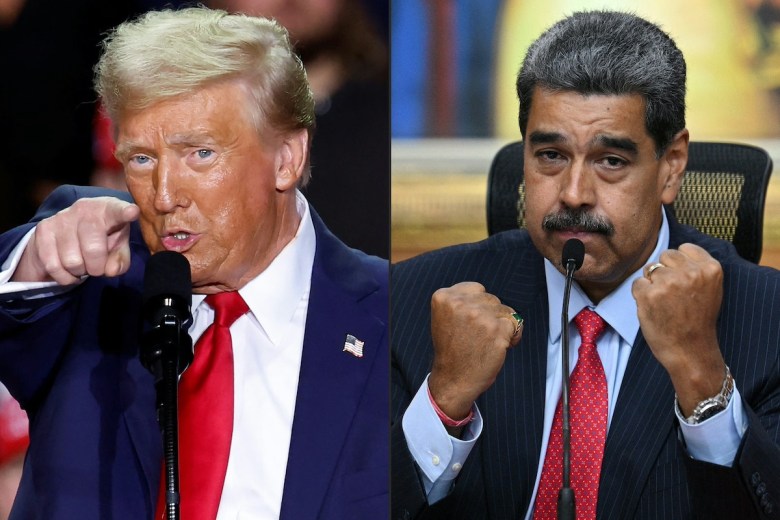
The United States has intensified its military presence in the Caribbean, indicating a shift from covert operations to overt actions in its ongoing conflict with Venezuela. In recent weeks, U.S. naval forces have conducted multiple drone strikes against vessels in the region, marking a significant escalation in what the administration frames as a counter-narcotics operation. However, the geographical context suggests a more complex agenda centered around Venezuela’s political landscape.
The U.S. military’s activities began discreetly, with drone strikes targeting small boats that are typically associated with fishing and smuggling. Over the course of several weeks, U.S. forces reportedly conducted fourteen strikes, which the administration attributed to efforts against drug trafficking. Yet, critics question this rationale, pointing out that cocaine trafficking routes predominantly traverse Colombia, Peru, and Mexico, rather than the Caribbean waters where these operations occurred.
Strategic Military Build-Up
By October 2023, evidence of a more aggressive U.S. stance became apparent. The Pentagon deployed its most advanced aircraft carrier to the Caribbean and authorized CIA operations within Venezuelan territory. This military build-up is reminiscent of the Cold War era, as the U.S. appears to be reaffirming its strategic influence in the region, especially under the shadow of the historic Monroe Doctrine.
The motivations behind this escalation are multifaceted. Venezuela is home to the world’s largest proven oil reserves, and its government has sought alliances with Russia and China, trading oil for security and infrastructure support. Recently, Venezuelan President Nicolas Maduro extended offers to U.S. firms for majority stakes in the country’s oil industry, but the U.S. dismissed these overtures, indicating a reluctance to engage diplomatically.
The potential for conflict has grown, particularly as the U.S. Southern Command transitioned to a more aggressive posture. The resignation of its commander two years ahead of schedule signals a shift towards a more assertive military strategy. Following this, more than 10,000 marines and sailors have been deployed, accompanied by an array of naval and aerial assets that far exceed what is typically necessary for anti-drug operations.
Challenges of Military Intervention
The U.S. military’s current capabilities in the region are considerable, with Reaper drones and advanced fighter jets positioned strategically. However, Venezuela’s military, while large on paper, struggles with internal corruption and resource shortages, rendering it vulnerable. Many of its Russian-made aircraft are reportedly non-operational due to lack of parts and maintenance.
Despite this apparent military advantage, the implications of a direct intervention raise significant concerns. Over the years, Maduro has armed civilian militias extensively, distributing hundreds of thousands of weapons. Should the U.S. succeed in toppling the Maduro regime, the resulting power vacuum could lead to widespread chaos, reminiscent of the conflicts seen in Libya and Syria, where the removal of a government did not lead to stability but rather to fragmentation and violence.
The current situation suggests that the U.S. may already be engaged in a conflict it has yet to fully acknowledge. This “war” is characterized by drone strikes, naval maneuvers, covert operations, and strategic isolation of Venezuela, all framed under the guise of anti-narcotics efforts but deeply rooted in geopolitical strategy.
As history has shown, powerful nations rarely enter conflicts with weaker states without a clear purpose. The U.S. may demonstrate military prowess in the short term, but the challenge of rebuilding a nation remains a daunting and complex task. The true test will lie in whether Washington is prepared for the aftermath of its actions in Venezuela.

India Unveils Long-Range Hypersonic Missile Amid Regional Tensions

SK bioscience Launches Global Trial for Universal Sarbecovirus Vaccine

Senegal Coach Pape Thiaw Suspended and Fined After Final Disruption

PAS Denies Abolishing Chairman Post, Contradicts Muhyiddin’s Claim

Mbappé Critiques Real Madrid’s Effort After Benfica Defeat

Thailand’s December Factory Output Surges 2.52% Year-on-Year

Ishita Dutta Reveals Her Parenting Secret: Strong Coffee

Older GPs Express Concerns Over New Digital Health Record Mandate

Urban Jurgensen: A 252-Year Legacy Enters a New Era

Regina Martinez Breaks New Ground for Mexico in Cross-Country Skiing

South Korea’s Foreign Minister Cho Hyun to Visit China This Week

Starling Bank Plans Secondary Share Sale, Targeting $5.4 Billion Valuation

Munsang College Celebrates 100 Years with Grand Ceremony

PAS Aims to Expand Parliamentary Influence in Upcoming Election

De Minaur Triumphs at Washington Open After Thrilling Comeback

Kenvue Dismisses CEO Thibaut Mongon as Strategic Review Advances

Humanism Camp Engages 250 Youths in Summer Fest 2025

Colombian Senator Miguel Uribe Shows Signs of Recovery After Attack
-
 Sports1 month ago
Regina Martinez Breaks New Ground for Mexico in Cross-Country Skiing
-
 World6 months ago
South Korea’s Foreign Minister Cho Hyun to Visit China This Week
-
 Business6 months ago
Starling Bank Plans Secondary Share Sale, Targeting $5.4 Billion Valuation
-
 Top Stories6 months ago
Munsang College Celebrates 100 Years with Grand Ceremony
-
 World6 months ago
PAS Aims to Expand Parliamentary Influence in Upcoming Election
-
 Sports7 months ago
De Minaur Triumphs at Washington Open After Thrilling Comeback
-
 Business8 months ago
Kenvue Dismisses CEO Thibaut Mongon as Strategic Review Advances
-
 Lifestyle7 months ago
Humanism Camp Engages 250 Youths in Summer Fest 2025
-
 Top Stories8 months ago
Colombian Senator Miguel Uribe Shows Signs of Recovery After Attack
-

 Sports8 months ago
Tupou and Daugunu Join First Nations Squad for Lions Clash
-
 World8 months ago
ASEAN Gears Up for Historic Joint Meeting of Foreign and Economic Ministers
-

 Health7 months ago
New Study Challenges Assumptions About Aging and Inflammation