
Politics
Tarique Rahman Returns to Bangladesh, Reviving Political Tensions

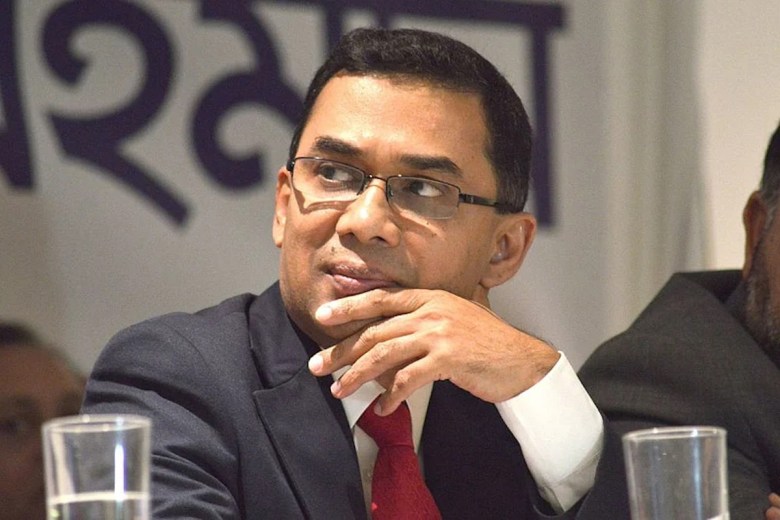
Tarique Rahman, the exiled leader of the Bangladesh Nationalist Party (BNP), returned to Bangladesh on December 25, 2023, after a 17-year absence. His arrival marks a pivotal moment for a nation grappling with political instability and the quest for democratic legitimacy. Stepping onto Bangladeshi soil and symbolically touching the ground, Rahman’s return is laden with implications for the country’s fragmented political landscape.
The political environment in Bangladesh has significantly deteriorated since Rahman’s departure in 2008. The country, once polarized, now faces deeper fractures following the recent political upheaval that led to the fall of long-serving Prime Minister Sheikh Hasina. With Hasina currently in exile in Delhi, an interim administration led by Muhammad Yunus is attempting to restore order, but the social contract has weakened. Public trust in institutions is low, and the power of street movements has resurged, creating a fertile ground for Rahman’s re-entry.
Rahman’s return has galvanized the BNP, providing the party with renewed energy and a clear leadership figure. For many supporters, he embodies the potential for genuine political change, contrasting sharply with the Awami League’s extended dominance. Under Hasina, elections became predictable, characterized by repression of dissent and a lack of genuine democratic processes. Rahman’s presence introduces a new variable, granting the BNP a claim to legitimacy that had long been stifled.
Despite the enthusiasm among his supporters, Rahman is not without controversy. As the son of former Prime Minister Khaleda Zia and President Ziaur Rahman, he represents both the continuity of political dynasties and their challenges. His previous tenure was marred by allegations of corruption and governance issues, leading to mixed perceptions among the public. For many, his name conjures images of patronage and the very governance failures that have plagued Bangladesh.
In recent speeches, Rahman has adopted a notably measured tone, focusing on themes of national unity, the protection of minority rights, and the restoration of law and order. This shift from confrontational rhetoric reflects an acute awareness of the current political climate, where voters are weary of cycles of violence and exclusion. Should he assume power, Rahman’s leadership will likely be shaped by the necessity of reform rather than ideology alone.
The challenges facing a potential Rahman-led government are substantial. Bangladesh’s economy is now more integrated into the global market, necessitating a focus on export-led growth and foreign investment. Governance will be another critical area. Expectations will be high for curbing corruption, ensuring a neutral bureaucracy, and establishing a fair electoral process. The stakes are high, and failure to address these issues could quickly erode any mandate he might receive.
Foreign relations, particularly with India, add another layer of complexity to Rahman’s political landscape. Historically, India has favored stability in Bangladesh, which it found under Hasina’s rule. The BNP, however, has often been viewed with skepticism in New Delhi due to its nationalist rhetoric and past associations. Rahman’s return is being met with cautious observation in India, as the regional dynamics have shifted significantly, with India facing a more unstable neighborhood.
Rahman seems to recognize the importance of maintaining balanced relations. His recent statements reflect a desire for cooperative ties with India while asserting Bangladesh’s sovereignty. Should he lead a BNP government, recalibrating these relationships, particularly in trade and security, will be paramount. The broader question remains whether Bangladesh can return to a political system defined by credible elections rather than turmoil.
The larger narrative surrounding Rahman’s return encapsulates a critical juncture in Bangladeshi politics. This is not merely a transfer of power between political families; it signifies a reckoning with the implications of enduring authoritarianism and the potential for renewed democratic competition. As uncertainty returns to the political sphere, it offers a chance for renewal after years of orchestrated outcomes.
What unfolds next will be crucial not only for Rahman’s legacy but for Bangladesh’s journey towards a more robust democratic framework. He has the opportunity to redefine leadership and foster stronger institutions that transcend individual power. Alternatively, he risks reverting to past practices that could undermine the hope for a more democratic Bangladesh. With little margin for error, the decisions made in the coming months will shape the future of the nation.

India Unveils Long-Range Hypersonic Missile Amid Regional Tensions

SK bioscience Launches Global Trial for Universal Sarbecovirus Vaccine

Senegal Coach Pape Thiaw Suspended and Fined After Final Disruption

PAS Denies Abolishing Chairman Post, Contradicts Muhyiddin’s Claim

Mbappé Critiques Real Madrid’s Effort After Benfica Defeat

Thailand’s December Factory Output Surges 2.52% Year-on-Year

Ishita Dutta Reveals Her Parenting Secret: Strong Coffee

Older GPs Express Concerns Over New Digital Health Record Mandate

Urban Jurgensen: A 252-Year Legacy Enters a New Era

Regina Martinez Breaks New Ground for Mexico in Cross-Country Skiing

South Korea’s Foreign Minister Cho Hyun to Visit China This Week

Starling Bank Plans Secondary Share Sale, Targeting $5.4 Billion Valuation

Munsang College Celebrates 100 Years with Grand Ceremony

PAS Aims to Expand Parliamentary Influence in Upcoming Election

De Minaur Triumphs at Washington Open After Thrilling Comeback

Kenvue Dismisses CEO Thibaut Mongon as Strategic Review Advances

Humanism Camp Engages 250 Youths in Summer Fest 2025

Colombian Senator Miguel Uribe Shows Signs of Recovery After Attack
-
 Sports3 months ago
Regina Martinez Breaks New Ground for Mexico in Cross-Country Skiing
-
 World7 months ago
South Korea’s Foreign Minister Cho Hyun to Visit China This Week
-
 Business7 months ago
Starling Bank Plans Secondary Share Sale, Targeting $5.4 Billion Valuation
-
 Top Stories7 months ago
Munsang College Celebrates 100 Years with Grand Ceremony
-
 World7 months ago
PAS Aims to Expand Parliamentary Influence in Upcoming Election
-
 Sports8 months ago
De Minaur Triumphs at Washington Open After Thrilling Comeback
-
 Business9 months ago
Kenvue Dismisses CEO Thibaut Mongon as Strategic Review Advances
-
 Lifestyle8 months ago
Humanism Camp Engages 250 Youths in Summer Fest 2025
-
 Top Stories9 months ago
Colombian Senator Miguel Uribe Shows Signs of Recovery After Attack
-

 Sports9 months ago
Tupou and Daugunu Join First Nations Squad for Lions Clash
-

 World9 months ago
ASEAN Gears Up for Historic Joint Meeting of Foreign and Economic Ministers
-

 Health8 months ago
New Study Challenges Assumptions About Aging and Inflammation