
Politics
Takaichi’s Leadership: A New Era for Japan’s Indo-Pacific Strategy

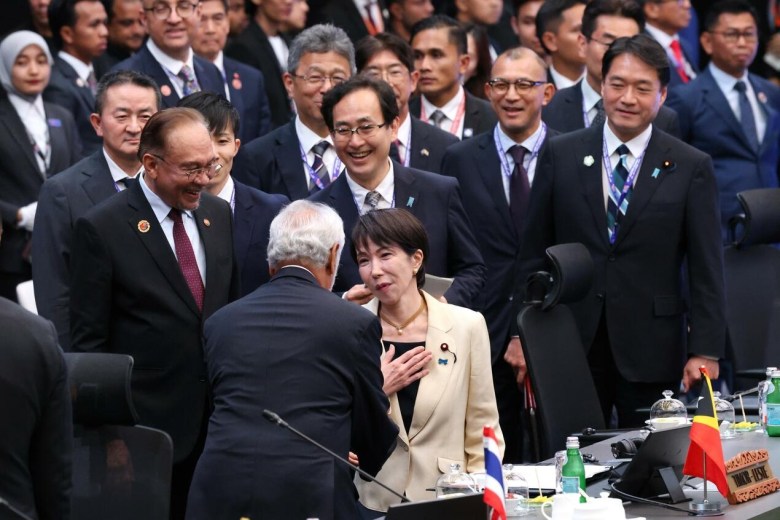
Sanae Takaichi has stepped into a pivotal role as the new leader of the Liberal Democratic Party (LDP) following her confirmation, positioning her to succeed outgoing Prime Minister Shigeru Ishiba. Her rise was initially clouded by political uncertainty after the LDP’s coalition partner, Komeito, distanced itself from the party. However, negotiations with the Japanese Innovation Party (Ishin no Kai) have diminished the threat of an opposition coalition, granting Takaichi a crucial opportunity to redefine the LDP’s identity.
Takaichi’s administration has the potential to rebrand itself after the leadership tenure of former Prime Minister Shinzo Abe. Sharing ideological similarities with Abe, particularly in foreign policy, Takaichi is poised to advance the Free and Open Indo-Pacific (FOIP) strategy, Japan’s primary diplomatic framework since 2016. This strategy not only emphasizes Japan’s regional influence but also reflects Takaichi’s economic perspectives, aligning with the proactive stance of the JIP on domestic reforms.
Strategic Directions for the Indo-Pacific
The new administration faces three possible paths regarding the FOIP. The first, and least likely, would be to completely overhaul the existing framework. Considering the established international influence and longevity of the FOIP, such a move would likely hinder Japan’s diplomatic momentum. The second option involves maintaining the current status quo, which would require minimal effort but could limit potential advancements.
The most promising approach is to evolve the FOIP, integrating Takaichi’s insights and economic security strategies to ensure its relevance amid changing regional dynamics. One significant avenue may involve advocating for Taiwan’s role as a global public good, particularly as Taiwan increasingly features in international discourse. Takaichi’s recent comments in the Diet regarding Japan’s stance in a potential Taiwan contingency have already sparked intense reactions from Chinese officials, highlighting the delicate nature of this diplomatic situation.
Additionally, Takaichi’s inaugural official visit to Southeast Asia underscores her commitment to regional cooperation. While ASEAN has adopted its own “Outlook on the Indo-Pacific,” it remains cautious and somewhat ambivalent. Japan should prioritize engaging with these regional players, particularly as allies like the United States, Australia, and New Zealand have already endorsed Japan’s FOIP vision.
Strengthening security initiatives, such as expanding Official Security Assistance (OSA) programs and enhancing cybersecurity cooperation, can be vital. Japan shares common interests with ASEAN nations in areas like disaster prevention and combating illegal fishing, presenting practical opportunities for collaboration beyond traditional security frameworks.
The FOIP’s Evolution Under Takaichi
U.S. President Donald Trump congratulated Takaichi on her new leadership role shortly after her appointment, reiterating the importance of maintaining a free and open Indo-Pacific. Takaichi’s response reflected her commitment to this framework, which has been evolving since its conceptualization in 2007 during Abe’s first term. This evolution can be categorized as FOIP 1.0, with the formal policy emerging in 2016 as FOIP 2.0. A rebranding in 2018 shifted the narrative from a strategy to a vision, aiming to counter perceptions of it being anti-China.
The latest iteration, FOIP 3.0, developed under former Prime Minister Fumio Kishida, framed Japan’s regional interests through four conceptual pillars. The challenge for Takaichi is to ensure that FOIP remains relevant as geopolitical and economic realities in the region shift. With Japan experiencing its fourth prime minister in five years, a refreshed FOIP 4.0 could be essential for establishing a stable government that clearly defines Japan’s role in the Indo-Pacific.
Kazuto Suzuki emphasizes that the current conditions facing Japan differ significantly from those in 2012, when Abe returned to power. Japan is grappling with demographic challenges, and its economy has stagnated despite previous administrations’ measures. The coalition with the JIP may offer new avenues for Takaichi, as it frees the LDP from the pacifist constraints imposed by Komeito.
Despite the obstacles, Takaichi’s leadership and her vision for the FOIP could inject vital energy into her administration, setting the stage for Japan to assert itself as a key player in the Indo-Pacific. The potential for a “Takaichification” of the FOIP might not only revive the framework but also provide a much-needed momentum for the new government.

India Unveils Long-Range Hypersonic Missile Amid Regional Tensions

SK bioscience Launches Global Trial for Universal Sarbecovirus Vaccine

Senegal Coach Pape Thiaw Suspended and Fined After Final Disruption

PAS Denies Abolishing Chairman Post, Contradicts Muhyiddin’s Claim

Mbappé Critiques Real Madrid’s Effort After Benfica Defeat

Thailand’s December Factory Output Surges 2.52% Year-on-Year

Ishita Dutta Reveals Her Parenting Secret: Strong Coffee

Older GPs Express Concerns Over New Digital Health Record Mandate

Urban Jurgensen: A 252-Year Legacy Enters a New Era

Regina Martinez Breaks New Ground for Mexico in Cross-Country Skiing

South Korea’s Foreign Minister Cho Hyun to Visit China This Week

Starling Bank Plans Secondary Share Sale, Targeting $5.4 Billion Valuation

Munsang College Celebrates 100 Years with Grand Ceremony

PAS Aims to Expand Parliamentary Influence in Upcoming Election

De Minaur Triumphs at Washington Open After Thrilling Comeback

Kenvue Dismisses CEO Thibaut Mongon as Strategic Review Advances

Humanism Camp Engages 250 Youths in Summer Fest 2025

Colombian Senator Miguel Uribe Shows Signs of Recovery After Attack
-
 Sports1 month ago
Regina Martinez Breaks New Ground for Mexico in Cross-Country Skiing
-
 World6 months ago
South Korea’s Foreign Minister Cho Hyun to Visit China This Week
-
 Business6 months ago
Starling Bank Plans Secondary Share Sale, Targeting $5.4 Billion Valuation
-
 Top Stories6 months ago
Munsang College Celebrates 100 Years with Grand Ceremony
-
 World6 months ago
PAS Aims to Expand Parliamentary Influence in Upcoming Election
-
 Sports7 months ago
De Minaur Triumphs at Washington Open After Thrilling Comeback
-
 Business8 months ago
Kenvue Dismisses CEO Thibaut Mongon as Strategic Review Advances
-
 Lifestyle7 months ago
Humanism Camp Engages 250 Youths in Summer Fest 2025
-
 Top Stories8 months ago
Colombian Senator Miguel Uribe Shows Signs of Recovery After Attack
-

 Sports8 months ago
Tupou and Daugunu Join First Nations Squad for Lions Clash
-
 World8 months ago
ASEAN Gears Up for Historic Joint Meeting of Foreign and Economic Ministers
-

 Health7 months ago
New Study Challenges Assumptions About Aging and Inflammation