
Politics
Stephen Miller Advocates Forceful US Foreign Policy Ideology

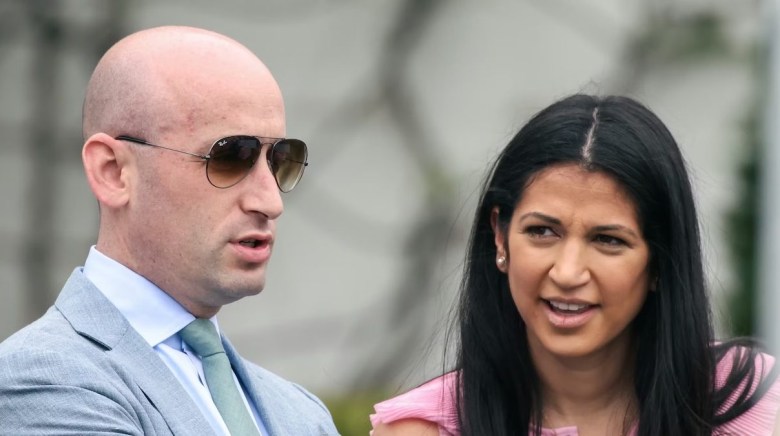
During a recent interview with CNN’s Jake Tapper, Stephen Miller, the White House deputy chief of staff, articulated a bold vision for United States foreign policy under President Donald Trump. He emphasized a philosophy grounded in the belief that “might is right,” declaring, “We’re a superpower. And under President Trump, we are going to conduct ourselves as a superpower.” Miller’s remarks came in the context of the administration’s controversial desire to assert control over Greenland, suggesting that military force could be considered if necessary.
Miller’s statements underscore the administration’s shift toward a more aggressive foreign policy stance. He remarked, “We live in a world in which you can talk all you want about international niceties… But we live in a world, in the real world … that is governed by strength, that is governed by force, that is governed by power.” This perspective reflects a fundamental change in how the U.S. positions itself globally.
Stephen Miller, who joined Trump’s campaign in January 2016, remains one of the most enduring figures in the Trump administration. Unlike many of his colleagues who cycled in and out of the administration, he has maintained a close working relationship with Trump, meeting daily alongside Chief of Staff Susie Wiles to strategize the administration’s agenda. Initially serving as a speechwriter, Miller has evolved into a crucial player in shaping and implementing policy, particularly concerning immigration and national security.
Origins of a Controversial Ideology
Miller’s radical views did not emerge in isolation. Throughout his life, he has expressed strong support for America First policies. His early disdain for multiculturalism surfaced during his high school years in Santa Monica, California, where he controversially claimed that students should not have to pick up litter, suggesting it was the responsibility of janitorial staff. At Duke University, he continued this trend by writing articles that criticized multiculturalism and defended right-wing ideologies.
His political career began as an aide to former Republican Representative Michele Bachmann and later as press secretary for Senator Jeff Sessions. Miller’s focus on immigration policy took shape during these roles, where he collaborated with organizations known for their strict anti-immigration stances. He played a key role in developing the infamous family separation policy, which drew widespread condemnation, including from the United Nations, for its harshness.
In the current administration, Miller has continued to push for stringent immigration measures. He is believed to be behind the deployment of immigration enforcement agents in U.S. cities, equipped with powers to detain and deport suspected undocumented immigrants. Among the more radical proposals he advocates is the elimination of birthright citizenship, challenging the 14th Amendment of the U.S. Constitution.
Miller has also raised eyebrows with comments suggesting suspension of habeas corpus rights under certain circumstances, further igniting debates about the administration’s adherence to constitutional norms. His views have positioned him at the center of significant legal and ethical discussions regarding executive power.
Public Perception and Political Impact
While Miller was relatively unnoticed during Trump’s first term, his profile has significantly risen in the second term. A YouGov poll from September 2025 indicates that 50% of respondents were aware of him, although he held a low popularity rating of only 18%. Despite being viewed unfavorably by many lawmakers and the public, Miller has a staunch ally in his wife, Katie Miller, who has supported his views publicly. She gained attention after tweeting a map of Greenland with the U.S. flag, which coincided with President Trump’s renewed interest in the territory for its resources.
Katie Miller has also worked in the Trump administration, specifically within the Department of Homeland Security. Her comments regarding the family separation policy indicate a shared ideology with her husband, emphasizing a lack of empathy towards the policy’s impact on families. She runs a podcast aimed at conservative women, providing a platform for administration officials and promoting their messaging.
The Millers’ rising visibility presents a complex challenge for the Trump administration. While they resonate with the far-right base of the Republican Party, their extreme positions may alienate moderate and independent voters crucial for upcoming elections. California Governor Gavin Newsom has publicly criticized Miller, likening him to Voldemort, the fictional embodiment of evil, a characterization that could hinder the Republican Party’s appeal in key elections.
As political dynamics continue to evolve, the impact of Miller’s ideology on U.S. policy and public opinion remains to be seen. The administration’s hardline approach may energize certain voter segments, but it could also deepen divisions within the electorate at a time when unity is essential for electoral success.

India Unveils Long-Range Hypersonic Missile Amid Regional Tensions

SK bioscience Launches Global Trial for Universal Sarbecovirus Vaccine

Senegal Coach Pape Thiaw Suspended and Fined After Final Disruption

PAS Denies Abolishing Chairman Post, Contradicts Muhyiddin’s Claim

Mbappé Critiques Real Madrid’s Effort After Benfica Defeat

Thailand’s December Factory Output Surges 2.52% Year-on-Year

Ishita Dutta Reveals Her Parenting Secret: Strong Coffee

Older GPs Express Concerns Over New Digital Health Record Mandate

Urban Jurgensen: A 252-Year Legacy Enters a New Era

Regina Martinez Breaks New Ground for Mexico in Cross-Country Skiing

South Korea’s Foreign Minister Cho Hyun to Visit China This Week

Starling Bank Plans Secondary Share Sale, Targeting $5.4 Billion Valuation

Munsang College Celebrates 100 Years with Grand Ceremony

PAS Aims to Expand Parliamentary Influence in Upcoming Election

De Minaur Triumphs at Washington Open After Thrilling Comeback

Kenvue Dismisses CEO Thibaut Mongon as Strategic Review Advances

Humanism Camp Engages 250 Youths in Summer Fest 2025

Colombian Senator Miguel Uribe Shows Signs of Recovery After Attack
-
 Sports2 months ago
Regina Martinez Breaks New Ground for Mexico in Cross-Country Skiing
-
 World7 months ago
South Korea’s Foreign Minister Cho Hyun to Visit China This Week
-
 Business7 months ago
Starling Bank Plans Secondary Share Sale, Targeting $5.4 Billion Valuation
-
 Top Stories7 months ago
Munsang College Celebrates 100 Years with Grand Ceremony
-
 World7 months ago
PAS Aims to Expand Parliamentary Influence in Upcoming Election
-
 Sports8 months ago
De Minaur Triumphs at Washington Open After Thrilling Comeback
-
 Business9 months ago
Kenvue Dismisses CEO Thibaut Mongon as Strategic Review Advances
-
 Lifestyle8 months ago
Humanism Camp Engages 250 Youths in Summer Fest 2025
-
 Top Stories9 months ago
Colombian Senator Miguel Uribe Shows Signs of Recovery After Attack
-

 Sports9 months ago
Tupou and Daugunu Join First Nations Squad for Lions Clash
-

 World9 months ago
ASEAN Gears Up for Historic Joint Meeting of Foreign and Economic Ministers
-

 Health8 months ago
New Study Challenges Assumptions About Aging and Inflammation