
Politics
South Korea’s President Navigates Diplomatic Tightrope Between China and Japan

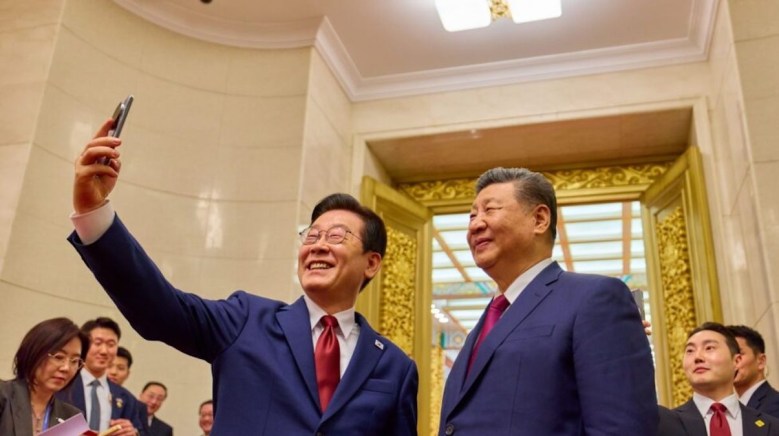
South Korean President Lee Jae Myung is embarking on a diplomatic effort to strengthen ties with both China and Japan. His recent official visit to Beijing marks the first by a South Korean president since 2019. Following this, he will meet with Japanese Prime Minister Sanae Takaichi in her hometown on January 13, 2024. These high-stakes meetings come as both nations seek to align with South Korea while navigating a landscape of complex regional tensions.
The backdrop of President Lee’s diplomatic mission is characterized by global uncertainty, particularly influenced by developments in the United States. According to Jung E-gil, a senior international affairs writer at the South Korean daily Hankyoreh, the U.S. is attempting to position itself as a major power focused on its own continent, which raises concerns about the carving up of global influence among the U.S., China, and Russia.
During his four-day visit to China, President Lee was accompanied by approximately 200 corporate leaders, underscoring the economic focus of the trip. The meeting with Chinese President Xi Jinping aimed to promote friendship and mutual benefit, emphasizing the historical context of the nations’ shared opposition to the Japanese Empire. Chinese officials expressed skepticism regarding Takaichi’s conservative nationalist views and her comments suggesting a potential military involvement in the Taiwan Strait.
While Lee’s visit aimed to foster closer relations with China, it also sought to maintain South Korea’s alliance with the United States. However, he left Beijing with limited progress on persuading Xi to engage North Korean leader Kim Jong Un in dialogue, as the discussions did not address the Korean Peninsula’s situation.
As President Lee heads to Japan, anticipation builds for his meeting with Takaichi. Their previous encounter at the APEC Summit showed promise, as Lee emphasized a “forward-looking” relationship, continuing the efforts made by former President Yoon Suk Yeol. This approach is viewed as crucial for both nations, particularly in light of shared concerns about China’s growing influence and the unpredictable nature of the Trump administration’s foreign policy.
Japanese scholar Ayumi Teraoka highlighted the necessity for collaboration between the leaders amid a deteriorating security environment in the Indo-Pacific region. However, the path forward is fraught with challenges, particularly concerning unresolved historical issues and territorial disputes, such as the contested islands of Dokdo (known as Takeshima in Japan).
Takaichi’s firm stance on these sensitive topics raises concerns about whether she can adopt a pragmatic approach to negotiations. The potential for progress hinges on both leaders’ ability to navigate these complex discussions without igniting longstanding tensions.
Korean progressives urge that addressing historical grievances is essential for a meaningful partnership. The Kyunghyang Shinmun editorial board emphasized that avoiding these issues could hinder the prospects for cooperation. Real progress on matters like compensation for forced labor victims remains elusive and could complicate diplomatic relations.
As President Lee continues to balance his diplomatic efforts between China and Japan, the long-term implications of these interactions remain uncertain. Former U.S. Ambassador to Korea Kathleen Stephens remarked on the intricate choreography of South Korea’s diplomatic relations, noting that the real challenges will arise when concrete decisions must be made.
The coming weeks will reveal whether President Lee can effectively manage South Korea’s strategic relationships while addressing historical complexities and emerging regional tensions.

India Unveils Long-Range Hypersonic Missile Amid Regional Tensions

SK bioscience Launches Global Trial for Universal Sarbecovirus Vaccine

Senegal Coach Pape Thiaw Suspended and Fined After Final Disruption

PAS Denies Abolishing Chairman Post, Contradicts Muhyiddin’s Claim

Mbappé Critiques Real Madrid’s Effort After Benfica Defeat

Thailand’s December Factory Output Surges 2.52% Year-on-Year

Ishita Dutta Reveals Her Parenting Secret: Strong Coffee

Older GPs Express Concerns Over New Digital Health Record Mandate

Urban Jurgensen: A 252-Year Legacy Enters a New Era

Regina Martinez Breaks New Ground for Mexico in Cross-Country Skiing

South Korea’s Foreign Minister Cho Hyun to Visit China This Week

Starling Bank Plans Secondary Share Sale, Targeting $5.4 Billion Valuation

Munsang College Celebrates 100 Years with Grand Ceremony

PAS Aims to Expand Parliamentary Influence in Upcoming Election

De Minaur Triumphs at Washington Open After Thrilling Comeback

Kenvue Dismisses CEO Thibaut Mongon as Strategic Review Advances

Humanism Camp Engages 250 Youths in Summer Fest 2025

Colombian Senator Miguel Uribe Shows Signs of Recovery After Attack
-
 Sports2 months ago
Regina Martinez Breaks New Ground for Mexico in Cross-Country Skiing
-
 World6 months ago
South Korea’s Foreign Minister Cho Hyun to Visit China This Week
-
 Business7 months ago
Starling Bank Plans Secondary Share Sale, Targeting $5.4 Billion Valuation
-
 Top Stories7 months ago
Munsang College Celebrates 100 Years with Grand Ceremony
-
 World6 months ago
PAS Aims to Expand Parliamentary Influence in Upcoming Election
-
 Sports8 months ago
De Minaur Triumphs at Washington Open After Thrilling Comeback
-
 Business8 months ago
Kenvue Dismisses CEO Thibaut Mongon as Strategic Review Advances
-
 Lifestyle8 months ago
Humanism Camp Engages 250 Youths in Summer Fest 2025
-
 Top Stories9 months ago
Colombian Senator Miguel Uribe Shows Signs of Recovery After Attack
-

 Sports8 months ago
Tupou and Daugunu Join First Nations Squad for Lions Clash
-
 World8 months ago
ASEAN Gears Up for Historic Joint Meeting of Foreign and Economic Ministers
-

 Health8 months ago
New Study Challenges Assumptions About Aging and Inflammation