
Politics
Parents Demand Action as Heavy Backpacks Burden Children

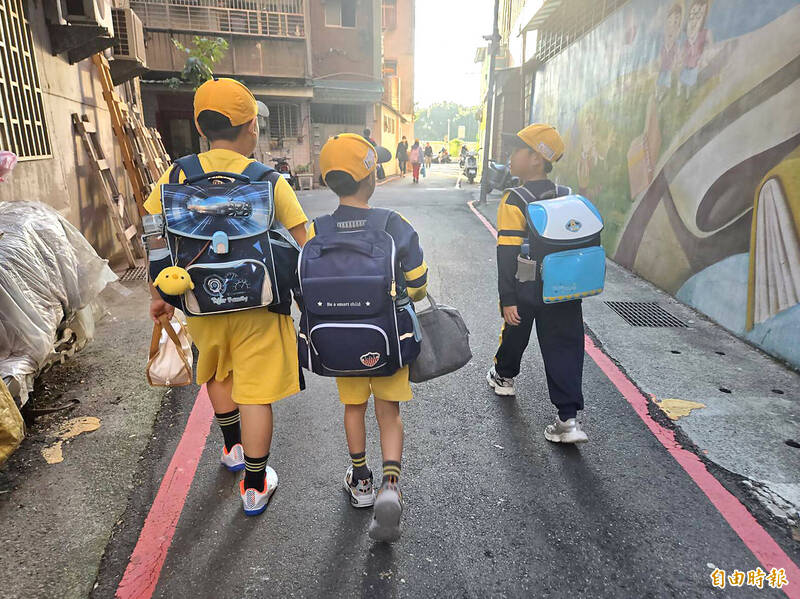
Concerns have surfaced among parents in Taiwan regarding the excessive weight of elementary school students’ backpacks. Many parents report that their children struggle to carry bags that can weigh significantly more than recommended limits, leading to fears about their health and development.
A second-grade student weighing 30 kg was found to be carrying a backpack weighing 5.8 kg, which far exceeds the Ministry of Education’s guideline that suggests school bags should not exceed one-eighth of a child’s body weight. The contents of the bag included a pencil case, water bottle, lunch box, textbooks, and various notebooks, illustrating the heavy load children are subjected to daily. Even after removing materials related to after-school programs, the backpack still weighed approximately 4 kg.
One parent, who wished to remain anonymous, expressed concern over the physical strain this places on children. “They can’t even lift it with one hand,” the parent noted. The burden of such weight raises significant worries about children’s growth and long-term health.
Health Risks Associated with Heavy Backpacks
According to Dr. Strong Po-chun, a physician specializing in Physical Medicine and Rehabilitation at Far Eastern Memorial Hospital, heavy backpacks can lead to poor posture and musculoskeletal issues. While a direct link between heavy loads and stunted growth has not been conclusively proven, it is critical to consider that children are still developing. Carrying excessive weight can lead to compensatory postures that may adversely affect their alignment.
Dr. Po-chun identified common postural problems associated with heavy loads, including hunched backs, rounded shoulders, and lower back pain, which can worsen over time. Children with weaker core muscles and those who lead sedentary lifestyles are particularly susceptible to these issues. The proliferation of electronic devices has also contributed to the emergence of “tech neck,” a condition that can lead to further complications in spinal health.
Frequent pain during formative school years can impose invisible stress on a child’s body, potentially disrupting hormone regulation, including those linked to growth. Dr. Po-chun advises that backpacks should not exceed 15 percent of a child’s body weight. He also provides practical solutions, recommending that students distribute weight evenly and ensure their backpacks are adjusted properly to minimize discomfort.
Policy Initiatives and Recommendations
To combat this issue, the New Taipei City Education Department has implemented policies aimed at reducing backpack weight since 1999. Although government subsidies for this initiative ended in 2012, the city has continued to promote measures that encourage students to carry only essential books home. The department reported that over NT$15 million (approximately US$476,872) has been allocated to help schools replace lockers, thereby reducing the number of items students must carry.
The department has called on parents, teachers, and students to collaborate on solutions, emphasizing the importance of choosing appropriate backpacks, organizing their contents, and understanding the correct way to carry them. Lin Sung-hung, Chairman of the New Taipei Teacher’s Union, highlighted the importance of fostering responsibility and good habits among students and parents alike.
While online learning resources have aided in reducing the burden of physical textbooks, many students still carry reference books and assignments from after-school programs, contributing to heavy loads. Lin recommends that parents regularly check their children’s backpacks and assist in organizing their contents.
The issue of heavy backpacks continues to be a prevalent concern in schools, particularly for younger students whose backpacks may be disproportionately large. As parents and educators work together to address these challenges, the health and well-being of children remain a top priority.

India Unveils Long-Range Hypersonic Missile Amid Regional Tensions

SK bioscience Launches Global Trial for Universal Sarbecovirus Vaccine

Senegal Coach Pape Thiaw Suspended and Fined After Final Disruption

PAS Denies Abolishing Chairman Post, Contradicts Muhyiddin’s Claim

Mbappé Critiques Real Madrid’s Effort After Benfica Defeat

Thailand’s December Factory Output Surges 2.52% Year-on-Year

Ishita Dutta Reveals Her Parenting Secret: Strong Coffee

Older GPs Express Concerns Over New Digital Health Record Mandate

Urban Jurgensen: A 252-Year Legacy Enters a New Era

Regina Martinez Breaks New Ground for Mexico in Cross-Country Skiing

South Korea’s Foreign Minister Cho Hyun to Visit China This Week

Starling Bank Plans Secondary Share Sale, Targeting $5.4 Billion Valuation

Munsang College Celebrates 100 Years with Grand Ceremony

PAS Aims to Expand Parliamentary Influence in Upcoming Election

De Minaur Triumphs at Washington Open After Thrilling Comeback

Kenvue Dismisses CEO Thibaut Mongon as Strategic Review Advances

Humanism Camp Engages 250 Youths in Summer Fest 2025

Colombian Senator Miguel Uribe Shows Signs of Recovery After Attack
-
 Sports2 months ago
Regina Martinez Breaks New Ground for Mexico in Cross-Country Skiing
-
 World7 months ago
South Korea’s Foreign Minister Cho Hyun to Visit China This Week
-
 Business7 months ago
Starling Bank Plans Secondary Share Sale, Targeting $5.4 Billion Valuation
-
 Top Stories7 months ago
Munsang College Celebrates 100 Years with Grand Ceremony
-
 World7 months ago
PAS Aims to Expand Parliamentary Influence in Upcoming Election
-
 Sports8 months ago
De Minaur Triumphs at Washington Open After Thrilling Comeback
-
 Business9 months ago
Kenvue Dismisses CEO Thibaut Mongon as Strategic Review Advances
-
 Lifestyle8 months ago
Humanism Camp Engages 250 Youths in Summer Fest 2025
-
 Top Stories9 months ago
Colombian Senator Miguel Uribe Shows Signs of Recovery After Attack
-

 Sports9 months ago
Tupou and Daugunu Join First Nations Squad for Lions Clash
-
 World9 months ago
ASEAN Gears Up for Historic Joint Meeting of Foreign and Economic Ministers
-

 Health8 months ago
New Study Challenges Assumptions About Aging and Inflammation