
Politics
Japan and India Forge Stronger Ties in Indo-Pacific Strategy

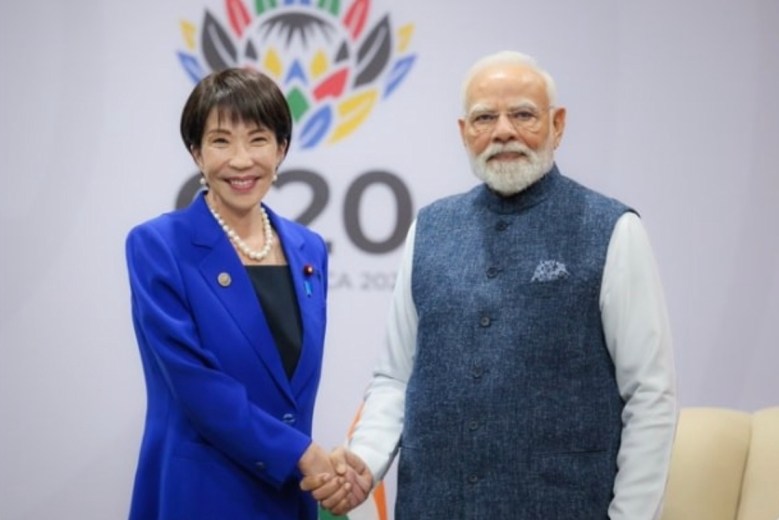
The strategic partnership between Japan and India in the Indo-Pacific region is gaining significant traction, reflecting both nations’ commitment to a stable and democratic regional order. This partnership, which has evolved through historical contexts and shared values, is increasingly viewed as a crucial stabilizing factor in a shifting geopolitical landscape.
To understand the present dynamics of the Japan-India partnership, it is essential to examine the historical context. During the Second World War, India was not a priority in Japan’s strategic considerations. Japan focused primarily on East and Southeast Asia, with India entering its calculations only late in the war. Consequently, the war did not establish a solid foundation for bilateral relations, instead leaving a complex legacy characterized by Japan’s defeat and India’s emergence as an independent nation.
Following Japan’s surrender, the postwar shaping of Japan occurred largely without input from India. The United States invited major powers like the Soviet Union and Great Britain to participate in the Far Eastern Advisory Commission, sidelining India despite its moral stature as a rising Asian power. By December 1945, a consensus emerged that embedded Japan within a US-led security framework, an exclusion that could have fostered resentment. Instead, India chose a different path, exemplified by the actions of Justice Radhabinod Pal during the Tokyo Trial. Pal’s dissent against the prosecution of Japanese leaders highlighted India’s ethical stance, reinforcing goodwill between the two nations.
In a notable gesture of reconciliation in 1952, India declined to accept war reparations from Japan. At a time when many nations sought compensation, this decision demonstrated India’s forward-thinking approach and commitment to building a cooperative relationship. India extended Most Favored Nation status to Japan, reciprocated by Japan, marking a significant step in bilateral ties. Furthermore, India became the first country to offer Official Development Assistance to Japan, a decision that underscored India’s belief in reconciliation over retribution.
The philosophical foundations of this partnership resonate deeply with shared cultural values. The notion of Majma-ul-Bahrain, or the “Confluence of the Two Oceans,” articulated by Mughal prince Dara Shikoh, later found expression in Japanese Prime Minister **Shinzo Abe’s** 2007 address to the Indian Parliament, where he emphasized the interconnected fates of Japan and India across the Indo-Pacific. This concept laid the groundwork for formal bilateral cooperation.
The evolution of this partnership gained momentum in the early 21st century. The year 2000 marked the inception of a Japan-India “Global Partnership,” which was elevated to a “Strategic and Global Partnership” in 2006. By 2011, trilateral dialogues involving India, Japan, and the United States began to take shape, reflecting shared concerns regarding regional stability. Japan’s endorsement of a “Free and Open Indo-Pacific” in 2016 and the revival of the Quadrilateral Security Dialogue (Quad) further institutionalized this alignment.
Both nations recognize that maritime security is vital for their economies. As **Shinzo Abe** quipped, “Let ‘Popeye’ eat spinach for a while,” underscoring the need to strengthen national capabilities while collaborating with allies. While Japan has historically depended on the United States for maritime security, it is increasingly aware that this reliance may not be sustainable in the long term. India’s growing naval capabilities, including the development of aircraft carriers, are viewed positively in Tokyo as a stabilizing force for regional sea lanes.
Despite the growing partnership, differing strategic visions remain a topic of discussion. Japan’s “Arc of Freedom and Prosperity” contrasts with India’s “Arc of Advantage and Prosperity,” reflecting variations in emphasis on values and strategic autonomy. These distinctions are not contradictions; rather, they represent productive tensions that enable both countries to coordinate without compromising their independent perspectives.
China continues to play a significant role in this relationship, serving as both an opportunity and a challenge. While political relations between Japan and China are strained, economic interdependence complicates Tokyo’s strategic options. For India, China presents both a benchmark for development and a security concern. Although Japan’s interest in India has surged with India’s economic ascent, several roadblocks—such as regulatory hurdles and infrastructure challenges—hinder the full realization of Japanese investments in India.
The partnership is deeply intertwined with domestic reforms and external balancing. The ancient Indian principle Kosh Muloo Dand, which asserts that economic strength underpins power, remains relevant today. Both Japan and India understand that sustained economic growth and innovation are essential for realizing their Indo-Pacific vision.
Historical experiences also temper optimism regarding the alliance. The security landscape in South Asia underwent a significant transformation in 1972 when US President **Richard Nixon** and **Henry Kissinger** visited Beijing, altering India’s threat perceptions. This episode highlighted the risks of great-power negotiations conducted without regional considerations, reinforcing India’s commitment to strategic autonomy even within partnerships.
In conclusion, Japan and India’s relations in the 21st century represent a nuanced partnership rooted in historical lessons, civilizational confidence, and practical alignment. From India’s moral stance during the Tokyo Trial to its refusal of reparations in 1952, the trajectory of their relationship has prioritized long-term stability over immediate gains. As the Indo-Pacific becomes a focal point of global politics, the Japan-India partnership faces challenges from shifting power dynamics and economic uncertainties.
Ultimately, success will depend not only on military cooperation and strategic dialogues but also on deeper economic ties and mutual understanding of each other’s strategic cultures. The confluence of the two seas is not merely a static meeting point but a dynamic relationship requiring continuous navigation, reflecting an enduring commitment to balanced and reciprocal regional stability.

India Unveils Long-Range Hypersonic Missile Amid Regional Tensions

SK bioscience Launches Global Trial for Universal Sarbecovirus Vaccine

Senegal Coach Pape Thiaw Suspended and Fined After Final Disruption

PAS Denies Abolishing Chairman Post, Contradicts Muhyiddin’s Claim

Mbappé Critiques Real Madrid’s Effort After Benfica Defeat

Thailand’s December Factory Output Surges 2.52% Year-on-Year

Ishita Dutta Reveals Her Parenting Secret: Strong Coffee

Older GPs Express Concerns Over New Digital Health Record Mandate

Urban Jurgensen: A 252-Year Legacy Enters a New Era

Regina Martinez Breaks New Ground for Mexico in Cross-Country Skiing

South Korea’s Foreign Minister Cho Hyun to Visit China This Week

Starling Bank Plans Secondary Share Sale, Targeting $5.4 Billion Valuation

Munsang College Celebrates 100 Years with Grand Ceremony

PAS Aims to Expand Parliamentary Influence in Upcoming Election

De Minaur Triumphs at Washington Open After Thrilling Comeback

Kenvue Dismisses CEO Thibaut Mongon as Strategic Review Advances

Humanism Camp Engages 250 Youths in Summer Fest 2025

Colombian Senator Miguel Uribe Shows Signs of Recovery After Attack
-
 Sports3 months ago
Regina Martinez Breaks New Ground for Mexico in Cross-Country Skiing
-
 World7 months ago
South Korea’s Foreign Minister Cho Hyun to Visit China This Week
-
 Business7 months ago
Starling Bank Plans Secondary Share Sale, Targeting $5.4 Billion Valuation
-
 Top Stories7 months ago
Munsang College Celebrates 100 Years with Grand Ceremony
-
 World7 months ago
PAS Aims to Expand Parliamentary Influence in Upcoming Election
-
 Sports8 months ago
De Minaur Triumphs at Washington Open After Thrilling Comeback
-
 Business9 months ago
Kenvue Dismisses CEO Thibaut Mongon as Strategic Review Advances
-
 Lifestyle8 months ago
Humanism Camp Engages 250 Youths in Summer Fest 2025
-
 Top Stories9 months ago
Colombian Senator Miguel Uribe Shows Signs of Recovery After Attack
-

 Sports9 months ago
Tupou and Daugunu Join First Nations Squad for Lions Clash
-
 World9 months ago
ASEAN Gears Up for Historic Joint Meeting of Foreign and Economic Ministers
-

 Health8 months ago
New Study Challenges Assumptions About Aging and Inflammation