
Politics
Jamaat-e-Islami Seeks Power in Bangladesh After Political Upheaval

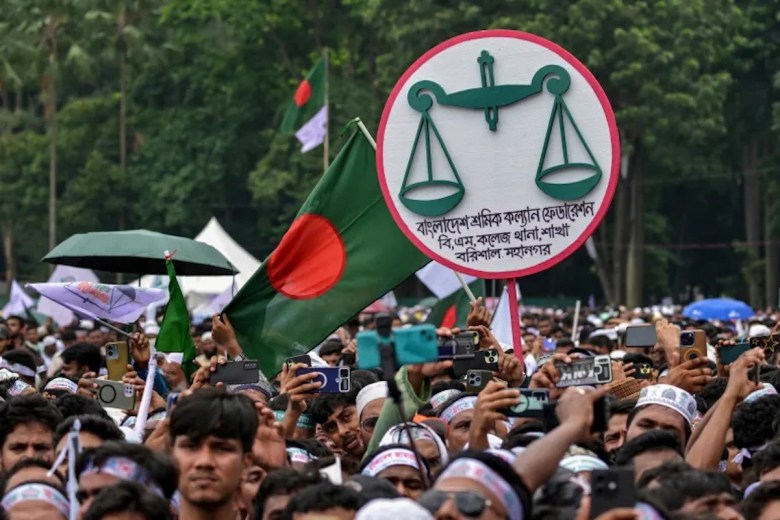
Bangladesh is facing a pivotal moment as the political landscape shifts dramatically following the collapse of the authoritarian regime led by Sheikh Hasina in 2024. The largest religion-based party, Jamaat-e-Islami, is positioning itself as a key player in the upcoming parliamentary elections scheduled for February 12, 2024. This emergence raises critical questions about the party’s capacity to govern within a pluralistic democracy without compromising its foundational ideals.
In recent months, Jamaat-e-Islami has attempted to rebrand itself as a disciplined and moral alternative amid widespread political discontent. However, the party’s ideological underpinnings suggest a potential threat to democratic principles. While party leaders engage in diplomatic dialogue promoting constitutionalism and distancing themselves from the immediate implementation of Sharia law, their rhetoric shifts significantly when addressing local constituents.
Jamaat employs a strategy of dual messaging, presenting a moderate front to international observers while espousing a more hardline stance domestically. At grassroots levels, the narrative transforms voting into a matter of faith, framing support for the party as a divine mandate. Senior figures, such as Barrister Shahriar Kabir, have characterized voting for Jamaat’s electoral symbol, the Daripalla (the scales), as an imanic duty—essentially a test of religious commitment.
Despite efforts to soften its image, Jamaat’s founding documents reveal a fundamental contradiction. The party’s constitution asserts that sovereignty belongs to God, not the people, and its ultimate goal remains the establishment of Islam as a comprehensive way of life, or Iqamat-e-Deen. This vision implies that the state functions not as a protector of individual rights but as a mechanism for enforcing moral standards, potentially undermining the principles of equality and social harmony embedded in Bangladesh’s constitution.
The implications of Jamaat’s agenda extend significantly to women’s rights. The party leadership, including Chief Dr. Shafikur Rahman, has proposed a social agenda that could curtail women’s mobility and working hours, framing these restrictions as necessary measures for maintaining social order. Given that women constitute approximately 35% of the formal workforce and play a vital role in the garment industry, such policies risk reversing decades of progress in gender equality and economic independence.
Jamaat’s policymaking body notably lacks female representation, and its leaders have suggested that women should only participate in certain societal roles, further marginalizing their presence in public life. Last year, a disturbing incident at Dhaka University exemplified this trend when a female student faced public harassment for her attire. The subsequent community response, which included calls for the release of the perpetrator, underscored the potential for informal moral enforcement to supersede legal protections.
The historical context of political movements in the region provides cautionary lessons. In countries like Turkey, the AKP has gradually implemented conservative norms under the guise of constitutional adherence, while in Afghanistan, women have faced systematic erasure from public life. In Bangladesh, recent political gestures, such as nominating a Hindu candidate, appear more as tactical maneuvers than indicators of genuine ideological reform.
As the February elections approach, the stakes are high. A political environment that derives its legitimacy from religious morality may tolerate minorities superficially but ultimately fails to ensure equal citizenship. In this context, dissent can be easily redefined as an affront to faith, transforming democratic rights into moral offenses.
The risk for Bangladesh is not only the resurgence of authoritarianism but also the emergence of a horizontal tyranny enforced by self-appointed guardians of morality. The electorate, weary from past political failures, must discern between mere change and meaningful progress. If Jamaat succeeds in establishing a monopoly over virtue, the implications could be dire for the pluralism that has characterized the nation’s democratic aspirations.
Ultimately, the future of Bangladesh hinges on a vigilant populace that recognizes the distinction between moral persuasion and coercion disguised as virtue. As the country stands at this critical juncture, the decision facing its citizens is whether their democracy can endure the pressures for conformity that threaten its very foundation.

India Unveils Long-Range Hypersonic Missile Amid Regional Tensions

SK bioscience Launches Global Trial for Universal Sarbecovirus Vaccine

Senegal Coach Pape Thiaw Suspended and Fined After Final Disruption

PAS Denies Abolishing Chairman Post, Contradicts Muhyiddin’s Claim

Mbappé Critiques Real Madrid’s Effort After Benfica Defeat

Thailand’s December Factory Output Surges 2.52% Year-on-Year

Ishita Dutta Reveals Her Parenting Secret: Strong Coffee

Older GPs Express Concerns Over New Digital Health Record Mandate

Urban Jurgensen: A 252-Year Legacy Enters a New Era

South Korea’s Foreign Minister Cho Hyun to Visit China This Week

Starling Bank Plans Secondary Share Sale, Targeting $5.4 Billion Valuation

Munsang College Celebrates 100 Years with Grand Ceremony

PAS Aims to Expand Parliamentary Influence in Upcoming Election

Kenvue Dismisses CEO Thibaut Mongon as Strategic Review Advances

Humanism Camp Engages 250 Youths in Summer Fest 2025

De Minaur Triumphs at Washington Open After Thrilling Comeback

Tupou and Daugunu Join First Nations Squad for Lions Clash

Colombian Senator Miguel Uribe Shows Signs of Recovery After Attack
-
 World5 months ago
South Korea’s Foreign Minister Cho Hyun to Visit China This Week
-
 Business5 months ago
Starling Bank Plans Secondary Share Sale, Targeting $5.4 Billion Valuation
-
 Top Stories5 months ago
Munsang College Celebrates 100 Years with Grand Ceremony
-
 World5 months ago
PAS Aims to Expand Parliamentary Influence in Upcoming Election
-
 Business7 months ago
Kenvue Dismisses CEO Thibaut Mongon as Strategic Review Advances
-
 Lifestyle6 months ago
Humanism Camp Engages 250 Youths in Summer Fest 2025
-
 Sports6 months ago
De Minaur Triumphs at Washington Open After Thrilling Comeback
-
 Sports7 months ago
Tupou and Daugunu Join First Nations Squad for Lions Clash
-
 Top Stories7 months ago
Colombian Senator Miguel Uribe Shows Signs of Recovery After Attack
-

 World7 months ago
ASEAN Gears Up for Historic Joint Meeting of Foreign and Economic Ministers
-

 Health6 months ago
New Study Challenges Assumptions About Aging and Inflammation
-

 Business6 months ago
Oil Prices Surge Following New EU Sanctions on Russia