
Politics
Experts Endorse Court Ruling, Reinforcing Constitutional Integrity

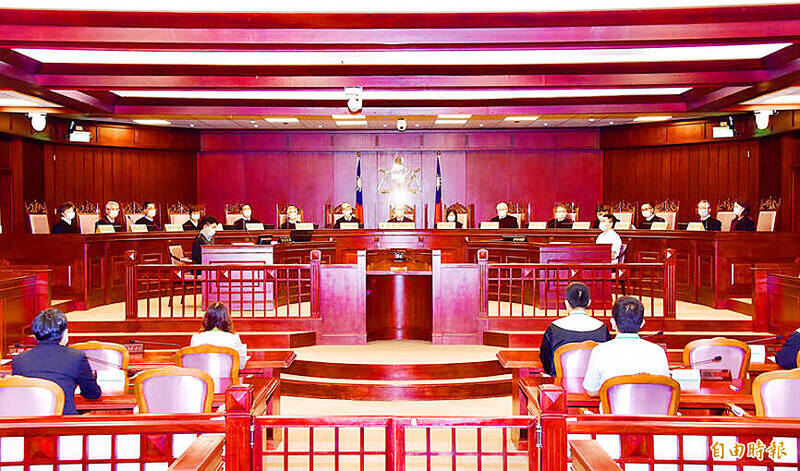
Over 1,000 academics and legal professionals have expressed their support for the recent ruling by the Constitutional Court of Taiwan, which declared that amendments to the Constitutional Court Procedure Act passed in December 2022 are unconstitutional. This ruling reinforces the principle of separation of powers and mandates transparency in the legislative process.
Background of the Ruling
On December 20, 2022, the Legislative Yuan enacted amendments requiring that at least ten justices participate in constitutional deliberations and that a minimum of nine justices must concur to declare any law unconstitutional. These amendments took effect on January 25, 2023. However, the court’s recent determination found that these changes introduced “obvious and significant defects” in the legislative process, thereby violating constitutional principles.
As of October 31, 2023, seven of the fifteen justices had completed their terms, leading to a lack of quorum for many deliberations. President William Lai faced opposition in his attempts to nominate replacements for these vacant positions, resulting in a protracted period without a full bench of justices.
Support from Civil Society
In a joint statement titled “Democracy must not regress, constitutional rulings must be followed,” various civic groups, legal experts, and academics rallied behind the court’s decision. As of last Friday, 96 civic organizations, 603 lawyers, and 690 academics had signed the petition, which included 651 university professors and researchers, among them 132 legal scholars.
The statement emphasizes that when the legislative process undermines transparency and public engagement, such actions become unconstitutional. It calls for lawmakers to respect the principles of democracy and not misuse majority power during legislative deliberations.
The ruling notably delineates the boundaries between judicial and legislative powers, ensuring that the Constitutional Court remains functional and independent from the influence of the Legislative Yuan. The court asserted that it is only bound by a constitutionally valid procedure act.
Furthermore, the statement addressed concerns regarding the absence of some justices from deliberation meetings, suggesting this gap has diminished public confidence in the court’s integrity. It posited that the three justices who did not participate should be viewed as having voluntarily recused themselves from the process.
Opposition Response
In contrast, the Chinese Nationalist Party (KMT) has filed malfeasance charges against the five justices who ruled on the case. The opposition argues that the ruling was rendered without sufficient justices, either according to the ten-justice minimum set by the recent amendments or the two-thirds requirement based on the previous version of the act.
The unfolding situation highlights the ongoing tensions between the legislative and judicial branches in Taiwan, as the nation grapples with the implications of the court’s ruling on its democratic framework.

India Unveils Long-Range Hypersonic Missile Amid Regional Tensions

SK bioscience Launches Global Trial for Universal Sarbecovirus Vaccine

Senegal Coach Pape Thiaw Suspended and Fined After Final Disruption

PAS Denies Abolishing Chairman Post, Contradicts Muhyiddin’s Claim

Mbappé Critiques Real Madrid’s Effort After Benfica Defeat

Thailand’s December Factory Output Surges 2.52% Year-on-Year

Ishita Dutta Reveals Her Parenting Secret: Strong Coffee

Older GPs Express Concerns Over New Digital Health Record Mandate

Urban Jurgensen: A 252-Year Legacy Enters a New Era

Regina Martinez Breaks New Ground for Mexico in Cross-Country Skiing

South Korea’s Foreign Minister Cho Hyun to Visit China This Week

Starling Bank Plans Secondary Share Sale, Targeting $5.4 Billion Valuation

Munsang College Celebrates 100 Years with Grand Ceremony

PAS Aims to Expand Parliamentary Influence in Upcoming Election

De Minaur Triumphs at Washington Open After Thrilling Comeback

Kenvue Dismisses CEO Thibaut Mongon as Strategic Review Advances

Humanism Camp Engages 250 Youths in Summer Fest 2025

Colombian Senator Miguel Uribe Shows Signs of Recovery After Attack
-
 Sports2 months ago
Regina Martinez Breaks New Ground for Mexico in Cross-Country Skiing
-
 World7 months ago
South Korea’s Foreign Minister Cho Hyun to Visit China This Week
-
 Business7 months ago
Starling Bank Plans Secondary Share Sale, Targeting $5.4 Billion Valuation
-
 Top Stories7 months ago
Munsang College Celebrates 100 Years with Grand Ceremony
-
 World7 months ago
PAS Aims to Expand Parliamentary Influence in Upcoming Election
-
 Sports8 months ago
De Minaur Triumphs at Washington Open After Thrilling Comeback
-
 Business9 months ago
Kenvue Dismisses CEO Thibaut Mongon as Strategic Review Advances
-
 Lifestyle8 months ago
Humanism Camp Engages 250 Youths in Summer Fest 2025
-
 Top Stories9 months ago
Colombian Senator Miguel Uribe Shows Signs of Recovery After Attack
-

 Sports9 months ago
Tupou and Daugunu Join First Nations Squad for Lions Clash
-

 World9 months ago
ASEAN Gears Up for Historic Joint Meeting of Foreign and Economic Ministers
-

 Health8 months ago
New Study Challenges Assumptions About Aging and Inflammation