
Politics
Bangladesh Faces Political Turmoil After Hasina’s Death Sentence

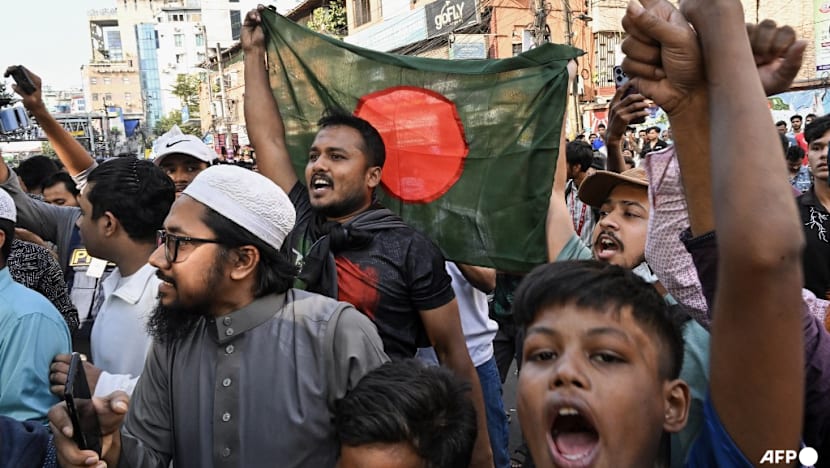
Bangladesh is navigating a turbulent political landscape following a tribunal’s ruling on November 17, 2024, that sentenced ousted Prime Minister Sheikh Hasina to death for crimes against humanity related to a violent crackdown on protests last year. While the verdict appears largely symbolic, given that Hasina currently resides in India, analysts warn it may exacerbate existing divisions within the country and complicate diplomatic relations with India.
Extradition Uncertain
In addition to Hasina, former Interior Minister Asaduzzaman Khan Kamal received a death sentence, and both figures are reportedly in hiding in India. The Bangladesh foreign ministry has requested New Delhi extradite Hasina and Khan, but as of now, India has not responded to this demand. Hasina has condemned the ruling as politically motivated and claims the judicial process was predetermined.
According to Amit Ranjan, a research fellow at the National University of Singapore’s Institute of South Asian Studies, India is likely to weigh its decision against its strategic interests rather than political pressures from Dhaka. Ranjan noted that India maintains close ties with Hasina’s family, complicating the decision on whether to comply with the extradition request. He highlighted that the extradition treaty permits India to refuse requests viewed as politically motivated.
Professor Greg Barton, chair in global Islamic politics at Deakin University, contended that complying with the request could be perceived domestically as a weakness, given Hasina’s history as a close ally of India. He suggested that allowing Hasina to seek refuge in a third country may help defuse tensions between New Delhi and Dhaka, but he remains skeptical that India would extradite her.
Potential for Escalating Violence
The unrest that led to Hasina’s ousting began over a contentious job quota perceived as favoring her supporters. This escalated into widespread protests against a government characterized by allegations of disappearances and extrajudicial killings. A United Nations-led investigation revealed that approximately 1,400 people, including many children, were killed during the violent protests of July and August 2023.
The UN welcomed the tribunal’s ruling as a significant moment for victims of the crackdown but reiterated its opposition to the death penalty. UN human rights chief Volker Turk called on the Bangladeshi government to prioritize national reconciliation and urged all parties to exercise restraint.
In the lead-up to the ruling, reports of violence emerged, including crude bomb explosions and arson against vehicles in Dhaka and other cities. Barton pointed out that while the death sentence is unlikely to be enacted, it raises the stakes for the interim government and could ignite further violence. He anticipates that Bangladesh may experience prolonged unrest, complicating the holding of elections scheduled for February.
Nobel laureate Muhammad Yunus, leading the interim government, faces a precarious situation. Ranjan emphasized that Yunus must avoid replicating the oppressive tactics of Hasina’s administration. In May, the Bangladesh Election Commission suspended the registration of Hasina’s Awami League party, effectively blocking it from participating in the upcoming national elections. Ranjan criticized this move as undemocratic, urging the interim government to differentiate itself from Hasina’s legacy.
Barton added that excluding the Awami League, one of the nation’s two dominant parties, risks alienating a significant portion of the electorate. He proposed a potential compromise—allowing the Awami League to participate but barring its indicted leaders from running.
The political uncertainty extends to Bangladesh’s crucial garment industry, the second largest globally, which is grappling with trade tariffs and declining investor confidence. Barton underscored the importance of public trust and confidence in ensuring the country’s economic stability. He stressed that minimizing protests and maintaining order is vital for Bangladesh to navigate these challenging times successfully.

India Unveils Long-Range Hypersonic Missile Amid Regional Tensions

SK bioscience Launches Global Trial for Universal Sarbecovirus Vaccine

Senegal Coach Pape Thiaw Suspended and Fined After Final Disruption

PAS Denies Abolishing Chairman Post, Contradicts Muhyiddin’s Claim

Mbappé Critiques Real Madrid’s Effort After Benfica Defeat

Thailand’s December Factory Output Surges 2.52% Year-on-Year

Ishita Dutta Reveals Her Parenting Secret: Strong Coffee

Older GPs Express Concerns Over New Digital Health Record Mandate

Urban Jurgensen: A 252-Year Legacy Enters a New Era

Regina Martinez Breaks New Ground for Mexico in Cross-Country Skiing

South Korea’s Foreign Minister Cho Hyun to Visit China This Week

Starling Bank Plans Secondary Share Sale, Targeting $5.4 Billion Valuation

Munsang College Celebrates 100 Years with Grand Ceremony

PAS Aims to Expand Parliamentary Influence in Upcoming Election

De Minaur Triumphs at Washington Open After Thrilling Comeback

Kenvue Dismisses CEO Thibaut Mongon as Strategic Review Advances

Humanism Camp Engages 250 Youths in Summer Fest 2025

Colombian Senator Miguel Uribe Shows Signs of Recovery After Attack
-
 Sports3 months ago
Regina Martinez Breaks New Ground for Mexico in Cross-Country Skiing
-
 World8 months ago
South Korea’s Foreign Minister Cho Hyun to Visit China This Week
-
 Business8 months ago
Starling Bank Plans Secondary Share Sale, Targeting $5.4 Billion Valuation
-
 Top Stories8 months ago
Munsang College Celebrates 100 Years with Grand Ceremony
-
 World8 months ago
PAS Aims to Expand Parliamentary Influence in Upcoming Election
-
 Sports9 months ago
De Minaur Triumphs at Washington Open After Thrilling Comeback
-
 Business10 months ago
Kenvue Dismisses CEO Thibaut Mongon as Strategic Review Advances
-
 Lifestyle9 months ago
Humanism Camp Engages 250 Youths in Summer Fest 2025
-
 Top Stories10 months ago
Colombian Senator Miguel Uribe Shows Signs of Recovery After Attack
-

 Sports10 months ago
Tupou and Daugunu Join First Nations Squad for Lions Clash
-

 World10 months ago
ASEAN Gears Up for Historic Joint Meeting of Foreign and Economic Ministers
-

 Health9 months ago
New Study Challenges Assumptions About Aging and Inflammation