
Lifestyle
Acharya Mithilesh Nandini Sharan Declares India’s Ancient History at Shabdotsav 2026

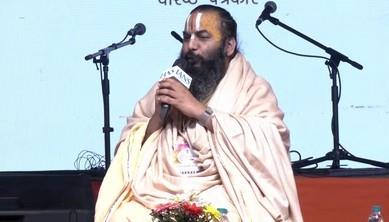
New Delhi hosted the second day of Shabdotsav 2026 at the Major Dhyan Chand Stadium, where Acharya Mithilesh Nandini Sharan emphasized India’s rich historical legacy. The head of Hanuman Niwas Peeth in Ayodhya Dham addressed the crowd on January 3, asserting that India’s history is deeply rooted in the ancient texts known as the Vedas. He countered the notion that India’s history has never been documented, describing it as a “complete lie and misinformation.”
During his speech, Acharya Sharan highlighted that the term “history” itself originated from the Indian subcontinent, with its usage dating back to the Upanishadic period. He argued that this demonstrates a long-standing tradition of historical writing in India, which he believes is as ancient as the Vedas themselves.
Ancient Values in Modern Context
Acharya Sharan stressed the importance of integrating ancient values into contemporary thought to fully appreciate India’s cultural richness. He noted that a central theme in Indian history is ‘Shanta Rasa’, a sentiment reflected in revered texts such as the Ramayana and the Shrimad Bhagavad Gita. He explained that these works encapsulate the essence of peace and tranquility, which are foundational to Indian society.
The Acharya further elaborated on the societal significance of history in India, stating that even a son’s marriage is considered challenging without knowledge of his family history. This perspective illustrates that history is not confined to written texts but is interwoven into the fabric of social life.
Challenging Misconceptions
Responding to claims that the Vedas are merely imaginary, Acharya Sharan described such assertions as a form of “mental illness.” He clarified that imagination plays a crucial role in the genesis of all creations, emphasizing that many scientific principles have roots in the methodological approaches articulated in the Vedas.
He argued that the discipline of Kalpa, one of the six auxiliary sciences of the Vedas, exemplifies how ancient sages approached knowledge systematically and scientifically. “No scientist has been able to disprove the principles established in the Vedas,” he asserted.
The Acharya concluded by stating, “When science has not been able to prove something false, it is unfair to label it as mere imagination or myth.” He emphasized that such characterizations are misleading and, therefore, represent misinformation.
Acharya Mithilesh Nandini Sharan’s insights at Shabdotsav 2026 challenge contemporary narratives about India’s historical documentation, reaffirming the country’s profound and enduring legacy that spans millennia.

India Unveils Long-Range Hypersonic Missile Amid Regional Tensions

SK bioscience Launches Global Trial for Universal Sarbecovirus Vaccine

Senegal Coach Pape Thiaw Suspended and Fined After Final Disruption

PAS Denies Abolishing Chairman Post, Contradicts Muhyiddin’s Claim

Mbappé Critiques Real Madrid’s Effort After Benfica Defeat

Thailand’s December Factory Output Surges 2.52% Year-on-Year

Ishita Dutta Reveals Her Parenting Secret: Strong Coffee

Older GPs Express Concerns Over New Digital Health Record Mandate

Urban Jurgensen: A 252-Year Legacy Enters a New Era

Regina Martinez Breaks New Ground for Mexico in Cross-Country Skiing

South Korea’s Foreign Minister Cho Hyun to Visit China This Week

Starling Bank Plans Secondary Share Sale, Targeting $5.4 Billion Valuation

Munsang College Celebrates 100 Years with Grand Ceremony

PAS Aims to Expand Parliamentary Influence in Upcoming Election

De Minaur Triumphs at Washington Open After Thrilling Comeback

Kenvue Dismisses CEO Thibaut Mongon as Strategic Review Advances

Humanism Camp Engages 250 Youths in Summer Fest 2025

Colombian Senator Miguel Uribe Shows Signs of Recovery After Attack
-
 Sports3 months ago
Regina Martinez Breaks New Ground for Mexico in Cross-Country Skiing
-
 World7 months ago
South Korea’s Foreign Minister Cho Hyun to Visit China This Week
-
 Business7 months ago
Starling Bank Plans Secondary Share Sale, Targeting $5.4 Billion Valuation
-
 Top Stories7 months ago
Munsang College Celebrates 100 Years with Grand Ceremony
-
 World7 months ago
PAS Aims to Expand Parliamentary Influence in Upcoming Election
-
 Sports8 months ago
De Minaur Triumphs at Washington Open After Thrilling Comeback
-
 Business9 months ago
Kenvue Dismisses CEO Thibaut Mongon as Strategic Review Advances
-
 Lifestyle8 months ago
Humanism Camp Engages 250 Youths in Summer Fest 2025
-
 Top Stories9 months ago
Colombian Senator Miguel Uribe Shows Signs of Recovery After Attack
-

 Sports9 months ago
Tupou and Daugunu Join First Nations Squad for Lions Clash
-
 World9 months ago
ASEAN Gears Up for Historic Joint Meeting of Foreign and Economic Ministers
-

 Health8 months ago
New Study Challenges Assumptions About Aging and Inflammation