
Politics
Taiwan’s Missile Tests Showcase Advanced Interception Capabilities

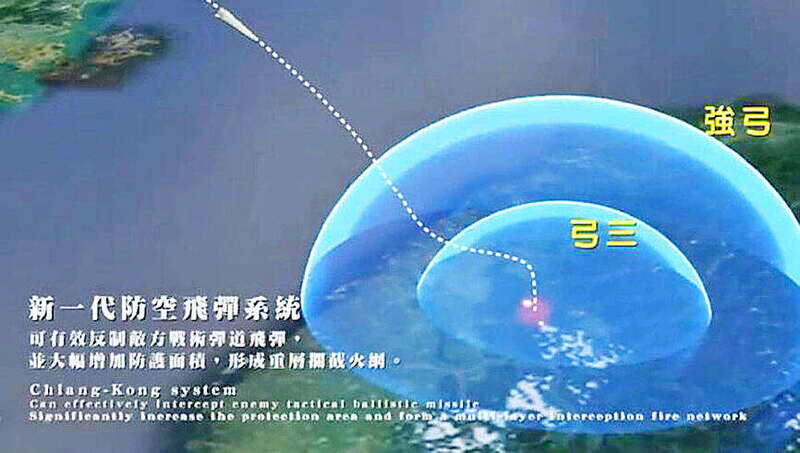
Recent missile tests conducted by the Chungshan Institute of Science and Technology (CSIST) have revealed Taiwan’s enhanced capabilities to intercept ballistic missiles during their re-entry phase. According to Chang Cheng, a former chief engineer of the Hsiung Feng III missile development project, these advancements present a significant deterrent against potential threats from Chinese missile systems.
The CSIST has been conducting tests at the Jiupeng Military Base in Pingtung County, which are believed to be part of Project Chiang Kung. Unlike previous tests, which often employed “unlimited” restriction zones, this new approach clearly defines a maximum test altitude of 30.48 km. Chang explained that the term “unlimited” does not imply an infinite altitude for missile launches but serves to caution aircraft from entering the designated area, as the extended-range version of the Tien Kung III missile can reach altitudes of up to 70 km, well beyond standard aircraft capabilities.
Establishing a clear altitude limit is crucial for understanding the missile’s capabilities. By designating a specific ceiling, the CSIST provides insights into the technological advancements that allow for missile interception at this altitude. Chang emphasized the engineering challenges associated with reaching an apogee of 30.48 km, where atmospheric density is only 1 percent of that at sea level. This presents unique difficulties for traditional missile technology, which relies on conventional aerodynamics.
To succeed in intercepting missiles at this height, a missile must utilize advanced systems such as divert and attitude control or thrust vector control. Chang noted that reaching this altitude is a critical milestone for intercepting ballistic missiles as they re-enter the atmosphere. He stated, “The CSIST is essentially telling the world that we have a limited high-altitude denial capability.”
The recent tests indicate that the CSIST has developed missiles capable of withstanding the extreme heat generated during atmospheric re-entry and functioning in near-vacuum conditions. This capability positions Taiwan to potentially deploy viable endo-atmospheric interceptors, thereby enhancing its defensive capabilities against missile threats.
Project Chiang Kung is focused on developing two distinct missile versions, I and II, which are based on the extended-altitude TK-III missile. Military sources indicate that the Chiang Kung I is anticipated to achieve interception altitudes exceeding those of the US-produced Patriot III system, with expectations set during the Taipei Aerospace and Defense Technology Exhibition in September 2023.
The Chiang Kung II is also expected to feature two derivatives: the Chiang Kung IIA, rumored to reach an interception altitude of 100 km, comparable to the US Terminal High Altitude Area Defense system, and the Chiang Kung IIB, a new surface-to-surface ballistic missile with an estimated range of 1,000 km.
These developments underscore Taiwan’s commitment to enhancing its defensive posture in the face of regional tensions, particularly concerning missile threats from China. The successful testing of these systems not only highlights Taiwan’s engineering capabilities but also serves to reassure its allies of its growing military proficiency.

India Unveils Long-Range Hypersonic Missile Amid Regional Tensions

SK bioscience Launches Global Trial for Universal Sarbecovirus Vaccine

Senegal Coach Pape Thiaw Suspended and Fined After Final Disruption

PAS Denies Abolishing Chairman Post, Contradicts Muhyiddin’s Claim

Mbappé Critiques Real Madrid’s Effort After Benfica Defeat

Thailand’s December Factory Output Surges 2.52% Year-on-Year

Ishita Dutta Reveals Her Parenting Secret: Strong Coffee

Older GPs Express Concerns Over New Digital Health Record Mandate

Urban Jurgensen: A 252-Year Legacy Enters a New Era

Regina Martinez Breaks New Ground for Mexico in Cross-Country Skiing

South Korea’s Foreign Minister Cho Hyun to Visit China This Week

Starling Bank Plans Secondary Share Sale, Targeting $5.4 Billion Valuation

Munsang College Celebrates 100 Years with Grand Ceremony

PAS Aims to Expand Parliamentary Influence in Upcoming Election

De Minaur Triumphs at Washington Open After Thrilling Comeback

Kenvue Dismisses CEO Thibaut Mongon as Strategic Review Advances

Humanism Camp Engages 250 Youths in Summer Fest 2025

Colombian Senator Miguel Uribe Shows Signs of Recovery After Attack
-
 Sports3 months ago
Regina Martinez Breaks New Ground for Mexico in Cross-Country Skiing
-
 World8 months ago
South Korea’s Foreign Minister Cho Hyun to Visit China This Week
-
 Business8 months ago
Starling Bank Plans Secondary Share Sale, Targeting $5.4 Billion Valuation
-
 Top Stories8 months ago
Munsang College Celebrates 100 Years with Grand Ceremony
-
 World8 months ago
PAS Aims to Expand Parliamentary Influence in Upcoming Election
-
 Sports9 months ago
De Minaur Triumphs at Washington Open After Thrilling Comeback
-
 Business10 months ago
Kenvue Dismisses CEO Thibaut Mongon as Strategic Review Advances
-
 Lifestyle9 months ago
Humanism Camp Engages 250 Youths in Summer Fest 2025
-
 Top Stories10 months ago
Colombian Senator Miguel Uribe Shows Signs of Recovery After Attack
-

 Sports10 months ago
Tupou and Daugunu Join First Nations Squad for Lions Clash
-
 World10 months ago
ASEAN Gears Up for Historic Joint Meeting of Foreign and Economic Ministers
-

 Health9 months ago
New Study Challenges Assumptions About Aging and Inflammation