
Politics
Trump’s UN Speech Fuels Concerns for Rohingya in Myanmar

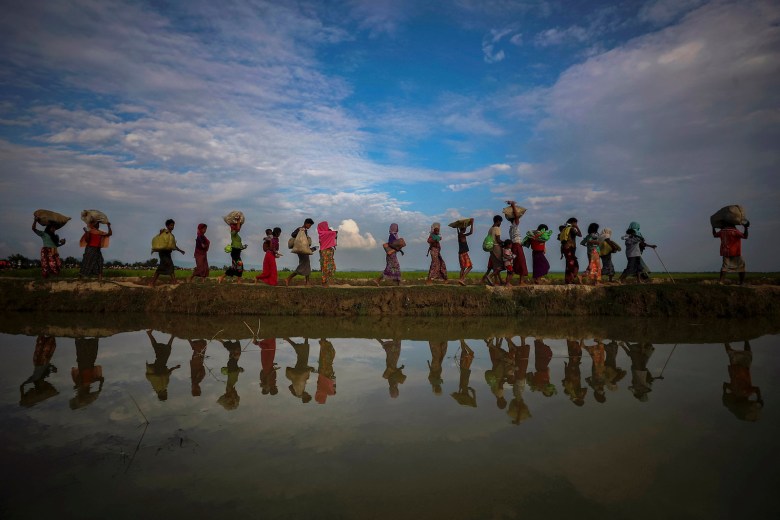
US President Donald Trump delivered a controversial address at the United Nations General Assembly that has raised alarm over the ongoing plight of the Rohingya people in Myanmar. During his speech, marking the UN’s 80th anniversary, Trump criticized what he termed the “globalist migration agenda.” His remarks, advocating for nations to close borders and expel foreigners, were perceived as a legitimization of exclusionary practices by authoritarian regimes, particularly in Myanmar, where the Rohingya have faced decades of persecution.
The Rohingya, a Muslim minority group in Myanmar, have been systematically rendered stateless by the government, which has denied them citizenship since the enactment of the 1982 Citizenship Law. This legal framework has stripped the Rohingya of recognition as one of Myanmar’s “national races,” leading to their classification as “Bengali” migrants from Bangladesh, despite their long-standing presence in the region.
Trump’s assertion that migration poses an “existential threat” to nations and his call for countries to protect themselves from “migrants you’ve never seen before” is alarming. Such rhetoric, delivered from a prominent platform like the UN, carries significant weight, suggesting a shifting international norm that could embolden regimes like Myanmar’s military, which has been accused of committing genocide against the Rohingya.
On August 25, 2017, the Myanmar military initiated a brutal campaign in Rakhine state that resulted in the displacement of over 700,000 Rohingya people, who fled to neighboring Bangladesh. Human Rights Watch has documented ongoing human rights abuses against the Rohingya, who remain trapped between refugee camps and apartheid-like conditions in Myanmar. The US government, along with various credible organizations, has classified these actions as genocide.
In this context, Trump’s speech appears to provide external validation to Myanmar’s military authorities, who have long pursued policies of forced displacement and violent repression against the Rohingya. The normalization of such rhetoric sends a troubling signal to other nations, suggesting that they may adopt similar exclusionary practices without fear of international repercussions.
The broader implications of Trump’s address extend beyond Myanmar. It suggests a global climate in which scapegoating vulnerable populations becomes politically acceptable, especially in countries facing economic or security challenges. This could lead to an era where expulsion policies are increasingly viewed as legitimate statecraft.
The Association of Southeast Asian Nations (ASEAN) faces a critical moment. Myanmar’s treatment of the Rohingya undermines the organization’s credibility as a proponent of peace and stability. Silence from ASEAN in response to the normalization of expulsion could be seen as complicity. The regional body must reaffirm its commitment to inclusivity and human dignity, particularly when the rhetoric from powerful nations encourages exclusion.
Trump’s address may have been aimed at solidifying his support domestically, but its international consequences could be far-reaching. For Myanmar’s military, it could signal a green light to intensify their oppressive policies. For the Rohingya, it deepens the uncertainty surrounding their future, as they remain vulnerable to further persecution.
The international community is at a crossroads. Governments and multilateral organizations must choose whether to challenge the emerging norm of expulsion or to uphold the universality of human rights. The words spoken at the UN are not merely fleeting moments; they have the power to shape policies and influence actions worldwide.
As history has shown, the language of exclusion can have dire consequences for marginalized communities. It is essential for global leaders to recognize the impact of their rhetoric on vulnerable populations like the Rohingya and to take a stand against the erosion of human rights principles. The world must decide whether to empower protection or to allow the dangerous normalization of persecution to take root.

India Unveils Long-Range Hypersonic Missile Amid Regional Tensions

SK bioscience Launches Global Trial for Universal Sarbecovirus Vaccine

Senegal Coach Pape Thiaw Suspended and Fined After Final Disruption

PAS Denies Abolishing Chairman Post, Contradicts Muhyiddin’s Claim

Mbappé Critiques Real Madrid’s Effort After Benfica Defeat

Thailand’s December Factory Output Surges 2.52% Year-on-Year

Ishita Dutta Reveals Her Parenting Secret: Strong Coffee

Older GPs Express Concerns Over New Digital Health Record Mandate

Urban Jurgensen: A 252-Year Legacy Enters a New Era

South Korea’s Foreign Minister Cho Hyun to Visit China This Week

Starling Bank Plans Secondary Share Sale, Targeting $5.4 Billion Valuation

Munsang College Celebrates 100 Years with Grand Ceremony

PAS Aims to Expand Parliamentary Influence in Upcoming Election

Kenvue Dismisses CEO Thibaut Mongon as Strategic Review Advances

Humanism Camp Engages 250 Youths in Summer Fest 2025

De Minaur Triumphs at Washington Open After Thrilling Comeback

Tupou and Daugunu Join First Nations Squad for Lions Clash

Colombian Senator Miguel Uribe Shows Signs of Recovery After Attack
-
 World5 months ago
South Korea’s Foreign Minister Cho Hyun to Visit China This Week
-
 Business5 months ago
Starling Bank Plans Secondary Share Sale, Targeting $5.4 Billion Valuation
-
 Top Stories5 months ago
Munsang College Celebrates 100 Years with Grand Ceremony
-
 World5 months ago
PAS Aims to Expand Parliamentary Influence in Upcoming Election
-
 Business7 months ago
Kenvue Dismisses CEO Thibaut Mongon as Strategic Review Advances
-
 Lifestyle6 months ago
Humanism Camp Engages 250 Youths in Summer Fest 2025
-
 Sports6 months ago
De Minaur Triumphs at Washington Open After Thrilling Comeback
-
 Sports7 months ago
Tupou and Daugunu Join First Nations Squad for Lions Clash
-
 Top Stories7 months ago
Colombian Senator Miguel Uribe Shows Signs of Recovery After Attack
-
 World7 months ago
ASEAN Gears Up for Historic Joint Meeting of Foreign and Economic Ministers
-

 Health6 months ago
New Study Challenges Assumptions About Aging and Inflammation
-

 Business7 months ago
Oil Prices Surge Following New EU Sanctions on Russia