
Politics
India Unveils Long-Range Hypersonic Missile Amid Regional Tensions

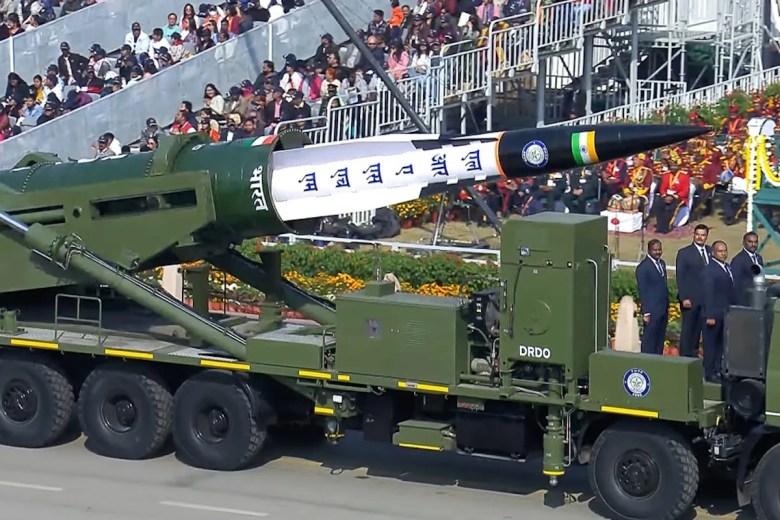
India has officially introduced its Long-Range Anti-Ship Hypersonic Missile (LR-AShM) as part of a strategic shift in response to increasing naval pressures from China and Pakistan in the Indian Ocean. The missile was showcased during the 77th Republic Day parade at Kartavya Path, highlighting India’s advancements in maritime defense capabilities. Developed by the Defence Research and Development Organization (DRDO), the LR-AShM is designed to engage targets approximately 1,500 kilometers away and can reach speeds of up to Mach 10.
The LR-AShM employs a two-stage solid propulsion system, allowing it to maintain an average speed of Mach 5 while flying at low altitudes. This maneuverability enables the missile to evade conventional ship-based radar systems, thus altering adversaries’ response times. A successful validation test of the missile conducted on November 2024 at Dr. APJ Abdul Kalam Island confirmed its capability to perform terminal maneuvers against moving maritime targets.
The introduction of the LR-AShM positions India alongside the United States, Russia, and China as one of the few nations to deploy hypersonic anti-ship systems. Initially intended for coastal defenses, the LR-AShM is expected to be operational within the next two to three years. It will support a shore-based launch strategy using both fixed and mobile platforms, including bases on the Andaman Islands, to target high-value assets such as aircraft carriers before they can pose a significant threat.
As China’s naval strength continues to grow, the need for India to adapt its maritime strategy becomes increasingly clear. The US Department of Defense’s 2024 China Military Power Report indicated that China had over 370 ships and submarines at the time of the report, with projections suggesting a fleet increase to 395 ships by 2025 and 435 ships by 2030. In contrast, the Indian Navy operates around 150 warships and plans to expand its fleet to 230 vessels by 2027, as noted by naval analyst James Fanell in a December 2025 article.
China’s rapid naval expansion poses a dual threat to India, particularly as it looks to secure its sea lanes of communication (SLOCs) in the Indian Ocean. The growing presence of the People’s Liberation Army Navy (PLAN) is further complicated by Pakistan’s military modernization, which has been supported by Chinese technology transfers, including advanced frigates and submarines. According to Syed Fazl-e-Haider, a strong Pakistani Navy could potentially control critical maritime routes, impacting India’s strategic interests.
In light of these developments, India is shifting from a traditional fleet-centric model to a technology-driven anti-access/area-denial (A2/AD) strategy. This new approach emphasizes long-range, land-based precision strike capabilities, such as the hypersonic missile, to counterbalance the numerical and geographic advantages of China and Pakistan. This transition indicates a broader trend towards effects-based deterrence, where the threat of long-range strikes can compensate for a smaller naval fleet.
The strategic implications of the LR-AShM extend beyond mere numbers. As highlighted by Tahir Azad in a December 2025 article, the conflicts in Ukraine and the Middle East underline the evolving nature of deterrence, emphasizing the increasing significance of hypersonic weapons. Conventional missiles are becoming more vulnerable to interception, while hypersonic arms are difficult to defend against, potentially reshaping the military balance in the region.
Nonetheless, the introduction of hypersonic technology may provoke countermeasures from China and Pakistan. China could enhance its naval defenses and expand its dual-use infrastructure in the Indian Ocean, while Pakistan may receive additional advanced weaponry. Concerns also arise regarding the ambiguity of India’s missile tests, which could be interpreted as either conventional or nuclear, increasing risks of misinterpretation and escalation in a densely populated maritime environment.
In conclusion, while India’s LR-AShM enhances its deterrent capabilities and addresses the challenges posed by regional adversaries, the effectiveness of this strategy will depend on India’s ability to manage escalation risks and maintain clear communication with neighboring countries. As the security landscape in the Indian Ocean evolves, India’s maritime strategy will play a pivotal role in shaping regional dynamics and ensuring its national interests are safeguarded.

India Unveils Long-Range Hypersonic Missile Amid Regional Tensions

SK bioscience Launches Global Trial for Universal Sarbecovirus Vaccine

Senegal Coach Pape Thiaw Suspended and Fined After Final Disruption

PAS Denies Abolishing Chairman Post, Contradicts Muhyiddin’s Claim

Mbappé Critiques Real Madrid’s Effort After Benfica Defeat

Thailand’s December Factory Output Surges 2.52% Year-on-Year

Ishita Dutta Reveals Her Parenting Secret: Strong Coffee

Older GPs Express Concerns Over New Digital Health Record Mandate

Urban Jurgensen: A 252-Year Legacy Enters a New Era

South Korea’s Foreign Minister Cho Hyun to Visit China This Week

Starling Bank Plans Secondary Share Sale, Targeting $5.4 Billion Valuation

Munsang College Celebrates 100 Years with Grand Ceremony

PAS Aims to Expand Parliamentary Influence in Upcoming Election

Kenvue Dismisses CEO Thibaut Mongon as Strategic Review Advances

Humanism Camp Engages 250 Youths in Summer Fest 2025

De Minaur Triumphs at Washington Open After Thrilling Comeback

Tupou and Daugunu Join First Nations Squad for Lions Clash

Colombian Senator Miguel Uribe Shows Signs of Recovery After Attack
-
 World5 months ago
South Korea’s Foreign Minister Cho Hyun to Visit China This Week
-
 Business5 months ago
Starling Bank Plans Secondary Share Sale, Targeting $5.4 Billion Valuation
-
 Top Stories5 months ago
Munsang College Celebrates 100 Years with Grand Ceremony
-
 World5 months ago
PAS Aims to Expand Parliamentary Influence in Upcoming Election
-
 Business7 months ago
Kenvue Dismisses CEO Thibaut Mongon as Strategic Review Advances
-
 Lifestyle6 months ago
Humanism Camp Engages 250 Youths in Summer Fest 2025
-
 Sports6 months ago
De Minaur Triumphs at Washington Open After Thrilling Comeback
-
 Sports7 months ago
Tupou and Daugunu Join First Nations Squad for Lions Clash
-
 Top Stories7 months ago
Colombian Senator Miguel Uribe Shows Signs of Recovery After Attack
-
 World7 months ago
ASEAN Gears Up for Historic Joint Meeting of Foreign and Economic Ministers
-

 Health6 months ago
New Study Challenges Assumptions About Aging and Inflammation
-

 Business6 months ago
Oil Prices Surge Following New EU Sanctions on Russia