
Politics
Study Reveals US Consumers Bear Burden of Trump’s Tariffs

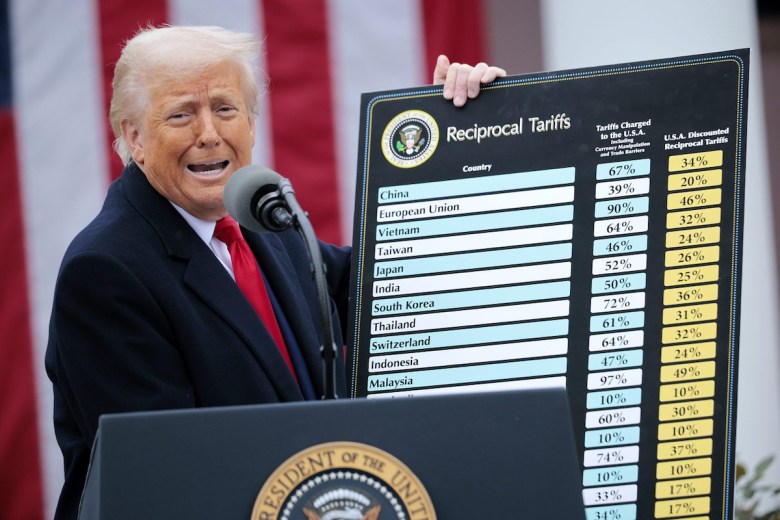
US President Donald Trump has consistently asserted that foreign producers are the primary bearers of the tariffs he imposed on imported goods. Yet a new study released by the Kiel Institute for the World Economy, a prominent economic think tank in Germany, challenges this claim. The research indicates that the financial burden falls predominantly on US businesses and consumers, rather than foreign exporters.
The study analyzed over 25 million shipment records from goods imported into the United States in the previous year. Findings reveal that foreign exporters absorbed only 4% of the approximately US$200 billion in tariff payments, with the remaining 96% passed on to US importers and consumers.
Implications of the Findings
The implications of this research are significant. According to the study, “If foreign exporters do not reduce their prices in response to tariffs, then the entire burden of the tariff falls on US buyers.” It further explains that the tariffs act not as a tax on foreign producers but as a consumption tax on American households. As a result, each dollar in tariff revenue essentially represents a dollar taken from the pockets of American consumers and businesses.
Several factors contribute to why foreign exporters did not lower their prices in response to tariffs. Some have redirected their sales to markets with less stringent tariffs, while others are unable to absorb the substantial price cuts needed to offset the tariffs imposed by the Trump administration. Additionally, there is a reluctance among companies to incentivize further tariff increases by lowering prices for US consumers.
Julian Hinz, research director at the Kiel Institute and co-author of the study, describes the Trump tariffs as an “own goal” that has predominantly harmed Americans. “The claim that foreign countries pay these tariffs is a myth,” Hinz stated. “The data show the opposite: Americans are footing the bill.”
Context of the Study
This study was published just two days after Trump announced plans to impose additional tariffs on European countries resistant to his attempts to acquire Greenland. Economist Dean Baker from the Center for Economic and Policy Research labeled the new tariffs on Europe a “US$75 billion tax increase.” He criticized the president’s ambitions regarding Greenland, stating that “well over 90% of the cost of a Trump tariff is borne by consumers or importers in the United States, not by the exporting countries.”
Baker emphasized that when Trump discusses tariffs, he is effectively discussing taxes that directly impact US citizens. “And US$75 billion is not trivial. It’s 1% of the budget, more than twice the cost of the enhanced premiums for Obamacare policies that Trump says we can’t afford,” he added.
As the discussion around tariffs continues, the findings from the Kiel Institute serve as a crucial reminder of the economic realities faced by everyday Americans in the context of international trade policies.

India Unveils Long-Range Hypersonic Missile Amid Regional Tensions

SK bioscience Launches Global Trial for Universal Sarbecovirus Vaccine

Senegal Coach Pape Thiaw Suspended and Fined After Final Disruption

PAS Denies Abolishing Chairman Post, Contradicts Muhyiddin’s Claim

Mbappé Critiques Real Madrid’s Effort After Benfica Defeat

Thailand’s December Factory Output Surges 2.52% Year-on-Year

Ishita Dutta Reveals Her Parenting Secret: Strong Coffee

Older GPs Express Concerns Over New Digital Health Record Mandate

Urban Jurgensen: A 252-Year Legacy Enters a New Era

South Korea’s Foreign Minister Cho Hyun to Visit China This Week

Starling Bank Plans Secondary Share Sale, Targeting $5.4 Billion Valuation

Munsang College Celebrates 100 Years with Grand Ceremony

PAS Aims to Expand Parliamentary Influence in Upcoming Election

Kenvue Dismisses CEO Thibaut Mongon as Strategic Review Advances

Humanism Camp Engages 250 Youths in Summer Fest 2025

De Minaur Triumphs at Washington Open After Thrilling Comeback

Tupou and Daugunu Join First Nations Squad for Lions Clash

Colombian Senator Miguel Uribe Shows Signs of Recovery After Attack
-
 World5 months ago
South Korea’s Foreign Minister Cho Hyun to Visit China This Week
-
 Business5 months ago
Starling Bank Plans Secondary Share Sale, Targeting $5.4 Billion Valuation
-
 Top Stories5 months ago
Munsang College Celebrates 100 Years with Grand Ceremony
-
 World5 months ago
PAS Aims to Expand Parliamentary Influence in Upcoming Election
-
 Business7 months ago
Kenvue Dismisses CEO Thibaut Mongon as Strategic Review Advances
-
 Lifestyle6 months ago
Humanism Camp Engages 250 Youths in Summer Fest 2025
-
 Sports6 months ago
De Minaur Triumphs at Washington Open After Thrilling Comeback
-
 Sports7 months ago
Tupou and Daugunu Join First Nations Squad for Lions Clash
-
 Top Stories7 months ago
Colombian Senator Miguel Uribe Shows Signs of Recovery After Attack
-

 World7 months ago
ASEAN Gears Up for Historic Joint Meeting of Foreign and Economic Ministers
-

 Health6 months ago
New Study Challenges Assumptions About Aging and Inflammation
-
 Business7 months ago
Oil Prices Surge Following New EU Sanctions on Russia