
Politics
US Naval Ships Navigate Taiwan Strait, Upholding Freedom of Navigation

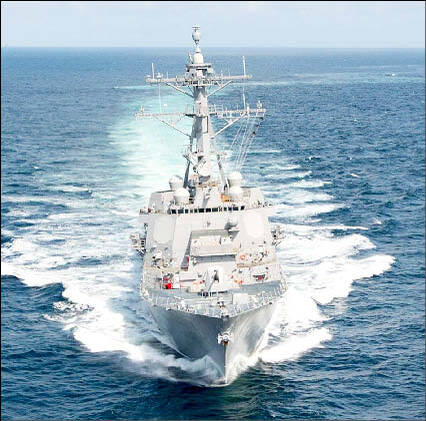
The United States Navy’s USS John Finn, an Arleigh Burke-class guided-missile destroyer, and the USNS Mary Sears, a Pathfinder-class oceanographic survey ship, transited the Taiwan Strait on January 16 and 17, 2024. This movement was confirmed by the US Navy’s Seventh Fleet, which emphasized the operation as part of routine naval activities in international waters.
During this transit, the ships navigated a corridor within the Taiwan Strait that is beyond the territorial sea of any coastal state, reinforcing the principle of high-seas freedoms of navigation and overflight in accordance with international law. According to a report by the US Naval Institute, the operation underscores the US commitment to upholding freedom of navigation for all nations, stating, “The international community’s navigational rights and freedoms in the Taiwan Strait should not be limited.”
The transit marks the fourth instance during former President Donald Trump‘s second term that a US warship has sailed through this strategically significant waterway. The Ministry of National Defense in Taiwan confirmed that it monitored the maritime and air activities around the island, employing joint intelligence, surveillance, and reconnaissance methods to ensure security.
Chinese military officials also acknowledged the movement, with the People’s Liberation Army (PLA) stating on its official WeChat account that it had tracked the transit. Xu Chenghua, a spokesman for the PLA’s Eastern Theater Command, stated that the command’s forces would “remain on high alert at all times” to “resolutely defend national sovereignty and security, and maintain regional peace and stability.”
The ongoing naval operations by the US reflect deeper geopolitical tensions in the region, particularly concerning China’s claims over Taiwan. These maneuvers serve as a reminder of the complex dynamics at play in the Taiwan Strait, a crucial area for international shipping and military strategy.
The international community continues to watch these developments closely, as they have significant implications for regional stability and the enforcement of maritime laws. The US Navy has reiterated its position against any assertion of sovereignty that contradicts established freedoms of the sea and air, signaling its intent to challenge any restrictions imposed by coastal states.

India Unveils Long-Range Hypersonic Missile Amid Regional Tensions

SK bioscience Launches Global Trial for Universal Sarbecovirus Vaccine

Senegal Coach Pape Thiaw Suspended and Fined After Final Disruption

PAS Denies Abolishing Chairman Post, Contradicts Muhyiddin’s Claim

Mbappé Critiques Real Madrid’s Effort After Benfica Defeat

Thailand’s December Factory Output Surges 2.52% Year-on-Year

Ishita Dutta Reveals Her Parenting Secret: Strong Coffee

Older GPs Express Concerns Over New Digital Health Record Mandate

Urban Jurgensen: A 252-Year Legacy Enters a New Era

Regina Martinez Breaks New Ground for Mexico in Cross-Country Skiing

South Korea’s Foreign Minister Cho Hyun to Visit China This Week

Starling Bank Plans Secondary Share Sale, Targeting $5.4 Billion Valuation

Munsang College Celebrates 100 Years with Grand Ceremony

PAS Aims to Expand Parliamentary Influence in Upcoming Election

De Minaur Triumphs at Washington Open After Thrilling Comeback

Kenvue Dismisses CEO Thibaut Mongon as Strategic Review Advances

Humanism Camp Engages 250 Youths in Summer Fest 2025

Colombian Senator Miguel Uribe Shows Signs of Recovery After Attack
-
 Sports2 months ago
Regina Martinez Breaks New Ground for Mexico in Cross-Country Skiing
-
 World6 months ago
South Korea’s Foreign Minister Cho Hyun to Visit China This Week
-
 Business7 months ago
Starling Bank Plans Secondary Share Sale, Targeting $5.4 Billion Valuation
-
 Top Stories7 months ago
Munsang College Celebrates 100 Years with Grand Ceremony
-
 World6 months ago
PAS Aims to Expand Parliamentary Influence in Upcoming Election
-
 Sports8 months ago
De Minaur Triumphs at Washington Open After Thrilling Comeback
-
 Business8 months ago
Kenvue Dismisses CEO Thibaut Mongon as Strategic Review Advances
-
 Lifestyle8 months ago
Humanism Camp Engages 250 Youths in Summer Fest 2025
-
 Top Stories9 months ago
Colombian Senator Miguel Uribe Shows Signs of Recovery After Attack
-

 Sports8 months ago
Tupou and Daugunu Join First Nations Squad for Lions Clash
-

 World8 months ago
ASEAN Gears Up for Historic Joint Meeting of Foreign and Economic Ministers
-

 Health8 months ago
New Study Challenges Assumptions About Aging and Inflammation