
Politics
China Enhances J-20 Fighter to Strengthen Air Warfare Strategy

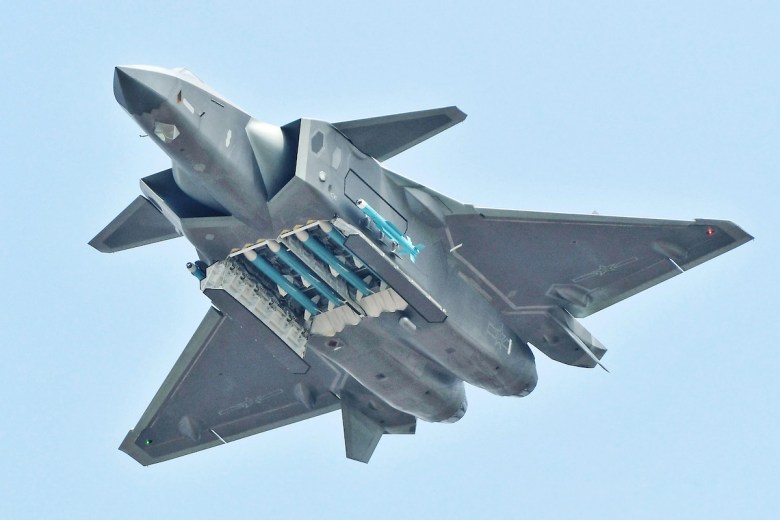
China is advancing its military capabilities by upgrading the J-20 stealth fighter, a strategic move aimed at enhancing air warfare, particularly concerning Taiwan. According to the South China Morning Post, the upgrades will involve advanced radar systems, improved engines, and artificial intelligence (AI) enhancements. This evolution marks a significant shift from traditional platform competition to a more integrated approach to air combat.
This month, military analyst Zhang Xuefeng, speaking on China Central Television, emphasized that the J-20 is central to the future operations of the People’s Liberation Army Air Force (PLAAF). The aircraft, developed by the Chengdu Aircraft Corporation, has been in active service since 2017 and is regarded as China’s most advanced response to U.S. stealth fighters. The J-20 has already demonstrated its capabilities alongside stealth attack drones and early-warning aircraft, illustrating China’s commitment to a networked air strategy.
The J-20 recently celebrated the 15th anniversary of its maiden flight in January 2011. While it possesses established features such as a low-observable design, internal weapons bays, and supersonic cruise capabilities, future enhancements will focus on internal systems. These will include more capable radar and infrared sensors, as well as longer-range air-to-air missiles. Additionally, the transition from Russian AL-31 engines to domestically produced WS-series engines is expected to further enhance the aircraft’s performance.
Zhang pointed out that AI will play a crucial role in the J-20’s operation, particularly in beyond-visual-range (BVR) combat and complex engagement scenarios. China currently operates multiple variants of the J-20, including the two-seat J-20S, which is designed to control drone swarms. The production rate of approximately 120 aircraft annually underscores China’s commitment to maintaining a technologically advanced air force.
In a potential conflict over Taiwan, Zhang outlined a strategy wherein the People’s Liberation Army Rocket Force (PLARF) would initiate strikes against key Taiwanese radar sites. Concurrently, the People’s Liberation Army Ground Force (PLAGF) would target ground installations. Following these initial strikes, the J-20 would penetrate Taiwan’s airspace, aiming to neutralize air defenses and secure air superiority over Taiwan’s fleet of F-16 fighters.
Coordination among various aircraft types is a vital aspect of this strategy. The J-20 is expected to work alongside J-16D electronic warfare aircraft, GJ-11 stealth drones, and KJ-500 airborne early warning and control (AEW&C) systems, enabling a streamlined operational cycle encompassing detection, jamming, and command.
China’s J-20 and J-35 fighters form the backbone of its high-end air capabilities. The J-20 is designed for penetrating enemy airspace and achieving air dominance, while the J-35 serves as a carrier-based fighter. This dual approach allows China to leverage both qualitative advantages through its sophisticated fighters and quantitative advantages through its J-16 and J-11 models.
Despite the J-20’s advancements, analysts note that it may not match the older U.S. F-22, which has proven reliability and operational experience. Maya Carlin, in an article for The National Interest, highlighted that while the J-20 may have advantages in range and thrust, the F-22’s larger missile capacity and combat-tested systems maintain its superiority in potential conflict scenarios.
In contrast, the J-20 presents a serious yet inferior challenge to the F-35. Although the J-20 is faster and has a longer range, the F-35’s superior stealth capabilities provide it with a first-look, first-shot advantage, according to analyst Brent Eastwood. The J-20’s lack of an internal cannon and the inexperience of its pilots are considered significant disadvantages.
These assessments hinge on the assumption that the United States can deploy its stealth fighters effectively in a Taiwan conflict. However, issues such as low U.S. aircraft readiness rates and the vulnerability of airbases have raised concerns. A report from the U.S. Government Accountability Office in October 2024 noted that neither the F-22 nor the F-35 met operational goals due to maintenance and supply challenges.
The evolving landscape of military technology highlights the critical nature of air superiority in any potential conflict. China’s expanding surveillance and missile capabilities, combined with its comprehensive intelligence network of over 359 satellites, significantly increase the risks for U.S. airbases in the Pacific. Wargames conducted by the Center for Strategic and International Studies in January 2023 indicated that the U.S. could face substantial losses early in a conflict, potentially losing 300 to 500 aircraft within weeks.
In summary, the upgrades to the J-20 and China’s broader military advancements underscore a strategic shift towards a more integrated and technologically sophisticated approach to air warfare. These developments may alter the balance of air power in the region, particularly concerning U.S. forces and their operational readiness in a future conflict over Taiwan.

India Unveils Long-Range Hypersonic Missile Amid Regional Tensions

SK bioscience Launches Global Trial for Universal Sarbecovirus Vaccine

Senegal Coach Pape Thiaw Suspended and Fined After Final Disruption

PAS Denies Abolishing Chairman Post, Contradicts Muhyiddin’s Claim

Mbappé Critiques Real Madrid’s Effort After Benfica Defeat

Thailand’s December Factory Output Surges 2.52% Year-on-Year

Ishita Dutta Reveals Her Parenting Secret: Strong Coffee

Older GPs Express Concerns Over New Digital Health Record Mandate

Urban Jurgensen: A 252-Year Legacy Enters a New Era

South Korea’s Foreign Minister Cho Hyun to Visit China This Week

Starling Bank Plans Secondary Share Sale, Targeting $5.4 Billion Valuation

Munsang College Celebrates 100 Years with Grand Ceremony

PAS Aims to Expand Parliamentary Influence in Upcoming Election

Kenvue Dismisses CEO Thibaut Mongon as Strategic Review Advances

Humanism Camp Engages 250 Youths in Summer Fest 2025

De Minaur Triumphs at Washington Open After Thrilling Comeback

Tupou and Daugunu Join First Nations Squad for Lions Clash

Colombian Senator Miguel Uribe Shows Signs of Recovery After Attack
-
 World5 months ago
South Korea’s Foreign Minister Cho Hyun to Visit China This Week
-
 Business5 months ago
Starling Bank Plans Secondary Share Sale, Targeting $5.4 Billion Valuation
-
 Top Stories5 months ago
Munsang College Celebrates 100 Years with Grand Ceremony
-
 World5 months ago
PAS Aims to Expand Parliamentary Influence in Upcoming Election
-
 Business7 months ago
Kenvue Dismisses CEO Thibaut Mongon as Strategic Review Advances
-
 Lifestyle6 months ago
Humanism Camp Engages 250 Youths in Summer Fest 2025
-
 Sports6 months ago
De Minaur Triumphs at Washington Open After Thrilling Comeback
-
 Sports7 months ago
Tupou and Daugunu Join First Nations Squad for Lions Clash
-
 Top Stories7 months ago
Colombian Senator Miguel Uribe Shows Signs of Recovery After Attack
-
 World7 months ago
ASEAN Gears Up for Historic Joint Meeting of Foreign and Economic Ministers
-

 Health6 months ago
New Study Challenges Assumptions About Aging and Inflammation
-

 Business7 months ago
Oil Prices Surge Following New EU Sanctions on Russia