
Top Stories
Taiwan Reveals Long-Secret Missile System Amid Rising Tensions

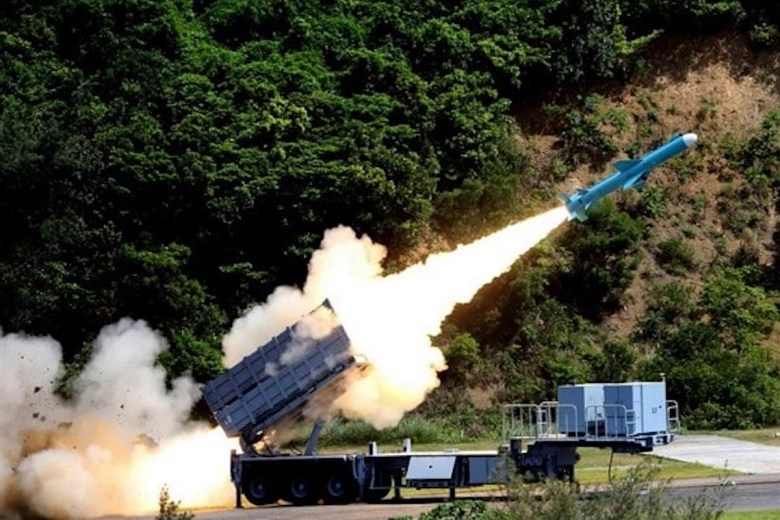
As Chinese live-fire drills intensify around Taiwan, the country has revealed a rare sighting of its long-secret cruise missile system, the Hsiung Feng IIE (HF-2E). This development underscores Taiwan’s strategy to hold key targets on the Chinese mainland at risk amid escalating military tensions. The missile launcher was spotted moving from Hualien to Taitung along Taiwan’s southeast coast, marking one of the few public appearances of the system since its development began in the early 2000s.
The HF-2E, comparable to the US Tomahawk missile, utilizes a booster-assisted launch followed by a jet engine for propulsion. It features GPS-aided inertial navigation and terrain-matching guidance, enabling it to strike targets between 300 and 600 kilometers away, with potential extended-range variants reaching up to 1,500 kilometers. This capability allows Taiwan to target critical installations such as People’s Liberation Army (PLA) airfields and missile sites, enhancing its ability to retaliate against potential invasions.
Taiwan’s decision to redeploy the HF-2E comes as China conducts its sixth and most extensive set of drills around the island since 2022. The move reflects Taiwan’s aim to complicate Chinese targeting strategies while maintaining mobile counterstrike options. Taiwan regards long-range strike systems as vital for deterring Chinese intervention, particularly as China boasts a significantly larger arsenal of ballistic and cruise missiles.
Strategic Military Developments
The recent missile deployment is part of Taiwan’s broader strategy to enhance its missile capabilities in response to rising cross-strait tensions. In September 2025, Taiwan introduced the Barracuda-500, a low-cost, US-co-produced land-mobile cruise missile designed to strike both sea and land targets. This development underscores the strengthening of defense ties between Taiwan and the United States, even as China warns against external interference.
In addition, Taiwan is reportedly developing a stealthy, long-range anti-ship missile capable of reaching 600 to 1,000 kilometers, aiming to push Chinese carrier groups further from the First Island Chain. This initiative aligns with Taiwan’s evolving military strategy, which emphasizes survivability and standoff capabilities. Furthermore, Taiwan has begun fielding Ching Tien hypersonic cruise missiles with ranges exceeding 2,000 kilometers, providing enhanced deterrence options deep into Chinese territory.
According to Drew Thompson, a scholar on Taiwan’s military strategy, the island’s war planning envisions limited, retaliatory strikes on the Chinese mainland. These strikes are designed to delay and disrupt PLA operations rather than to seize territory or achieve decisive victories. Thompson notes that within Taiwan’s Overall Defense Concept (ODC), strikes against the mainland serve as a tool of denial, deployed only after hostilities have commenced.
Regional and Global Implications
The potential for Taiwan to conduct strikes on the Chinese mainland raises significant concerns regarding escalation. Eric Gomez, in a report for the Cato Institute, indicates that the United States has been cautious about supplying Taiwan with long-range land-attack weapons, fearing they could undermine strategic ambiguity and escalate tensions further. Despite these limitations, Taiwan is allowed to develop its own long-range missile capabilities.
The US Department of Defense’s 2025 China Military Power Report highlights that China is strengthening its air and missile defenses to protect key political, military, and economic nodes from long-range attacks. This includes the deployment of integrated surface-to-air missile systems and advanced radar technologies to enhance detection and interception capabilities.
The risks associated with striking the Chinese mainland are substantial. Military analysts warn that such actions could be viewed as existential threats to the Chinese Communist Party’s survival. As Brian MacLean notes, even limited conventional strikes might provoke a disproportionate response from China, including potential nuclear escalation.
Taiwan’s strategic military developments signal a shift from a purely defensive posture to a more proactive counterstrike capability. By holding targets on the Chinese mainland at risk, Taiwan aims to complicate PLA invasion plans and force China into difficult operational and political decisions. Yet, this approach also raises the stakes for all parties involved, as even minor military actions could blur the lines of deterrence and escalate into broader conflicts.

India Unveils Long-Range Hypersonic Missile Amid Regional Tensions

SK bioscience Launches Global Trial for Universal Sarbecovirus Vaccine

Senegal Coach Pape Thiaw Suspended and Fined After Final Disruption

PAS Denies Abolishing Chairman Post, Contradicts Muhyiddin’s Claim

Mbappé Critiques Real Madrid’s Effort After Benfica Defeat

Thailand’s December Factory Output Surges 2.52% Year-on-Year

Ishita Dutta Reveals Her Parenting Secret: Strong Coffee

Older GPs Express Concerns Over New Digital Health Record Mandate

Urban Jurgensen: A 252-Year Legacy Enters a New Era

Regina Martinez Breaks New Ground for Mexico in Cross-Country Skiing

South Korea’s Foreign Minister Cho Hyun to Visit China This Week

Starling Bank Plans Secondary Share Sale, Targeting $5.4 Billion Valuation

Munsang College Celebrates 100 Years with Grand Ceremony

PAS Aims to Expand Parliamentary Influence in Upcoming Election

De Minaur Triumphs at Washington Open After Thrilling Comeback

Kenvue Dismisses CEO Thibaut Mongon as Strategic Review Advances

Humanism Camp Engages 250 Youths in Summer Fest 2025

Colombian Senator Miguel Uribe Shows Signs of Recovery After Attack
-
 Sports2 months ago
Regina Martinez Breaks New Ground for Mexico in Cross-Country Skiing
-
 World6 months ago
South Korea’s Foreign Minister Cho Hyun to Visit China This Week
-
 Business7 months ago
Starling Bank Plans Secondary Share Sale, Targeting $5.4 Billion Valuation
-
 Top Stories7 months ago
Munsang College Celebrates 100 Years with Grand Ceremony
-
 World6 months ago
PAS Aims to Expand Parliamentary Influence in Upcoming Election
-
 Sports8 months ago
De Minaur Triumphs at Washington Open After Thrilling Comeback
-
 Business8 months ago
Kenvue Dismisses CEO Thibaut Mongon as Strategic Review Advances
-
 Lifestyle8 months ago
Humanism Camp Engages 250 Youths in Summer Fest 2025
-
 Top Stories8 months ago
Colombian Senator Miguel Uribe Shows Signs of Recovery After Attack
-

 Sports8 months ago
Tupou and Daugunu Join First Nations Squad for Lions Clash
-
 World8 months ago
ASEAN Gears Up for Historic Joint Meeting of Foreign and Economic Ministers
-

 Health8 months ago
New Study Challenges Assumptions About Aging and Inflammation